**WTMS Blog Today = What’s up in Mortgage Today (AM) – 09/08/2026**
Oil prices surged past $98 a barrel on Saudi Arabian production disruptions, reigniting inflation fears that could push the Federal Reserve toward rate hikes in September. The 10-year Treasury yield climbed to 4.80 percent as markets priced in stagflation risk—a toxic combination of rising energy costs and persistent wage pressures. MBS prices remained flat to slightly higher despite broader bond weakness, as investors questioned whether mortgage rates will decline meaningfully before year-end.
The three-month Treasury auction calendar kicks off today with a $58 billion three-year note sale, followed by 10-year and 30-year offerings that test demand at elevated yields. This week’s inflation data (PPI Thursday, CPI Friday) will likely determine whether the Fed can hold its September 18 rate decision steady or capitulates to higher-for-longer policy expectations. NEXA Lending elevated Geri Farr to Chief Executive Officer while outgoing CEO Mike Kortas transitioned to Executive Partner, marking a structural shift designed to separate operations from strategic vision.
The personnel moves at NEXA underscore a broader industry pattern: mortgage originators are tightening expense structures as consumer-direct channels contract amid persistent rate headwinds. Dark Matter bolstered its product leadership by hiring a former national lender’s SVP for strategy and a veteran technology implementation executive, betting that automation and AI investment will drive competitive advantage. Meanwhile, Fair Isaac’s stock collapsed 17 percent Friday after FHFA Director Bill Pulte mandated Fannie Mae and Freddie Mac accept VantageScore for mortgage underwriting effective immediately, threatening FICO’s two-decade pricing dominance.
The directive—framed as completing the 2018 Credit Score Competition Act—shifts the competitive landscape as VantageScore costs roughly $1 per pull versus FICO’s $10-plus price point. Stronger-than-expected August employment (162k payrolls versus 55k forecast) reinforced expectations that the Fed will prioritize inflation control over labor-market softness. While wage growth decelerated to 3.1 percent year-over-year, the strongest in over a year, underlying labor-force participation hit 61.6 percent, complicating the disinflationary narrative mortgage investors need.
The dual pressure from commodity-driven inflation and sticky wage growth leaves mortgage investors facing a prolonged period of elevated term premiums. Fannie Mae 15-year and 20-year MBS retained relative appeal on Thursday afternoon as shorter-duration securities offer partial insulation from further yield bear-steepening. Gen Z borrowers now account for one in five purchase locks despite lower credit scores and smaller down payments, forcing lenders to invest in digital-first guided experiences that scale across origination and servicing platforms.
FHFA’s VantageScore mandate represents a structural shift for secondary markets and correspondent lending. Lenders selling community reinvestment act (CRA)-eligible loans have historically relied on narrow buyer relationships, but technology platforms like GATHER are expanding execution by connecting originators with broader institutional buyer networks. The credit-score directive combined with broader market access tools could reduce correspondent seller reliance on legacy pricing relationships and unlock competitive tension that benefits both originators and institutional buyers.
Treasury borrowing remains aggressive—the government faces $40 trillion in outstanding debt and a bear-flattening yield curve that tests investor demand at longer tenors. Short-duration Agency MBS with durations under four years may represent the least-painful parking spot for mortgage investor capital if rates remain locked higher through year-end. The conference season kicks into high gear this week with the Western States CREF Conference, PNMLC Annual Meeting, and Loan Vision Innovation Conference all running through mid-September.
Industry discussions center on balance-sheet risk management, servicer expectations for lender capital adequacy, and how firms are positioning for the next mortgage-market phase. Larger originators are hosting multiple podcasts and market panels to address originator concerns about rate stability, credit risks, and staffing in a volume-constrained environment. Technology vendors report strong interest in AI-powered loan processing and document automation, with some platforms claiming 8x processor output improvements and 80 percent defect reductions.
The talent market remains active despite layoff rumors: OptiFunder earned its fourth consecutive Inc. 5000 recognition for warehouse-funding automation, while Click n’ Close expanded its down-payment-assistance product suite and hired a two-decade secondary market veteran as director of whole-loan trading. Mortgage investors should expect Treasury yields to oscillate tightly around 4.80 percent until Friday’s CPI print provides directional clarity.
Iran-oil supply disruptions and China’s tariff retaliation could sustain commodity-based inflation fears through the Fed’s September meeting, keeping long-end yields anchored near recent highs. MBS price momentum remains fragile given negative carry dynamics and the unwind of speculative long positioning in shorter-dated securities. Refinance activity remains dormant across most vintages except 2025 cohorts showing steeper early-aging curves, indicating borrowers retain some willingness to refi if rates collapse decisively.
The mortgage industry’s focus on cost control, technology automation, and secondary market optionality reflects a professional consensus that rate relief may not arrive until 2027, forcing originators to compete on execution rather than rate environment tailwinds.
**Locking vs Floating**
Economic data arriving next week—particularly mid-week CPI and PPI prints—carries decisive weight for mortgage-rate direction. The combination of ongoing geopolitical risk from Iran tensions and absence of clear disinflationary momentum argues for a defensive rate-lock posture until inflation proves definitively contained.
MBS prices provide intraday risk management, while 10-year Treasury yield ceilings and floors track broader bond-market momentum that ultimately drives mortgage pricing.
**Today’s Events**
August NFIB Small Business Optimism Index (released, down 1.1 to 98.7)
$58 billion 3-year Treasury note auction (11:30 AM ET)
July Consumer Credit (later today)
$39 billion 10-year Treasury note auction (Wednesday)
August Existing Home Sales (Thursday)
Producer Price Index inflation data (Thursday)
Consumer Price Index inflation data (Friday)
Preliminary September University of Michigan Consumer Sentiment (Friday)
**Bond Pricing**
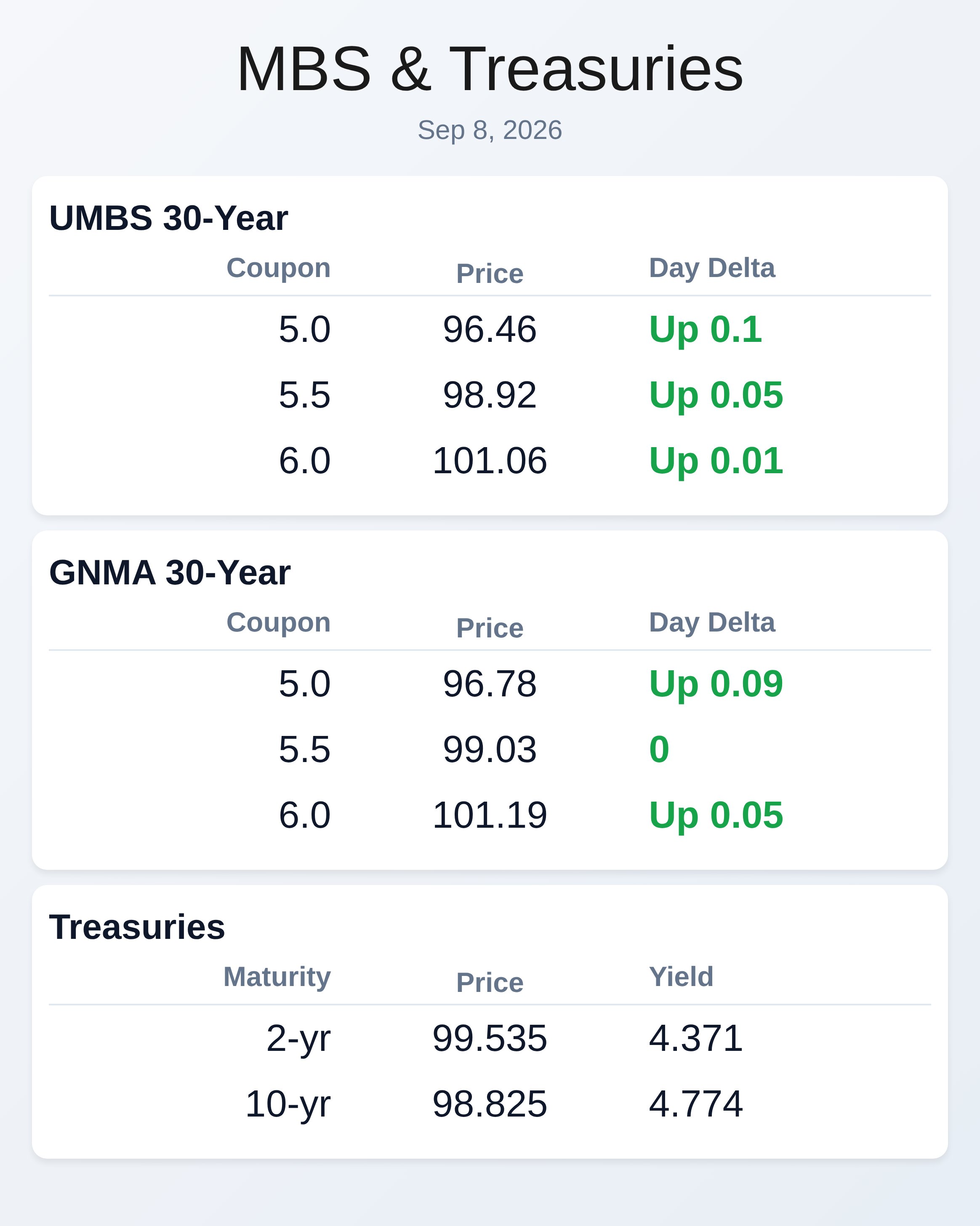
**UMBS 30 yr**
| Coupon | Price | Intra-Day Change |
| 5.0 | 96.46 | 0.1 |
| 5.5 | 98.92 | 0.05 |
| 6.0 | 101.06 | 0.01 |
**GNMA 30 yr**
| Coupon | Price | Intra-Day Change |
| 5.0 | 96.78 | 0.09 |
| 5.5 | 99.03 | 0 |
| 6.0 | 101.19 | 0.05 |
**Treasuries**
| Term | Yield | Price | Intra-Day Yield Change |
| 2 yr | 4.371 | 99.535 | 0.007 |
| 3 yr | 4.445 | 99.458 | -0.002 |
| 5 yr | 4.543 | 99.256 | -0.003 |
| 7 yr | 4.651 | 99.108 | -0.005 |
| 10 yr | 4.774 | 98.825 | -0.014 |
| 30 yr | 5.23 | 98.425 | -0.015 |