**WTMS Blog Today = What’s up in Mortgage Today (AM) – 09/15/2026**
The 10-year Treasury yield breached 5 percent—for only the third time in two decades—as oil prices surge and bond investors demand higher compensation for inflation risk ahead of tomorrow’s Federal Reserve decision. The yield hit 5.04% this morning, matching a 19-year high last seen in 2007 before the financial crisis. Energy prices are the culprit: Brent crude climbed toward $107 a barrel after attacks on Saudi infrastructure, feeding persistent inflation fears.
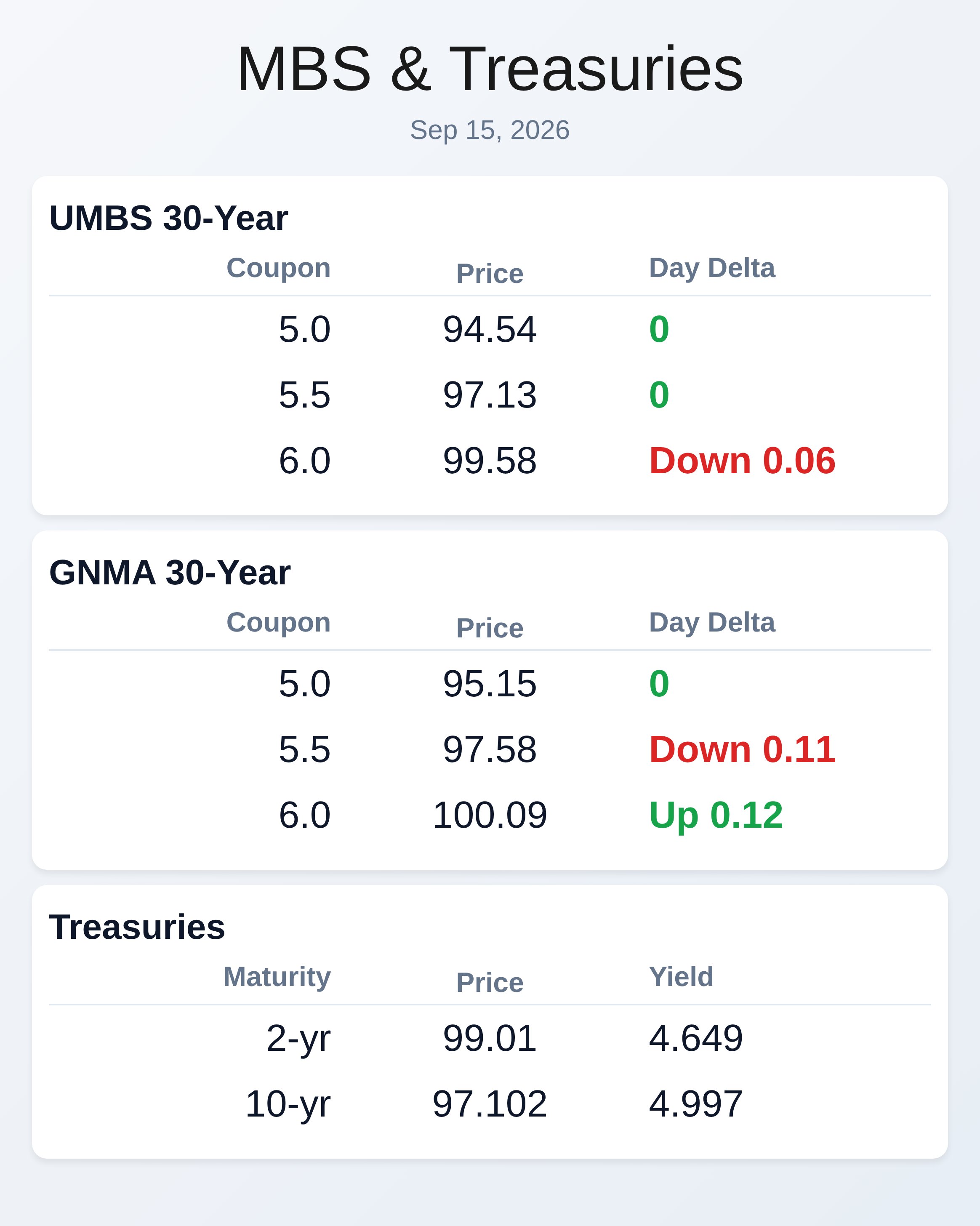
The Fed faces mounting pressure to raise rates tomorrow to defend its credibility after years of inflation overshooting targets. Investors are already pricing in a greater than 90% probability of a 25-basis-point hike. UMBS 30-year coupons showed mixed intraday movement, with the 6.0 coupon down just 0.06 points while the 5.0 and 5.5 coupons held flat at 94.54 and 97.13 respectively.
GNMA 30-year bonds displayed similar sideways pressure, with the 6.0 coupon up 0.12 points and the 5.5 coupon down 0.11 points. These muted price swings reflect dealers and originators sitting on their hands while awaiting clarity on the Fed’s rate trajectory and its impact on future refinance supply. Mortgage origination volume continues deteriorating, with the MBA refinance index down 58 percent over six months, driven by government borrowers especially VA applicants, which have plummeted 77 percent in that timeframe.
Bond market weakness poses a structural headache for mortgage sellers: MBS issuance could fall below $100 billion per month by year-end if refinance activity continues eroding and prepayments remain suppressed. The administration wants lower 10-year yields to boost housing affordability ahead of midterm elections, but Treasury supply pressures and cooling demand from foreign buyers are working in the opposite direction. With only 3.4 percent of borrowers retaining a meaningful refinance incentive today, rate-driven supply shock seems unlikely in the near term.
The yield-curve continues flattening, pinching the income margin for loan production and servicing portfolios. Expectations for a sharp decline in yields have been scaled back: strategists now target year-end 10-year yields around 4.60 percent—still above current levels—with persistent upward pressure from both geopolitical oil risks and federal debt issuance needs. Treasury curve is steepening with 2-year yields richer than 10-year yields on a relative basis, a sign that rate-cut expectations beyond 2026 have dimmed considerably.
Persistent inflation swaps suggest the bond market has already factored in higher-for-longer rate expectations. The concern among a third of fund managers surveyed is that a disorderly rise in yields could cascade into credit spreads and equity volatility, creating portfolio contagion. Mortgage lock/float decisions remain defensive: slower pace of selling and modest intraday bounces continue to tempt originators to catch falling knives, but advisors recommend waiting for a confirmed trend shift before adjusting lock positioning.
Volatility potential remains elevated through at least Wednesday’s Fed announcement, with war-related headlines adding two-way risks to markets. The 10-year yield ceiling and floor levels tracked by MBS market watchers are showing bigger-picture bond momentum deterioration. Lenders should use MBS price action for intraday risk management but rely on Treasury yields for strategic positioning decisions.
Retail-funded mortgage rates in August averaged 6.52 percent, up 10 basis points from July but still 16 basis points lower than a year ago, according to Curinos data from lenders across the market. Purchase activity remains essentially flat, down less than 1 percent over both six-month and 12-month periods, suggesting housing demand has stabilized at current price levels. The conventional refinance sector showed a 12 percent uptick over three months despite elevated rates, hinting that some borrowers with equity are bypassing rates and capturing home value instead.
Cash-out refinances remain the lone origination category showing month-over-month growth, a sign that equity extraction is driving demand more than rate arbitrage. Tomorrow’s Fed decision and press conference will reset market expectations and potentially unlock new supply pipelines if officials signal patience on future tightening.
**Locking vs Floating**
Originators face persistent temptation to lock loans during the intraday bounces we’ve seen recently, but strategists caution that a single bounce does not confirm a trend reversal in this volatile environment.
Continue defending your pipeline with a cautious stance until the 10-year yield shows sustained settlement below the 5 percent psychological level. Volatility should remain elevated at minimum through Wednesday’s Fed announcement, and geopolitical risks on oil and Middle East conflict could create sharp intraday swings in either direction. MBS price action can help manage intraday tactical positioning, but base strategic lock/float decisions on longer-dated Treasury yield momentum and ceilings and floors that track the bigger picture.
**Today’s Events**
September Empire State Manufacturing Index (minor data point). Treasury auction for $13 billion of 20-year bonds. Federal Reserve rate decision and press conference (tomorrow, September 16).
**Bond Pricing**
**UMBS 30 yr**
| Coupon | Price | Intra-Day Change |
| 5.0 | 94.54 | 0 |
| 5.5 | 97.13 | 0 |
| 6.0 | 99.58 | -0.06 |
**GNMA 30 yr**
| Coupon | Price | Intra-Day Change |
| 5.0 | 95.15 | 0 |
| 5.5 | 97.58 | -0.11 |
| 6.0 | 100.09 | 0.12 |
**Treasuries**
| Term | Yield | Price | Intra-Day Yield Change |
| 2 yr | 4.649 | 99.01 | -0.017 |
| 3 yr | 4.748 | 98.968 | -0.008 |
| 5 yr | 4.818 | 98.051 | -0.001 |
| 7 yr | 4.904 | 97.63 | 0.001 |
| 10 yr | 4.997 | 97.102 | 0.012 |
| 30 yr | 5.37 | 96.368 | 0.022 |