I’ll proceed with writing the blog post based on the email content provided, as the article fetches are encountering technical issues. **WTMS Blog Today = What’s up in Mortgage Today (PM) – 09/16/2026**
The Federal Reserve hiked rates by 25 basis points to a 3.75-4% target range today, the first increase since 2023, sending mortgage markets into a day of whipsaws and uncertainty. Fed officials signaled at least one more hike could come before year-end, with some policymakers expecting two additional increases to combat persistent inflation.
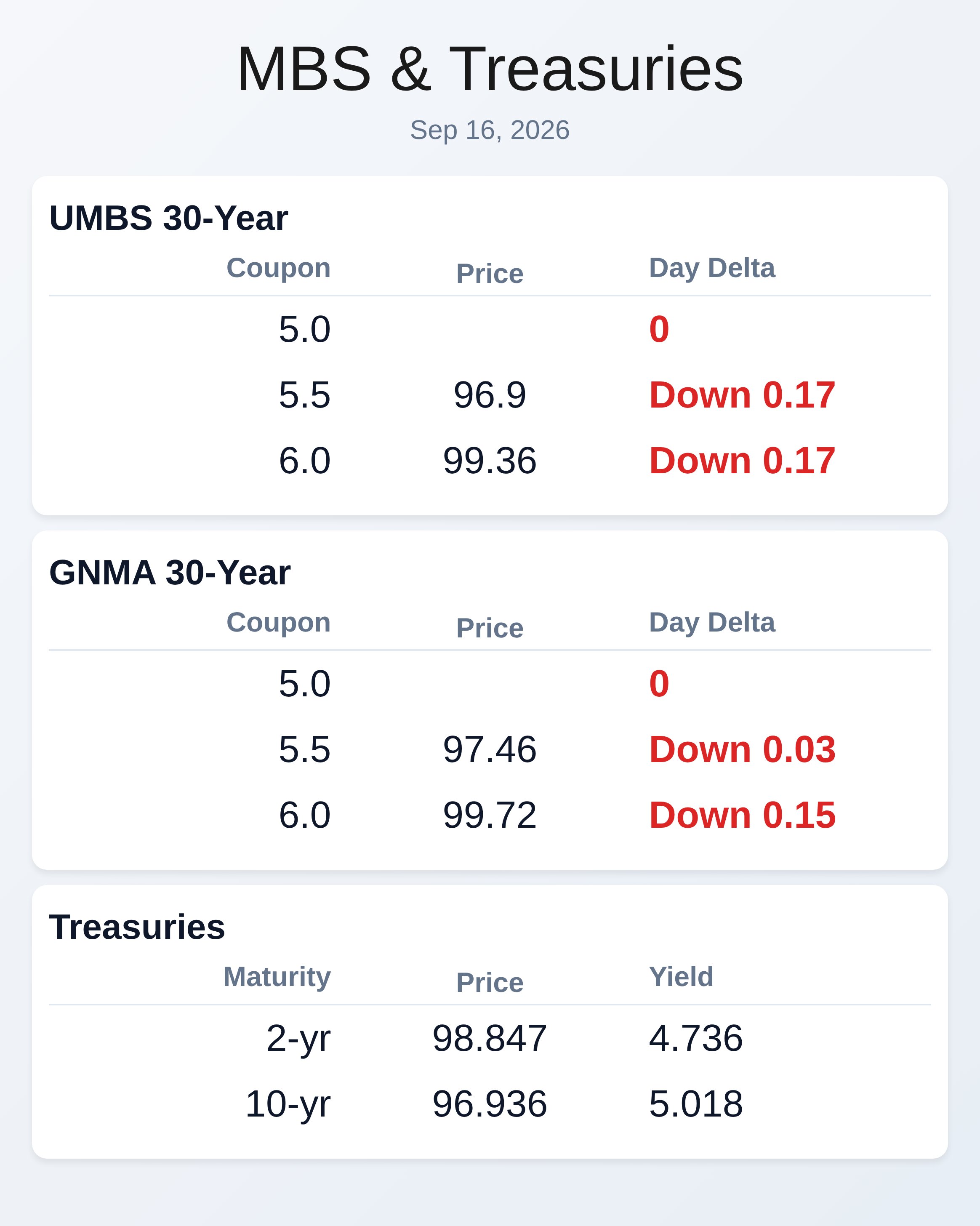
The 10-year Treasury cracked 5% early this week and settled around 5% by day’s end, creating modest headwinds for MBS prices that finished down roughly an eighth of a point despite initial intraday strength. Bank of America strategists project the 10-year could eventually settle around 4.5%, which would put conventional mortgage rates somewhere in the 6.5%-7% range—painfully high for borrowers who already face the tightest lending standards in decades. Purchase demand has collapsed, with application volume down 19% year over year as rates surged from 6.97% to 7.22% in just six days.
Negative reprice risk spiked Wednesday afternoon as MBS fell an eighth of a point from many lenders’ morning rate sheet prints, forcing originators to make critical lock-or-float decisions for pending loans. The volatility around Fed Chair Kevin Warsh’s post-announcement remarks moved bonds lower again, creating uncertainty about whether lenders would need to adjust rates downward overnight or hold their positions through Thursday morning. Several large lenders did not immediately reprice the afternoon, creating additional risk that they would face adjustments at tomorrow’s open when wholesale pricing potentially moves their direction.
MBS traders are watching the Fed’s communications closely for any hints about the pace of future rate increases, as the trajectory of Treasury yields will ultimately determine whether mortgage rates stabilize or drift higher through year-end. Lenders holding unpriced pipelines face the toughest environment in months, with rate locks becoming increasingly expensive for originators as the cost to produce a mortgage climbs closer to $11,000 per loan. Pennymac raised its conforming loan limit to $850,000—$17,250 above the current $832,750 baseline—in a calculated move to capture higher-balance borrowers before the official FHFA announcement arrives.
This early increase gives Pennymac’s TPO partners and correspondent lenders a competitive edge in a purchase market where every qualified borrower counts, allowing them to keep higher-balance loans in conventional territory rather than pushing them into expensive jumbo programs. The broader competitive message is clear: lenders are once again racing ahead of regulatory limits to secure market share and strengthen partner relationships before the official 2027 limit is set. This strategy has become table stakes in the origination business, with larger players using higher limits as a customer-acquisition and pipeline-building tool.
For smaller originators and brokers, the move signals that access to higher-balance conventional borrowers now depends on partnering with lenders willing to move fast and early. Title and deed fraud continues to accelerate in the mortgage ecosystem, with First American extending its property-monitoring service to independent title agents nationwide to help homeowners receive alerts about suspicious filings. The expansion reflects an industrywide crisis of growing sophistication in fraud schemes targeting home equity and mortgage documents.
Meanwhile, a $14 million DSCR fraud scheme in Baltimore involving shell LLCs, fraudulent appraisals, and coordinated title-company participation has resulted in RICO claims and highlights the vulnerability of emerging lending channels to organized fraud. Ameritrust’s lawsuit alleges roughly 90 loans defaulted immediately, many without a single payment, in what mirrors a broader Baltimore DSCR fraud wave identified last year. These cases underscore that as new loan products and investor demand grow, so does organized fraud targeting those programs, requiring stronger underwriting and documentation discipline across all channel partnerships.
Fed Fund futures now price in additional rate hikes through year-end, with several strategists expecting at least one more increase in October or December despite political pressure from the Trump administration to cut. The conflict between inflation reality and administration messaging has created headwinds for Fed Chair Kevin Warsh, who faces demands to prioritize rate cuts while underlying inflation signals persist. Bank of America’s rate team sees little room for mortgage rate improvement unless Treasury yields reverse course significantly, and they project mortgages settling in the 6.5%-7% range under their base-case scenarios.
Originators should assume rates stay elevated through the remainder of 2026, making pipeline management, lock discipline, and cost control paramount to survive compressed margins. Borrowers closing soon should lock rather than float, given the elevated volatility and hawkish Fed trajectory now baked into market pricing.
**Locking vs Floating**
MBS Live strategists advise caution on floating positions given the negative reprice risk rising after this afternoon’s market moves.
Lenders who repriced early hold more flexibility, while those delaying adjustments face potential pressure at tomorrow’s open. The consensus is defensive—lock pending loans unless the borrower has significant rate lock cushion and genuine appetite for the downside volatility risk.
**Today’s Events**
Import prices mm (Aug): 0.7% vs 0.4% forecast, -0.4% previous
Retail Sales (Aug): 1.2% vs 0.8% forecast, -0.6% previous
Retail Sales Control Group MoM (Aug): 1.4% vs 0.4% forecast, -0.4% previous
Headline CPI y/y (Aug): 3.4% vs 3.4% forecast, 3.4% previous
**Bond Pricing**
**UMBS 30 yr**
| Coupon | Price | Intra-Day Change |
**GNMA 30 yr**
| Coupon | Price | Intra-Day Change |
**Treasuries**
| Term | Yield | Price | Intra-Day Yield Change |
| 2 yr | 4.736 | 98.847 | 0.065 |
| 3 yr | 4.825 | 98.756 | 0.057 |
| 5 yr | 4.88 | 97.785 | 0.044 |
| 7 yr | 4.951 | 97.359 | 0.035 |
| 10 yr | 5.018 | 96.936 | 0.013 |
| 30 yr | 5.363 | 96.469 | -0.005 |