Loading...
HOME2023-01-22T13:43:33-07:00

Damn, there is so much great knowledge out there. Did you know that “BOOKS” are full of smart?? No, I mean like life changing, I-wish-I-knew-that-years-ago type stuff.

I know that I was waaaayyy late to the game figuring it out. And I know that a lot of you are too busy to read as much as you ‘should’. And that is why you need me.

I still remember how it started for me. It started in June of 2008. After 11  years …..Click to continue

Mortgage Today (PM) - 09/17/26 {{catlist}}
September 17, 2026
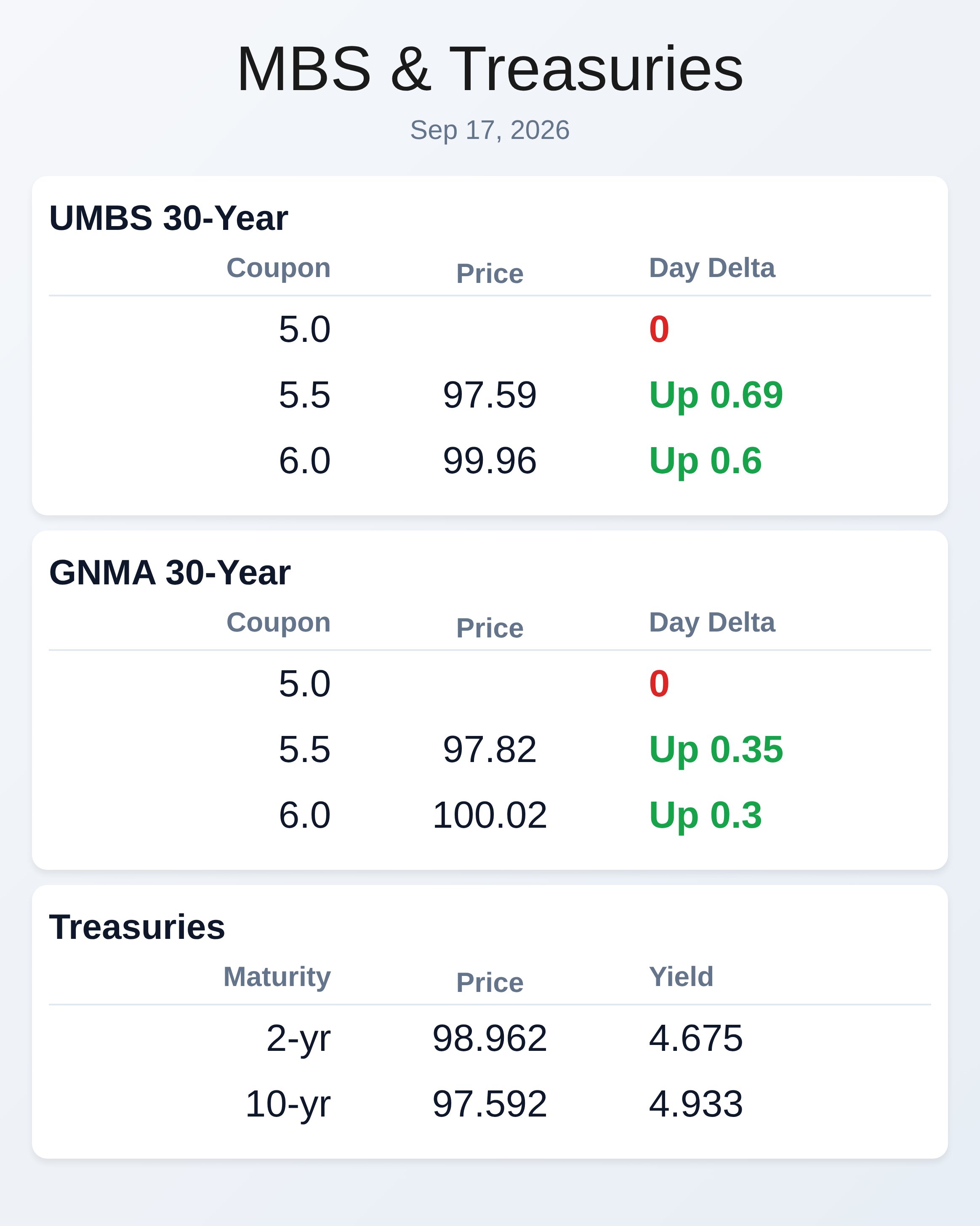
READ MORE **WTMS Blog Today = What's up in Mortgage Today (PM) - 09/17/2026** Mortgage rates caught a reprieve today as Treasury yields retreated following the Federal Reserve's widely anticipated rate hike, with the 10-year yield sliding 8.5 basis points to settle near 4.93%. UMBS securities gained significant ground throughout the session, with the 5.5 coupon jumping 69 basis points to 97.59 and the 6.0 coupon rising 60 ticks to 99.96. The bond market's positive reception suggests investors believe the Fed's tightening cycle may be nearing its end, though officials signaled additional rate increases could still be on the table if inflation persists. Economic data painted a mixed picture, with jobless claims coming in better than expected at 196K versus 208K forecast, while building permits and housing starts both lagged forecasts. The market's challenge now revolves around whether this modest rally represents a true shift in momentum or merely profit-taking before the Fed's next move. The disconnect between Fed policy and mortgage rates remains a critical lesson for originators to communicate. While the Fed's rate hike will push HELOC costs higher immediately—since those products typically track the prime rate—mortgage rates hardly budged because they forward-price Treasury expectations and long-term inflation outlooks. This fundamental difference allows loan officers to educate borrowers that a Fed hike does not automatically translate into higher mortgage rates, especially when Treasury yields are moving lower simultaneously. Homebuyers fixated on Fed announcements often miss the more relevant driver: 10-year Treasury yields. Understanding this relationship helps originators cut through market noise and position themselves as credible advisors during volatile rate environments. The Philly Fed Business Index surged to 37.8 from the prior 47.4 reading, falling short of the 30.5 forecast and signaling cooling manufacturing activity. Continued jobless claims dropped to 1.73 million from 1.774 million previously, suggesting labor market resilience despite tightening monetary policy. Building permits slipped to 1.394 million versus a 1.41 million forecast, while housing starts fell to 1.275 million compared to expectations of 1.31 million. Prices paid in the Philly region jumped to 48.6, marking persistent inflationary pressures even as economic growth moderates. These crosscurrents reinforce the volatility mortgage originators face: softening activity paired with sticky inflation creates an uncertain outlook for rate direction and borrower demand. The critical technical level to watch remains the 4.94% threshold on 10-year yields, which serves as both a floor for optimistic traders and a ceiling for risk-averse investors. Breaking below this level cleanly would signal a meaningful shift toward lower rates, though energy prices remain a wildcard that could undermine sustained improvement. By day's end, UMBS 6.5 coupons notched a 54-basis-point gain to 102.08, providing some relief for lenders holding in-the-money servicing portfolios. GNMA securities lagged slightly, with the 6.5 coupon up just 4 basis points to 101.77, likely reflecting different prepayment assumptions. Treasury curve steepening—particularly the 2-year to 10-year spread—adds complexity for hedging strategies and lock management. Originators should recognize that today's rally occurred on tighter credit spreads and improving risk sentiment, not on weakness in economic fundamentals. The fact that mortgage rates held firm near 7% despite the Fed's hike demonstrates the secondary market's confidence in a pause cycle, but that conviction could evaporate if inflation data surprises to the upside. Lock strategies should remain disciplined; borrowers closing within 30 to 45 days face genuine rate risk if Treasury yields retest higher levels. Float positions benefit from the current softness, but the risk-reward profile deteriorates quickly once we move past September's data calendar. Loan officers must balance optimism about today's moves with realistic hedging around next week's economic releases. Subscribe free to WTMS Blog Today at WellThatMakesSense.com to stay ahead of mortgage market shifts and origination insights. **Locking vs Floating** The market's narrative shifted today: the Fed's rate hike did not automatically derail mortgage rates because those products are driven by Treasury yields and inflation expectations, not Fed policy directly. Jobless claims beating forecasts reinforced the view that one more rate hike may already be priced in, removing some urgency around aggressive Fed tightening. The 4.94% ceiling on 10-year yields represents a psychological and technical pivot point—breaking below it cleanly would favor floaters and increase confidence in lower future rates. Conversely, if yields retest higher after better-than-expected data next week, locks become increasingly attractive relative to floating risk. **Today's Events** Building Permits (Aug): 1.394M vs 1.41M forecast, 1.433M previous Housing Starts (Aug): 1.275M vs 1.31M forecast, 1.239M previous Jobless Claims (Sep/12): 196K vs 208K forecast, 206K previous Continued Claims (Sep/05): 1.73M vs 1.78M forecast, 1.774M previous Philly Fed Business Index (Sep): 37.8 vs 30.5 forecast, 47.4 previous Philly Fed Prices Paid (Sep): 48.60 vs forecast not available, 40.90 previous **Bond Pricing** **UMBS 30 yr** | Coupon | Price | Intra-Day Change | **GNMA 30 yr** | Coupon | Price | Intra-Day Change | **Treasuries** | Term | Yield | Price | Intra-Day Yield Change | **GNMA 30yr** | Coupon | Price | Intra-Day Change | |---:|---:|---:| | 5.5 | 97.82 | 0.35 | | 6.0 | 100.02 | 0.3 | | 6.5 | 101.77 | 0.04 | **Treasuries** | Term | Yield | Price | Intra-Day Yield Change | |---|---:|---:|---:| | 2yr | 4.675 | 98.962 | -0.059 | | 3yr | 4.742 | 98.984 | -0.078 | | 5yr | 4.787 | 98.185 | -0.087 | | 7yr | 4.858 | 97.9 | -0.088 | | 10yr | 4.933 | 97.592 | -0.086 | | 30yr | 5.289 | 97.548 | -0.07 | Market Data
Mortgage Today (AM) - 09/17/26 {{catlist}}
September 17, 2026
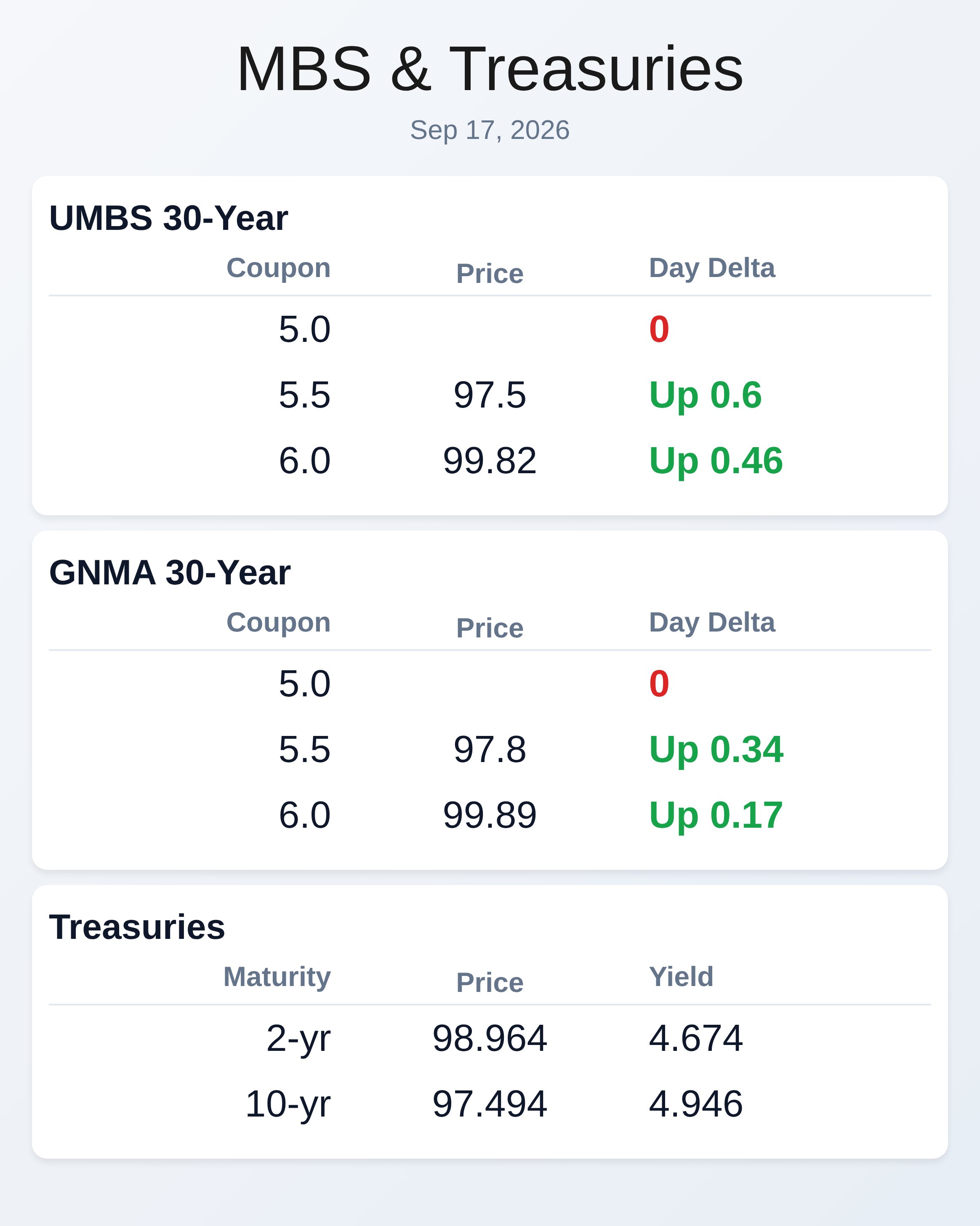
READ MORE **WTMS Blog Today = What's up in Mortgage Today (AM) - 09/17/2026** The Federal Reserve's quarter-point rate hike to 4.00 percent sent mixed signals through bond markets yesterday, with Treasury yields rallying back this morning even as policymakers signaled more tightening ahead. Agency MBS prices rebounded modestly overnight, with UMBS 6.0s holding at 99.82, suggesting some stabilization after the initial volatility. The hawkish tone from Fed policymakers—16 of 18 officials now see at least one more hike in 2026—continues to create uncertainty for lenders trying to lock or float rate locks. Jobless claims came in stronger than expected at 196,000 versus forecasts of 207,000, adding to the mixed economic picture. The 10-year Treasury yield opened this morning at 4.97 percent, down nearly 5 basis points from yesterday's close at 5.01 percent. The week's economic data painted a picture of an economy resilient on employment but fragile on housing. August housing starts fell short at 1.275 million versus expectations of 1.31 million, marking continued weakness in new construction. Building permits also disappointed at 1.394 million, though continuing claims declined to 1.730 million from 1.774 million the prior week. The Philly Fed Business Index dropped to 37.8 from 47.4, signaling a noticeable pullback in regional manufacturing sentiment. These crosscurrents leave originators navigating an environment where robust labor markets contrast sharply with deteriorating housing demand. GNMA 30-year securities showed less volatility than UMBS in overnight trading, with the 6.0 coupon priced at 99.89 after gaining just 17 basis points intraday. The 6.5 coupon held at 102.03, suggesting investors are rotating into higher coupons as rate expectations stabilize. GNMA's more stable performance reflects the government guarantee and continued demand from portfolio managers seeking yield in a higher-for-longer rate environment. Treasury curve positioning shows the 2-year yielding 4.67 percent and the 30-year at 5.30 percent, indicating markets are pricing in eventual rate cuts but not expecting them anytime soon. The spread dynamics between shorter and longer maturities remain the key lens for tracking duration bets across fixed-income desks. Originators face a critical decision point as secondary desks have already repriced locks following the Fed's move. Some lenders held back repricing yesterday afternoon, likely setting themselves up for adjustments this morning, which increases float risk for brokers still holding paper. The consensus among trading desks is cautious: higher Fed funds rates should ultimately help mortgage rates by fighting inflation, but the near-term noise from Fed decisions makes it impossible to confirm that benefit immediately. Floating on lenders who haven't repriced introduces execution risk, while those who repriced for the worse still leave room for tactical positioning before a clear trend emerges. The defensive strategy of waiting for momentum confirmation remains the prudent choice given the elevated uncertainty in rate direction. Mortgage application data from the Mortgage Bankers Association revealed that builder applications for new home purchases fell 5.5 percent year-over-year and declined 6 percent month-over-month in August. This marks the fifth consecutive month of declining applications and represents 2026's lowest monthly total for new construction purchases. Retail sales proved stronger than anticipated at 1.2 percent month-over-month, with core sales up 1.4 percent, showing consumers remain willing to spend even at elevated borrowing costs. The tension between consumer spending power and housing affordability continues to define market dynamics as mortgage rates remain elevated despite yesterday's Treasury rally. The Fed's updated projections now show a median year-end fed funds rate of 4.125 percent, implying one to two additional rate moves before year-end depending on inflation data. Treasury yields have stabilized this morning after moving lower on expectations that the aggressive tightening cycle may finally be plateauing, though any signs of sticky inflation could trigger another leg higher. Oil prices fell 2.5 percent overnight to $99.90 per barrel, easing some of the near-term inflation concerns that had pushed yields to multi-decade highs. The combination of cooling commodity prices, resilient labor markets, and weaker housing activity creates a complex backdrop where mortgage originators must balance rate lock strategy with pipeline management. Markets will closely watch the October and December Fed meetings and any revisions to the neutral rate before committing to a clear directional view on 2027 rates. **Locking vs Floating** Yesterday's Fed hike created an extremely difficult environment for lock-versus-float decisions. Several lenders did not reprice yesterday afternoon, meaning brokers holding loans with those lenders face repricing risk this morning when the lender adjusts. Floating strategy works best when lenders who repriced for worse leave room for positive adjustments, but even then the prudent approach is to wait for clear momentum before abandoning defensive positioning. Treasury support has returned near yesterday's levels, confirming some stability, but the bigger picture question remains unanswered: will higher Fed funds rates ultimately help or hurt mortgage rates? The safest path is to hold defensive floats while monitoring for a strong directional shift rather than trying to catch tops or bottoms during Fed weeks. **Today's Events** Building Permits (Aug): 1.394M vs 1.41M forecast, 1.433M prior Continued Claims (Sep/05): 1.730M vs 1.780K forecast, 1.774K prior Housing Starts (Aug): 1.275M vs 1.31M forecast, 1.239M prior Jobless Claims (Sep/12): 196K vs 208K forecast, 206K prior Philly Fed Business Index (Sep): 37.8 vs 30.5 forecast, 47.4 prior Philly Fed Prices Paid (Sep): 48.60 vs no forecast, 40.90 prior **Bond Pricing** **UMBS 30 yr** | Coupon | Price | Intra-Day Change | | 5.5 | 97.5 | 0.6 | | 6.0 | 99.82 | 0.46 | | 5.5 | 97.8 | 0.34 | **GNMA 30 yr** | Coupon | Price | Intra-Day Change | **Treasuries** | Term | Yield | Price | Intra-Day Yield Change | | 2 yr | 4.674 | 98.964 | -0.06 | | 3 yr | 4.745 | 98.976 | -0.08 | | 5 yr | 4.791 | 98.17 | -0.089 | | 7 yr | 4.863 | 97.869 | -0.088 | | 10 yr | 4.946 | 97.494 | -0.073 | | 30 yr | 5.304 | 97.323 | -0.059 | Market Data
Mortgage Today (PM) - 09/16/26 {{catlist}}
September 17, 2026
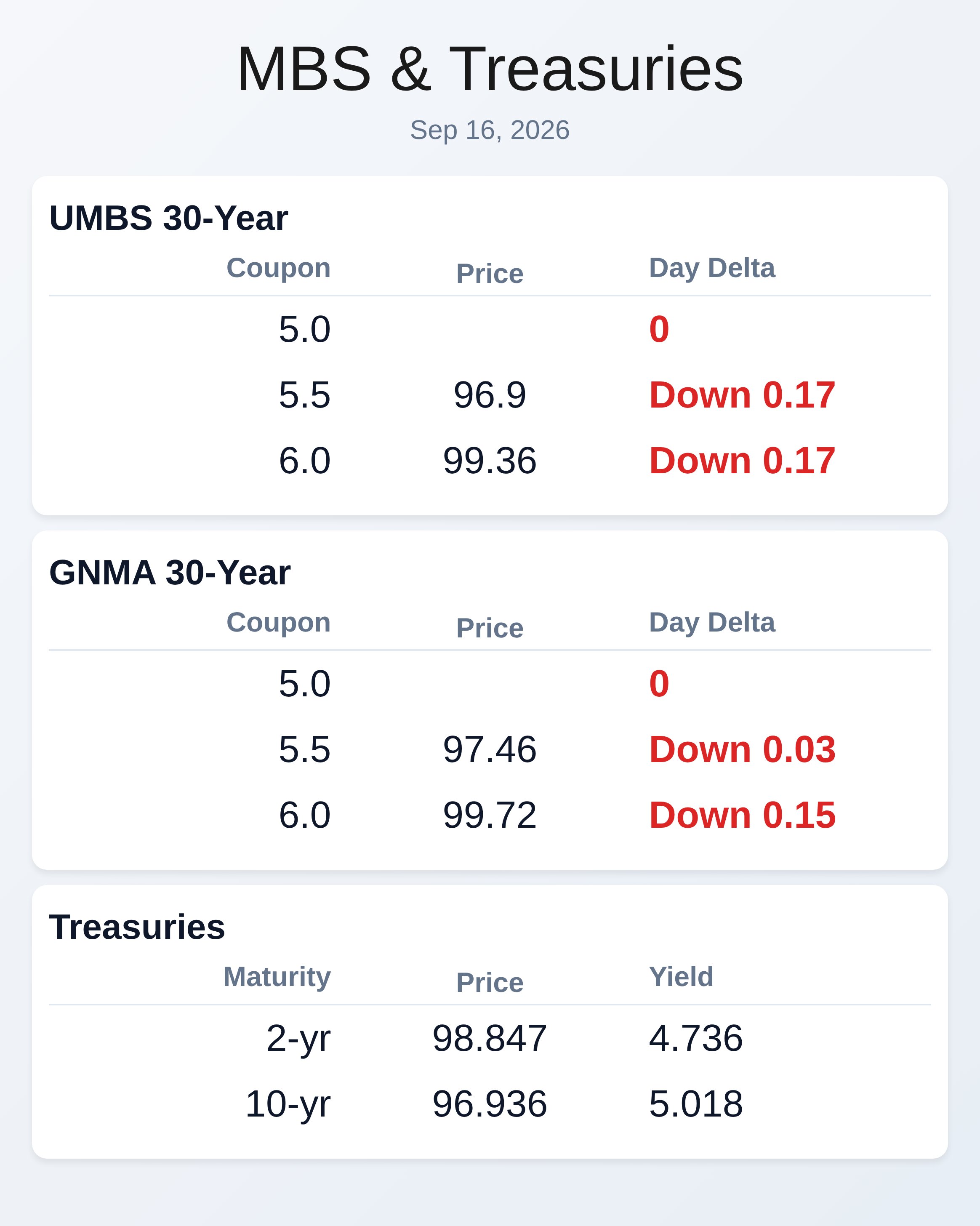
READ MORE I'll proceed with writing the blog post based on the email content provided, as the article fetches are encountering technical issues. **WTMS Blog Today = What's up in Mortgage Today (PM) - 09/16/2026** The Federal Reserve hiked rates by 25 basis points to a 3.75-4% target range today, the first increase since 2023, sending mortgage markets into a day of whipsaws and uncertainty. Fed officials signaled at least one more hike could come before year-end, with some policymakers expecting two additional increases to combat persistent inflation. The 10-year Treasury cracked 5% early this week and settled around 5% by day's end, creating modest headwinds for MBS prices that finished down roughly an eighth of a point despite initial intraday strength. Bank of America strategists project the 10-year could eventually settle around 4.5%, which would put conventional mortgage rates somewhere in the 6.5%-7% range—painfully high for borrowers who already face the tightest lending standards in decades. Purchase demand has collapsed, with application volume down 19% year over year as rates surged from 6.97% to 7.22% in just six days. Negative reprice risk spiked Wednesday afternoon as MBS fell an eighth of a point from many lenders' morning rate sheet prints, forcing originators to make critical lock-or-float decisions for pending loans. The volatility around Fed Chair Kevin Warsh's post-announcement remarks moved bonds lower again, creating uncertainty about whether lenders would need to adjust rates downward overnight or hold their positions through Thursday morning. Several large lenders did not immediately reprice the afternoon, creating additional risk that they would face adjustments at tomorrow's open when wholesale pricing potentially moves their direction. MBS traders are watching the Fed's communications closely for any hints about the pace of future rate increases, as the trajectory of Treasury yields will ultimately determine whether mortgage rates stabilize or drift higher through year-end. Lenders holding unpriced pipelines face the toughest environment in months, with rate locks becoming increasingly expensive for originators as the cost to produce a mortgage climbs closer to $11,000 per loan. Pennymac raised its conforming loan limit to $850,000—$17,250 above the current $832,750 baseline—in a calculated move to capture higher-balance borrowers before the official FHFA announcement arrives. This early increase gives Pennymac's TPO partners and correspondent lenders a competitive edge in a purchase market where every qualified borrower counts, allowing them to keep higher-balance loans in conventional territory rather than pushing them into expensive jumbo programs. The broader competitive message is clear: lenders are once again racing ahead of regulatory limits to secure market share and strengthen partner relationships before the official 2027 limit is set. This strategy has become table stakes in the origination business, with larger players using higher limits as a customer-acquisition and pipeline-building tool. For smaller originators and brokers, the move signals that access to higher-balance conventional borrowers now depends on partnering with lenders willing to move fast and early. Title and deed fraud continues to accelerate in the mortgage ecosystem, with First American extending its property-monitoring service to independent title agents nationwide to help homeowners receive alerts about suspicious filings. The expansion reflects an industrywide crisis of growing sophistication in fraud schemes targeting home equity and mortgage documents. Meanwhile, a $14 million DSCR fraud scheme in Baltimore involving shell LLCs, fraudulent appraisals, and coordinated title-company participation has resulted in RICO claims and highlights the vulnerability of emerging lending channels to organized fraud. Ameritrust's lawsuit alleges roughly 90 loans defaulted immediately, many without a single payment, in what mirrors a broader Baltimore DSCR fraud wave identified last year. These cases underscore that as new loan products and investor demand grow, so does organized fraud targeting those programs, requiring stronger underwriting and documentation discipline across all channel partnerships. Fed Fund futures now price in additional rate hikes through year-end, with several strategists expecting at least one more increase in October or December despite political pressure from the Trump administration to cut. The conflict between inflation reality and administration messaging has created headwinds for Fed Chair Kevin Warsh, who faces demands to prioritize rate cuts while underlying inflation signals persist. Bank of America's rate team sees little room for mortgage rate improvement unless Treasury yields reverse course significantly, and they project mortgages settling in the 6.5%-7% range under their base-case scenarios. Originators should assume rates stay elevated through the remainder of 2026, making pipeline management, lock discipline, and cost control paramount to survive compressed margins. Borrowers closing soon should lock rather than float, given the elevated volatility and hawkish Fed trajectory now baked into market pricing. **Locking vs Floating** MBS Live strategists advise caution on floating positions given the negative reprice risk rising after this afternoon's market moves. Lenders who repriced early hold more flexibility, while those delaying adjustments face potential pressure at tomorrow's open. The consensus is defensive—lock pending loans unless the borrower has significant rate lock cushion and genuine appetite for the downside volatility risk. **Today's Events** Import prices mm (Aug): 0.7% vs 0.4% forecast, -0.4% previous Retail Sales (Aug): 1.2% vs 0.8% forecast, -0.6% previous Retail Sales Control Group MoM (Aug): 1.4% vs 0.4% forecast, -0.4% previous Headline CPI y/y (Aug): 3.4% vs 3.4% forecast, 3.4% previous **Bond Pricing** **UMBS 30 yr** | Coupon | Price | Intra-Day Change | **GNMA 30 yr** | Coupon | Price | Intra-Day Change | **Treasuries** | Term | Yield | Price | Intra-Day Yield Change | | 2 yr | 4.736 | 98.847 | 0.065 | | 3 yr | 4.825 | 98.756 | 0.057 | | 5 yr | 4.88 | 97.785 | 0.044 | | 7 yr | 4.951 | 97.359 | 0.035 | | 10 yr | 5.018 | 96.936 | 0.013 | | 30 yr | 5.363 | 96.469 | -0.005 | Market Data
LATEST ARTICLES

RECENT ARTICLES

Mortgage Today (AM) – 01/12/26

January 12th, 2026|Week In Review|

WTMS Blog Today = What's up in Mortgage Today (AM) - 01/12/2026 Markets are under pressure this morning as the Department of Justice escalated its attack on Fed independence with criminal investigation threats. Fed Chair [...]

Article Archive

No Excuses by Brian Tracy -3

February 6th, 2024|0 Comments

My Reading Notes From: No Excuses By Brian Tracy Most people think success comes from good luck or enormous talent, but many successful people achieve their accomplishments in a simpler way: through self-discipline. [...]

No Excuses by Brian Tracy – 2

February 1st, 2024|0 Comments

My Reading Notes From: No Excuses By Brian Tracy Most people think success comes from good luck or enormous talent, but many successful people achieve their accomplishments in a simpler way: through self-discipline. [...]

No Excuses by Brian Tracy – 1

January 30th, 2024|0 Comments

My Reading Notes From: No Excuses By Brian Tracy Most people think success comes from good luck or enormous talent, but many successful people achieve their accomplishments in a simpler way: through self-discipline. [...]

Subscribe

Send me some brain food

Go to Top