**WTMS Blog Today = What’s up in Mortgage Today (AM) – 07/30/2026**
Economic data disappointed this morning, with second-quarter GDP growth coming in at just 1.5% versus the 2.0% forecast, though consumer spending surged 3.2% and inflation continued moderating. Core PCE rose only 0.1% month-over-month in June, matching expectations and falling well short of the prior 0.3%, while the annual core rate held steady at 3.3%. Jobless claims came in hotter at 197,000 versus the 200,000 forecast, with continuing claims at 1.782 million, signaling a still-resilient labor market despite the softer economic growth.
The mixed signals left markets puzzled about the Federal Reserve’s next moves, especially after Chair Warsh’s sparse communication style failed to clarify whether rate cuts might be coming. MBS prices managed modest gains overnight, with the 30-year up roughly 3 ticks, but longer-dated Treasuries now face headwinds from renewed inflation concerns and Middle East geopolitical tensions. Fed policy uncertainty is creating a paradoxical reaction in markets: weaker GDP data should push rates lower, yet longer-dated bonds are actually higher because investors doubt the Fed’s commitment to price stability.
Warsh’s minimal forward guidance during yesterday’s post-meeting press conference has left traders interpreting every data point as a potential policy signal rather than relying on official Fed communication. Mortgage originators face a credibility problem in this environment—without clear direction from the central bank, borrowers and lenders alike are holding back on rate locks and commitments. The mortgage servicing industry has consolidated dramatically with Rocket’s acquisition of Mr.
Cooper and bank exits from Ginnie Mae, concentrating 60% of conventional servicing and 75% of Ginnie Mae servicing among the top ten firms. This concentration brings operational scale but also increases systemic risk that regulators will eventually scrutinize. The broader economic backdrop shows consumer resilience offsetting growth disappointments, with personal spending and AI-driven business investment providing support against headwinds from geopolitical conflict and higher energy costs.
Real GDP price inflation hit 6.2% on a quarterly basis, well above the Fed’s 2% target, though core measures remain elevated rather than accelerating. The U.S. economy continues demonstrating notable resilience, but the path forward hinges on whether tariffs, supply disruptions, and AI-related bottlenecks ease as expected or persist longer.
Treasury yields on the 30-year maturity have hit their highest levels since 2007, creating a challenging competitive environment for mortgage originators trying to capture loan share. Unless significant economic deterioration emerges, mortgage rates may struggle to fall materially from current levels, forcing lenders to compete on service quality and speed rather than price. Geopolitical escalation in the Middle East is amplifying safe-haven demand and widening credit spreads across riskier segments of the bond market, though equity markets rallied today on strong Microsoft earnings.
The market’s focus has shifted sharply from rate-cut expectations to questions about whether massive AI investment spending will eventually generate profitable returns. Nasdaq 100 futures jumped 1.4% and the S&P 500 gained 0.7% in morning trading as technology stocks found footing after five consecutive days of losses. Energy volatility persists with Brent crude trading near $90 per barrel, adding inflationary pressure that the Fed cannot easily dismiss.
For mortgage professionals, this technical bounce in equities may mask underlying weakness—the shift from riskier assets back to Treasuries reflects deep uncertainty about monetary policy and economic direction. UAD 3.6 appraisal changes arrive November 2, but mortgage professionals should mark October 1 as their operational deadline to account for appraisal turn times and system integration testing. The modernized appraisal form collapses five separate documents into one dynamic report, introduces roughly 750 new data points, and may quietly break legacy LOS integrations requiring heavy underwriting retraining beyond typical operations preparation.
Freddie Mac and Fannie Mae both reported strong profitability this quarter—Freddie earning $3.8 billion and Fannie $4.0 billion—fueling ongoing policy adjustments across loan eligibility, credit scoring, manufactured housing, and gift fund requirements. Correspondents and sellers must track bulletins from Freddie, Fannie, and servicers like Pennymac, Newrez, Citi, and AmeriHome for compliance deadlines that shift weekly. The capital markets backdrop of elevated long-term rates and policy uncertainty makes this a difficult moment to navigate operational transitions and pricing changes simultaneously.
**Locking vs Floating**
Markets are sending paradoxical signals today: weaker-than-forecast GDP should encourage rate cuts, yet the 10-year Treasury actually climbed higher due to investor doubts about the Fed’s inflation-fighting resolve. Chair Warsh’s sparse communication style has traders second-guessing whether the Fed will act decisively on price pressures, creating a regime uncertainty that neither rate locks nor floats can reliably protect against in the short term. The safest approach on volatile days like today is to guard against conditions getting worse before improving—in other words, avoid aggressive lock or float decisions until this move in the bond market demonstrates it has run its course.
With mortgage rates near their highest levels in over a year, most borrowers are already priced out of refinancing activity, so the margin for further rate deterioration grows limited. Monitor the 10-year Treasury’s behavior around the 4.65 level; a break below that would signal meaningful momentum toward lower rates and justify taking a more constructive stance on new purchases.
**Today’s Events**
Continued Claims (Jul/18): 1,782K vs.
1,800K forecast, 1,796K prior
Core PCE (m/m) (Jun): 0.1% vs. 0.2% forecast, 0.3% prior
Core PCE (y/y) (Jun): 3.3% vs. 3.3% forecast, 3.4% prior
GDP Q2: 1.5% vs.
2.1% forecast, 2.1% prior
Jobless Claims (Jul/25): 197.0K vs. 200K forecast, 187K prior
PCE (y/y) (Jun): 3.7% vs. 3.7% forecast, 4.1% prior
PCE prices (m/m) (Jun): -0.1% vs.
-0.1% forecast, 0.4% prior
**Bond Pricing**
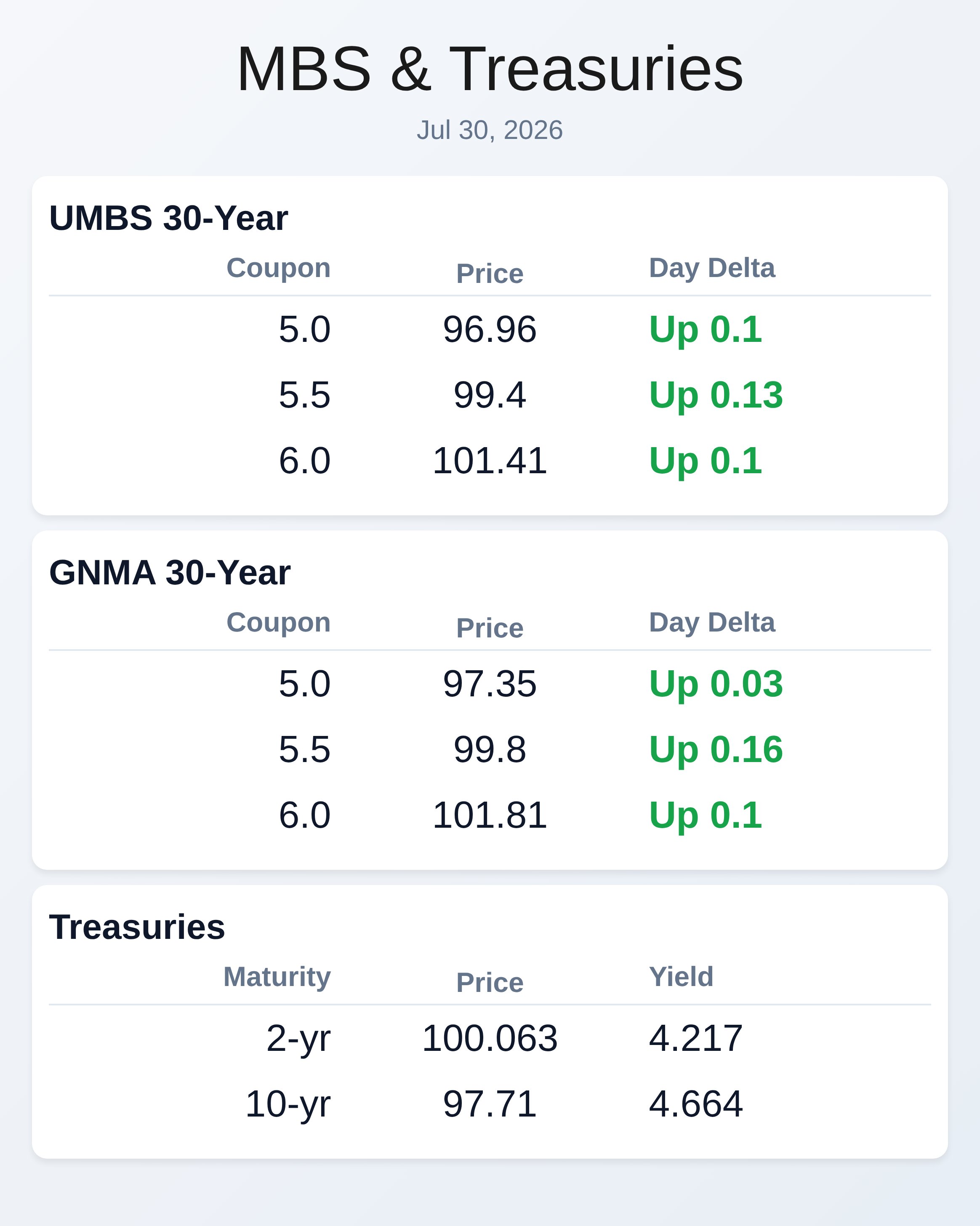
**UMBS 30 yr**
| Coupon | Price | Intra-Day Change |
| 5.0 | 96.96 | 0.1 |
| 5.5 | 99.4 | 0.13 |
| 6.0 | 101.41 | 0.1 |
**GNMA 30 yr**
| Coupon | Price | Intra-Day Change |
| 5.0 | 97.35 | 0.03 |
| 5.5 | 99.8 | 0.16 |
| 6.0 | 101.81 | 0.1 |
**Treasuries**
| Term | Yield | Price | Intra-Day Yield Change |
| 2yr | 4.217 | 100.063 | -0.056 |
| 3yr | 4.277 | 99.576 | -0.053 |
| 5yr | 4.37 | 100.024 | -0.033 |
| 7yr | 4.514 | 99.176 | -0.029 |
| 10yr | 4.664 | 97.71 | -0.016 |
| 30yr | 5.209 | 96.843 | 0.007 |