**WTMS Blog Today = What’s up in Mortgage Today (PM) – 11/18/2026**
Retail sales beat expectations at 0.2% month-over-month in October, surpassing the 0.1% forecast and signaling continued consumer spending resilience despite rising mortgage rates. The stronger reading reinforces Federal Reserve officials’ conviction that multiple rate increases remain likely through spring 2027, with St. Louis Fed President Alberto Musalem stating that “several” hikes will be needed to achieve price stability by that timeline.
This hawkish messaging has kept the 10-year Treasury yield elevated above 5.1% as market participants price in quarter-point increases in December and January, creating headwinds for mortgage originators seeking to attract borrowers. Homebuilders are leveraging powerful financing incentives to lock in new home purchasers, offering rates with a 114-basis-point advantage over what independent loan originators can match in today’s market. The incentive gap represents a structural competitive disadvantage for traditional LOs competing for purchase business, as builders bundle attractive financing offers directly with home sales and effectively convert mortgage origination into part of the builder’s overall sales advantage.
For lenders without builder partnerships, the path forward requires shifting conversations toward true cost of financing, long-term value, and total loan cost rather than rate alone. Mortgage origination economics continue deteriorating across the industry, with independent mortgage banks losing an average of $30 per loan in the third quarter of 2026 after recording a $973 profit in the second quarter. Production costs have climbed to $11,615 per loan, devastating profitability even during what should be the mortgage industry’s highest-volume quarter.
Fitch Ratings has shifted Pennymac, Freedom Mortgage, and Planet Home Lending to negative outlooks, citing rising leverage, MSR exposure, and poor earnings as the primary drivers of the downgrade. FHA delinquencies reveal a troubling concentration of repeat defaulters with minimal sustainable improvements, as 15,000 borrowers have experienced 10 or more serious delinquency episodes over their loan lifetimes. The agency identified 320,000 borrowers who defaulted multiple times within just 24 months and another 230,000 with at least five separate serious-delinquency episodes, underscoring the difficulty in converting temporary loss mitigation into permanent cures.
Higher borrower debt-to-income ratios, increasing use of down payment assistance, and risk layering in the FHA portfolio create structural vulnerabilities for nonbank servicers who must advance payments and manage liquidity during prolonged delinquency periods. Mortgage Solutions Financial is shifting its origination business to Fairway on November 30, retaining its brand identity while gaining access to a larger platform as consolidation continues reshaping the competitive landscape. Fairway is absorbing approximately $1.1 billion in production from the transaction, allowing the lending team to operate independently while leveraging the parent company’s focus on servicing and portfolio management.
This move exemplifies the accelerating trend of independent lenders seeking strategic partnerships or outright acquisition as rising costs and shrinking volumes make standalone operations increasingly unsustainable. CFPB submitted a revised mortgage servicing rule to the White House for review, bringing potential changes to foreclosure protections and loss mitigation options closer to implementation under the new administration. The updated rule, descended from the controversial 2024 proposal that sought to expand borrower protections, remains undisclosed pending White House review and could significantly reshape servicer obligations regarding payment deferrals, modification options, and borrower outreach requirements.
Servicers should monitor this rulemaking closely as it may impose operational and compliance costs that differ substantially from the Trump administration’s deregulatory agenda.
**Locking vs Floating**
Bonds have exited their October rally trend and remain in a defensive posture despite stock market volatility and systemic concerns. The 10-year yield has held above 5.1% despite intraday flights to safety, signaling that any rate decline will require sustained evidence of new bullish momentum in fixed income.
Borrowers closing within 30 days should consider locking given the Fed’s persistent hawkish messaging and ongoing inflation concerns.
**Today’s Events**
Retail Sales Control Group: 0.6% actual vs. 0.4% forecast (October)
NY Fed Manufacturing: 7.8 actual vs.
18.0 forecast (reported earlier)
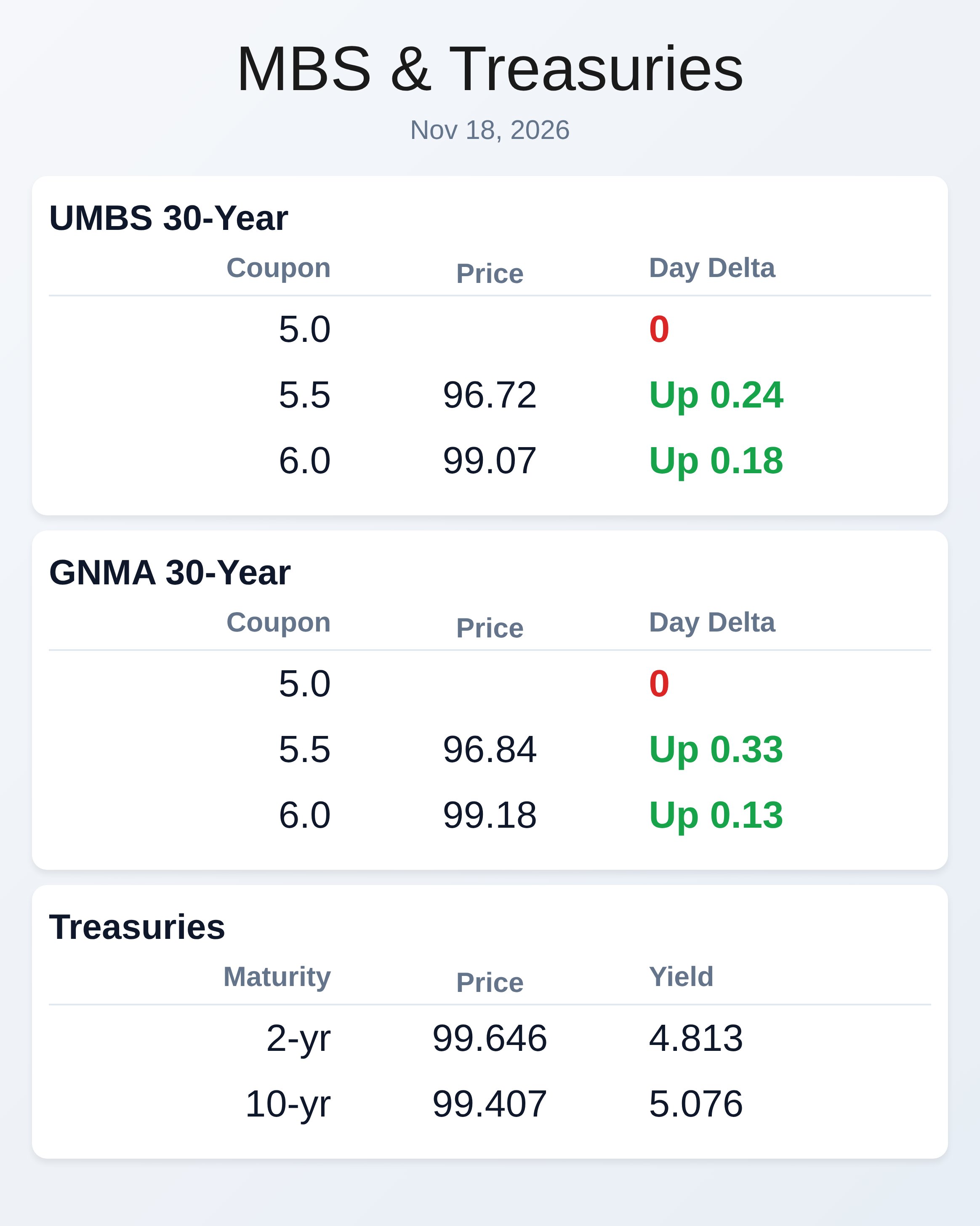
**Bond Pricing**
**UMBS 30 yr**
| Coupon | Price | Intra-Day Change |
**GNMA 30 yr**
| Coupon | Price | Intra-Day Change |
**Treasuries**
| Term | Yield | Price | Intra-Day Yield Change |