
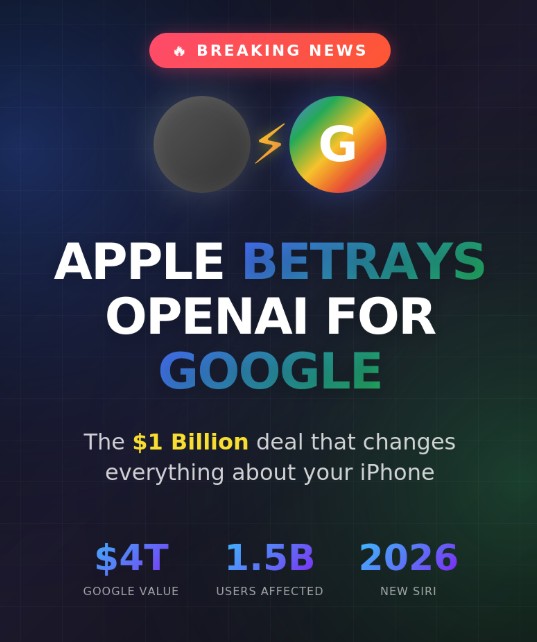
Apple Just Betrayed Its Best Friend for Google
And It Could Change Everything About Your iPhone Forever
6 min read
Plot twist of the century: Apple and Google, two of the fiercest rivals in tech history, just announced they’re teaming up on artificial intelligence. Yeah, you read that right. The same companies that have been throwing shade at each other for over a decade are now best friends in the AI game.
On Monday, the tech world collectively lost its mind when Apple and Google revealed a multi-year partnership that will put Google’s powerful Gemini AI at the heart of Apple’s products—including a completely revamped Siri that’s actually, finally, supposed to be good.
This isn’t just tech industry gossip. This deal affects 1.5 billion iPhone users worldwide—probably including you—and it’s reshaping the entire AI race as we know it. Let’s break down what’s happening, who wins, who loses, and why you should care.
What’s Actually in This Deal?
Here’s the short version: Apple is paying Google an estimated $1 billion per year to use Google’s Gemini 3 AI model—a massive 1.2 trillion parameter brain—to power the next generation of Apple Intelligence features.
What does that mean in plain English? The AI that runs behind Siri, helps you write emails, suggests photos, and basically makes your iPhone feel smart? That’s about to get a serious upgrade, courtesy of Google’s technology.
Apple’s official statement was basically a mic drop for Google: they said that “after careful consideration,” Google’s AI technology “provides the most capable foundation for Apple Foundation Models.” Translation? Apple tried everyone else—including ChatGPT maker OpenAI—and decided Google was the best.
If You’re a Google Fan: Time to Celebrate
Remember when everyone thought Google was getting absolutely destroyed by ChatGPT? When Google’s early AI attempts were embarrassingly recommending people put glue on their pizza? Those days are officially over.
This deal is Google’s ultimate comeback story. The company’s market cap just shot past $4 trillion—yes, trillion with a T—making it one of the most valuable companies on the planet. Google’s Gemini 3 model is now widely considered among the best AI systems available, and having Apple publicly endorse it is like getting a gold star from the popular kid at school.
But here’s the real prize: Google now has a direct line to those 1.5 billion iPhone users. That’s not just bragging rights—it’s a potential goldmine for future Google products, services, and revenue streams. Analysts are already speculating that we might eventually see Google’s Gemini chatbot app pre-installed on iPhones.
If You’re an Apple Fan: It’s Complicated
Let’s be real for a second: Siri has been kind of a joke. While everyone else was playing with ChatGPT and asking AI to write their essays, Siri was still struggling to set a timer correctly. Apple’s AI features have been delayed, disappointing, and frankly, behind the curve.
The good news? Your iPhone is about to get a lot smarter. With Google’s Gemini powering the new Siri (expected later this year), you’re finally going to have a voice assistant that can actually hold a conversation, understand context, and help you in meaningful ways. Think of it as Siri finally going to college and learning some real skills.
The concerning news? Apple—the company famous for building everything in-house—apparently couldn’t build its own AI fast enough. That’s a bit like finding out the valedictorian had to copy someone else’s homework. Analysts are calling 2026 a “make-or-break year” for Apple, and the company clearly needed this partnership to stay competitive.
One silver lining: Apple specifically chose Google partly because of privacy guarantees. Google owns its entire cloud infrastructure, which apparently gave Apple confidence that your data won’t be used to train AI models without your consent. So at least your embarrassing Siri requests might stay private.
The Big Loser: OpenAI and the Shifting AI Race
If there’s a villain origin story happening anywhere, it’s at OpenAI headquarters right now. The company behind ChatGPT—the app that basically started the entire AI craze—just watched its biggest potential partner walk into the arms of its archrival.
Until now, OpenAI was Apple’s go-to AI partner. ChatGPT was integrated into iPhones, and there were rumors that OpenAI might power the new Siri. Instead, Apple basically said “thanks, but Google’s better.”
This is a massive blow for several reasons. First, OpenAI just lost access to the world’s largest smartphone distribution channel. Second, it reinforces the narrative that Google has caught up—and maybe even surpassed—OpenAI in the AI race. When Google launched Gemini 3 late last year, OpenAI CEO Sam Altman reportedly declared a “code red” internally.
OpenAI isn’t giving up, though. They’re working on a mysterious new AI device with Jony Ive—the legendary designer who created the iPhone’s iconic look. Altman has even said he sees Apple as his company’s primary long-term rival. The AI wars are just getting started.
What This Actually Means for You
Let’s cut through the corporate drama and get to what matters: how does this affect your daily life?
If you have an iPhone, expect Siri to finally become useful later this year. We’re talking about an assistant that can actually understand complex requests, have back-and-forth conversations, and help you with real tasks—not just set alarms and play music.
If you’re an Android user, this deal means Google is doubling down on AI. Expect even more Gemini features coming to your devices as Google rides this momentum.
And for everyone? This is proof that the AI race is heating up faster than ever. The tech giants are betting billions that AI assistants will become the primary way we interact with our devices. Your phone is about to become a lot more like a helpful friend and a lot less like a fancy calculator.
The Bottom Line
The Apple-Google AI partnership is one of the biggest tech stories of the year, and we’re only in January. It represents a fundamental shift in how the biggest companies in the world are approaching artificial intelligence—and it’s a clear signal that AI is no longer a “someday” technology. It’s the main event.
For consumers, this is mostly good news: better AI features, more competition, and companies fighting hard to win your attention. For the tech industry, it’s a reminder that even the mightiest rivalries can turn into partnerships when trillions of dollars are on the line.
One thing’s for sure: the next time you ask Siri a question and actually get a helpful answer, you’ll have Google to thank for it. How’s that for a plot twist?