**WTMS Blog Today = What’s up in Mortgage Today (AM) – 07/31/2026**
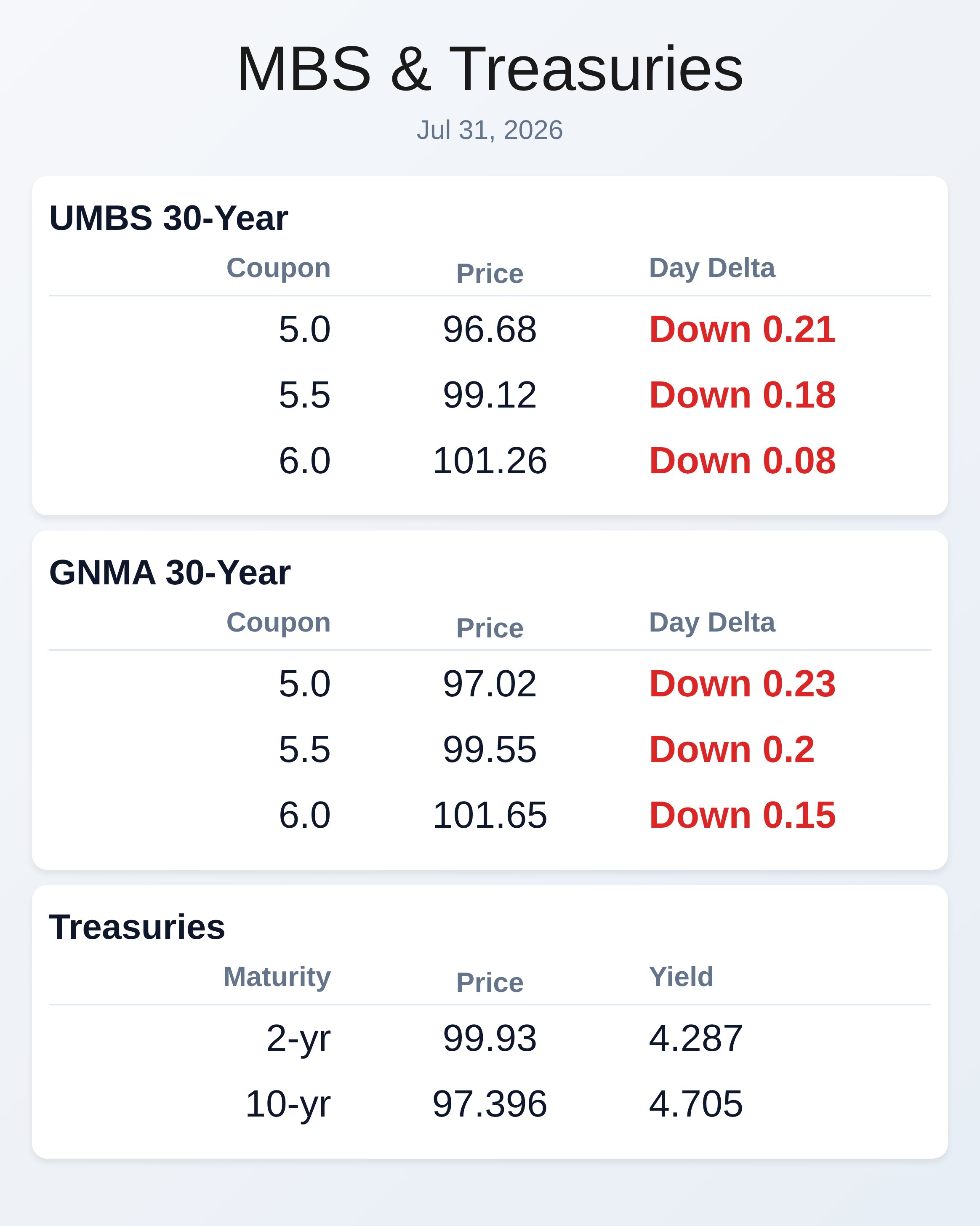
Employment cost inflation came in hotter than expected, pushing bonds weaker and causing UMBS 5.5s to trade down about 0.18 points as the 10-year yield rose to 4.70%. Japan’s currency intervention overnight and rising oil prices added selling pressure, but markets are taking the move in stride after Fed Chair Warsh signaled that rate decisions will be driven by data, not forward guidance. The bond market’s “protest” against Warsh policy messaging appears to have cooled from worst-case scenarios, allowing traders to focus on technical levels rather than policy shock.
MBS prices remain under pressure, but the intraday weakness is modest given the negative inputs. This represents a meaningful shift: risk-averse clients can hold their ground while risk-takers watch familiar yield ceilings for bounce opportunities. A top mortgage loan officer’s guilty plea is shaking the industry’s compliance culture.
Christopher Gallo, once among the nation’s most productive loan officers, pleaded guilty to conspiring to commit bank fraud for systematically falsifying property occupancy status from 2018 through 2023, allowing borrowers to qualify for lower rates on investment properties disguised as primary residences. His scheme operated at two major firms and could result in 30 years in prison at December sentencing. Lender reputations depend on document integrity and borrower truthfulness; any evidence of systematic falsification triggers immediate regulatory scrutiny and potential loss of selling authority.
The guilty plea underscores that enforcement remains sharp despite industry headwinds. First-time buyers are driving Fannie Mae’s strongest quarter since the housing recovery began. The mortgage giant reported $4 billion in net income for Q2 2026, its 34th consecutive profitable quarter, fueled by $72.8 billion in single-family purchase acquisitions—the highest quarterly volume since Q3 2022—with nearly 55% of purchases going to first-time homebuyers.
This cohort’s dominance signals that lower-income and credit-constrained borrowers remain central to origination pipelines even as rates hold elevated. Refinance volume declined 12.3% as rates stay sticky, though it remains more than double year-ago levels. Serious delinquency held steady at 0.58%, reflecting borrower resilience.
Median mortgage payments fell $7 month-over-month despite higher rates, a sign that loan sizes are shrinking as affordability constraints bite harder. The MBA’s affordability index declined 0.3% to 157.9, yet household income growth of 4.6% year-over-year means payments are consuming a smaller income share than a year ago. New construction bucked the trend with payments rising $26 to $2,199, signaling builder strength in premium segments.
Idaho, Nevada, and Arizona remain least affordable; Louisiana and D.C. rank most affordable. Originators should expect continued volume concentration in starter segments and geographic pockets where payment-to-income ratios remain favorable.
Reverse mortgage opportunities are being overlooked by mainstream lenders targeting younger demographics. Senior home equity surged to a record $14.92 trillion in Q1 2026, representing an estimated $314.8 billion increase in home values among ages 62 and older, even as senior-held mortgage debt increased modestly. Hundreds of thousands of Americans turn 62 monthly; establishing reverse mortgage divisions requires far less capital complexity than wholesale lending expansion.
Lenders capturing this segment differentiate their product mix while tapping a defensive asset base with lower default risk. Treasury yields hit their highest levels in 19 years as fiscal concerns, persistent inflation expectations, and policy uncertainty weigh on long-duration bonds. The 30-year yield closed at 5.24%, up 24 basis points intraday, while the 2-year held at 4.29%.
Curve steepening accelerated yesterday as investors absorbed the message that Fed guidance matters less than incoming data, reducing the “Warsh shock” premium that drove selling early in the week. Longer-dated yields now do “the tightening the Fed is not doing,” potentially improving servicing margins but creating customer acquisition challenges for loan officers. August trading books are thin, meaning modest economic data could spark outsized moves.
**Locking vs Floating**
Bond market momentum has shifted meaningfully after Wednesday’s Fed messaging reduced policy shock fears. Risk-averse clients should wait for legitimate, sustained rally confirmation before moving to floating-rate lock strategies; yields bouncing off familiar technical ceilings do not yet signal trend reversal. Risk-takers can eye technical levels for tactical entry points, though the negative bias risk has diminished significantly now that the worst-case policy outcomes are off the table.
**Today’s Events**
Q2 Employment Cost Index: 0.8% forecast (actual: 0.9% vs. 0.9% prior)
July Chicago PMI: 56 forecast (prior: 56.7)
Final July University of Michigan Consumer Sentiment
**Bond Pricing**
**UMBS 30 yr**
| Coupon | Price | Intra-Day Change |
| 5.0 | 96.68 | -0.21 |
| 5.5 | 99.12 | -0.18 |
| 6.0 | 101.26 | -0.08 |
**GNMA 30 yr**
| Coupon | Price | Intra-Day Change |
| 5.0 | 97.02 | -0.23 |
| 5.5 | 99.55 | -0.20 |
| 6.0 | 101.65 | -0.15 |
**Treasuries**
| Term | Yield | Price | Intra-Day Yield Change |