**WTMS Blog Today = What’s up in Mortgage Today (AM) – 11/20/2026**
Homebuilder confidence crashed to its lowest level since April 2012 this week, with the NAHB Housing Market Index plummeting four points to 25 as mortgage rates above 7% and consumer uncertainty choke buyer traffic and demand. The severity of the decline reflects a structural affordability crisis: 46% of builders cut prices in November—the highest share since the pandemic—while 68% are now offering sales incentives just to move inventory. This represents a complete reversal from earlier in the year and signals builders’ desperation to maintain cash flow even at thinner margins.
Mortgage rates surged to 7.28% by Friday, ending a four-week downtrend and erasing recent relief borrowers had enjoyed from the mid-November dip. The rebound followed inflation data showing hotter-than-expected consumer price pressures, which revived Fed rate-hike expectations and pushed 10-year Treasury yields higher across the week despite significant equity market turbulence. With the 30-year rate now back to near its early November high of 7.40%, refinance activity has virtually disappeared, leaving production pipelines starved for the most profitable volume originators rely on.
The mortgage banking business crumbled in the third quarter of 2026, with independent mortgage banks reporting an average pre-tax net production loss of $30 per loan versus a $973 profit in Q2. Per-loan production costs ballooned to $11,615 while revenue fell to $11,585, creating a razor-thin margin that turned 56% of IMBs unprofitable. Without mortgage servicing income, only 44% of lenders would have remained profitable, underscoring how critical MSR valuation improvements have become to survival as production economics deteriorate.
Artificial intelligence sector volatility roiled financial markets throughout the week, with Anthropic’s record $107.3 billion IPO launching strong but failing to hold gains as doubts about AI spending sustainability spread globally. The Nasdaq 100 entered correction territory, equities posted their longest losing streak since September 2023, and risk-off flows sparked a Treasury rally as investors fled to safety—a dynamic that inverted the typical relationship between stocks and bonds seen throughout 2026. Tech weakness and questions about whether AI capex can deliver returns large enough to justify its scale are pressuring both equity and credit markets heading into year-end.
Household financial stress is intensifying as real wages declined 0.6% year-over-year through September while PCE inflation sits at 3.6%, meaning everyday consumers are losing purchasing power despite historically strong headline employment numbers. Real disposable income fell 0.3% in September, and inflation-adjusted consumer spending was nearly flat, creating a painful disconnect between positive economic growth headlines and the financial squeeze families actually feel at the grocery store and mortgage office. This squeeze explains why purchase mortgage applications have sunk to 26% below the 2016–2019 annual average, even as dollar-based MBS issuance remains relatively stable.
Cybersecurity failures at major servicers drew regulatory fire this week, with Rocket and Mr. Cooper collectively fined $6.75 million by New York regulators for critical lapses in breach reporting and multifactor authentication controls. Rocket delayed reporting seven cybersecurity incidents for years in some cases, while Mr.
Cooper’s social-engineered takeover of its help desk exposed data on substantially all current and former borrowers, highlighting how compliance shortfalls during stressed operational periods can cascade into enormous financial and reputational costs for lenders already fighting profitability headwinds.
**Locking vs Floating**
No lock-versus-float data was provided in this week’s source materials. With rates having jumped 17 basis points in one week to 7.28%, borrowers currently favoring locks over floats are likely enjoying moderate rate protection after the spike, but the decision remains individual to each loan’s circumstances and pricing environment.
**Today’s Events**
No events calendar was included in the source materials for today’s date.
**Bond Pricing**
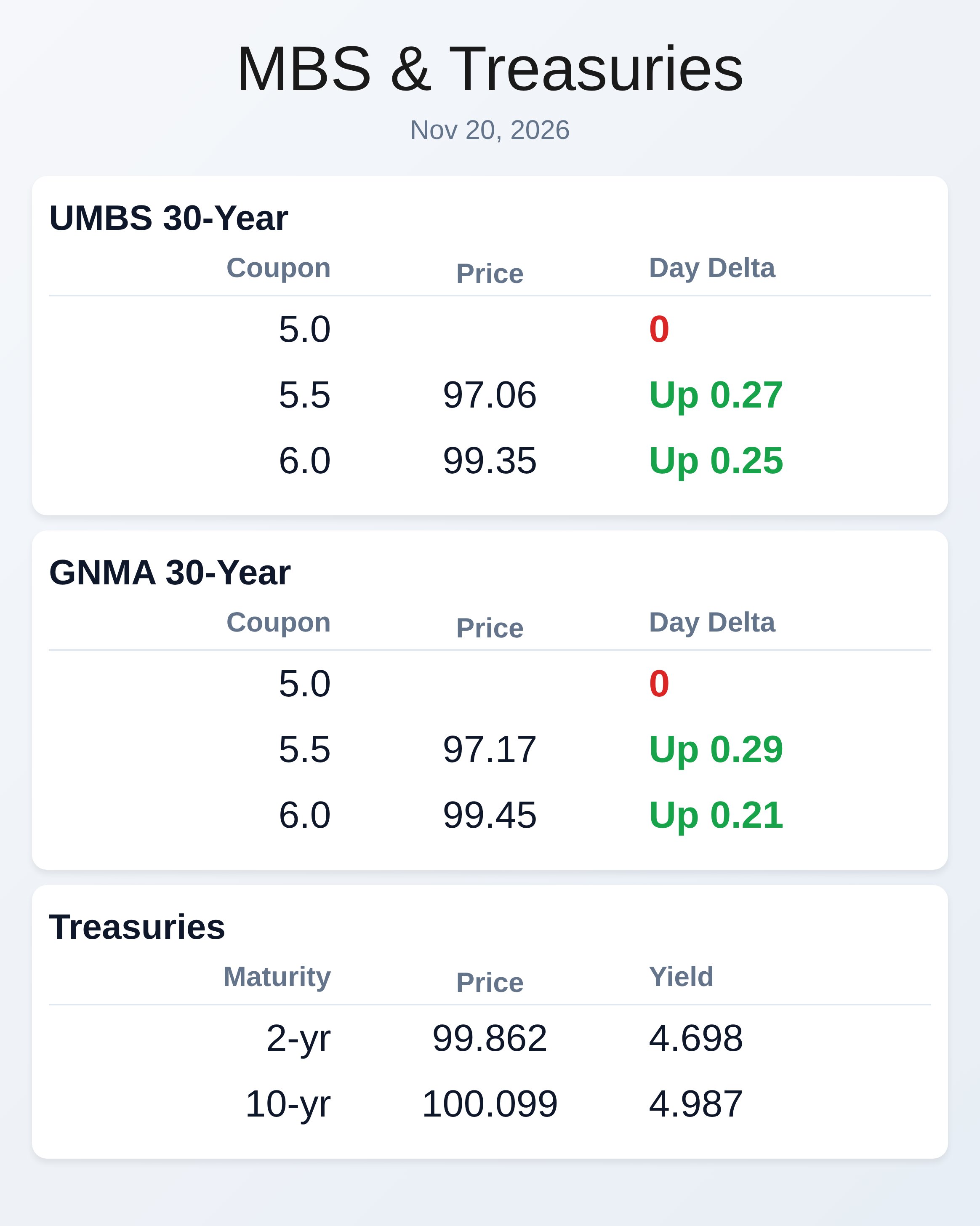
**UMBS 30 yr**
| Coupon | Price | Intra-Day Change |
**GNMA 30 yr**
| Coupon | Price | Intra-Day Change |
**Treasuries**
| Term | Yield | Price | Intra-Day Yield Change |