**WTMS Blog Today = What’s up in Mortgage Today (PM) – 05/20/2026**
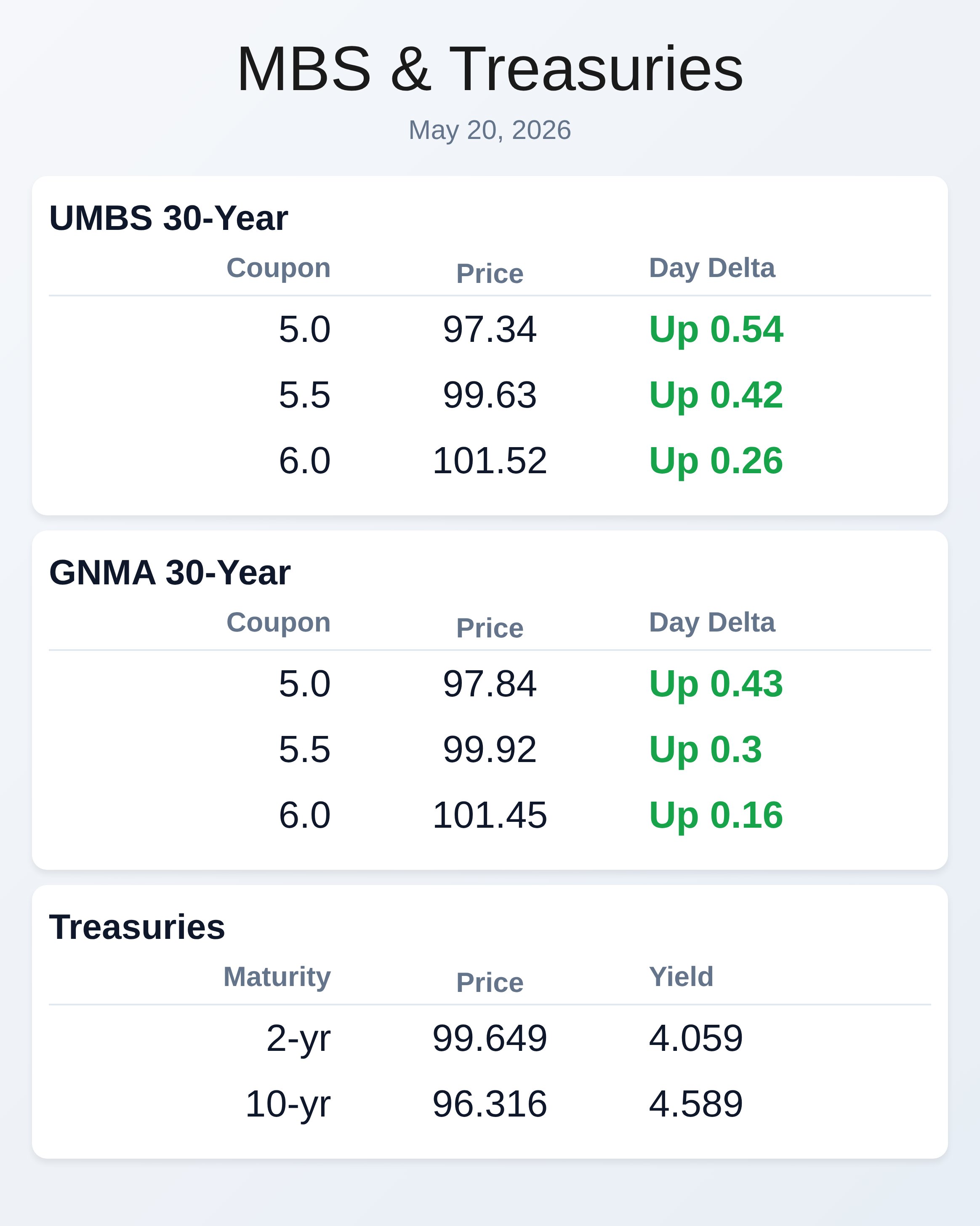
Bonds exploded higher on Wednesday with a stunning 10-basis-point rally in the 10-year Treasury, powered entirely by geopolitical optimism rather than economic data. News that U.S. and Iran peace negotiations are in final stages—with Pakistani military officials potentially announcing agreement details as soon as today—triggered broad-based buying across MBS and Treasuries.
This sharp reversal erased Tuesday’s rout and reinforces a critical lesson for loan officers: confirmed peace resolutions could spark additional rate rallies, but uncertainty remains the dominant risk factor. UMBS 5.0 closed at 97.41, up 0.60 from Tuesday’s close, while the 10-year yield collapsed to 4.567%. For originators, this intraday volatility underscores why daily rate monitoring matters more than ever.
Down payments have fallen to their lowest level since 2021 as rising inventory and moderating price growth ease the pressure that defined recent years in housing. Realtor.com’s latest data shows buyers no longer need massive cash reserves just to compete in offer wars, a structural shift with profound implications for loan structuring conversations. However, lower down payments do not mean easier lending—mortgage rates remain elevated, affordability is still strained, and FHA and VA financing have become critical tools for closing deals.
Loan officers must pivot from “winning the race to the offer table” toward helping borrowers preserve liquidity and optimize financing options. This shift favors originators who can educate clients on product selection rather than simply compete on rate. Barney Frank, the architect of post-2007 mortgage regulation, passed away at 86, leaving behind a legacy that fundamentally reshaped how every lender and servicer operates today.
The Dodd-Frank Act’s Ability-to-Repay rule and Qualified Mortgage standard ended predatory lending practices that nearly destroyed the housing market, yet the same rules now cost lenders thousands of dollars per loan in compliance overhead. Frank’s regulatory framework has proven difficult to unwind despite evolving technology and market conditions over the past 15 years. While his work achieved its primary objective—preventing another housing collapse—critics argue the blunt-force rules ignore how the modern mortgage business actually functions.
Two Harbors’ board postponed the long-anticipated shareholder vote on the CCM-UWM merger saga to at least May 28, extending investor uncertainty another week. The delayed vote frustrated market observers who expected resolution this week, but the board determined additional time was necessary to address shareholder concerns. Meanwhile, Rocket Pro announced integration of VantageScore 4.0, which has sparked industry conversation about credit score divergence: one Midwest borrower scored 600–670 on FICO Classic but 745–772 on VantageScore 4.0, a stunning 133-point gap that could dramatically alter borrower eligibility.
The credit scoring controversy highlights how different methodologies can benefit certain borrower profiles, creating arbitrage opportunities for brokers and wholesale lenders who strategically deploy competing score models. This trend will only accelerate as more players adopt alternative credit scoring frameworks. Finally, loan officers should note that inventory gains and moderating price growth are reshaping origination conversations from “how do I close this deal faster” to “how do I help my client maximize financial flexibility.” The down payment decline combined with elevated rates means borrowers need smarter structuring advice: FHA versus conventional trade-offs, purchase versus HELOC strategies, and liquidity preservation tactics.
Total Expert and other LOS providers are responding with new lead management tools designed to accelerate response times and pipeline visibility. For originators willing to evolve beyond rate competition toward financial advisory positioning, the current market environment presents significant opportunity.
**Locking vs Floating**
Market connection between bond prices and geopolitical headlines remains extraordinarily strong.
A confirmed peace deal between the United States and Iran would likely spark additional rate rallies, but high uncertainty about the timeline and ultimate resolution keeps risk bidirectional. MBS pricing continues to help with intraday portfolio management, while 10-year yield levels at 4.567% provide helpful technical ceilings and floors for locking decisions. Originators should monitor 4.59% as a resistance floor and 4.80% as a ceiling on the upside.
**Bond Pricing**
**UMBS 30 yr**
| Coupon | Price | Intra-Day Change |
**GNMA 30 yr**
| Coupon | Price | Intra-Day Change |
**Treasuries**
| Term | Yield | Price | Intra-Day Yield Change |