
The New Credit Score Reality: 4 Pros and 4 Cons That Will Actually Affect Your Business
How the shift to FICO 10T and VantageScore 4.0 will change your daily workflow, your opportunities, and your bottom line
Change in the mortgage industry typically arrives with all the grace of a drunk elephant: loud, disruptive, and leaving a mess you’ll be cleaning up for months. The transition to new credit scoring models is no exception. But unlike some regulatory changes that are all pain and no gain, this one actually comes with legitimate opportunities—if you know where to look and how to position yourself.
Let’s cut through the noise and focus on the four most significant advantages and the four biggest challenges these credit scoring changes will create for mortgage companies, loan officers, and lenders. This isn’t theory—this is what’s going to affect your pipeline, your workflow, and your wallet.
The Pros: Real Opportunities in the New Scoring Landscape
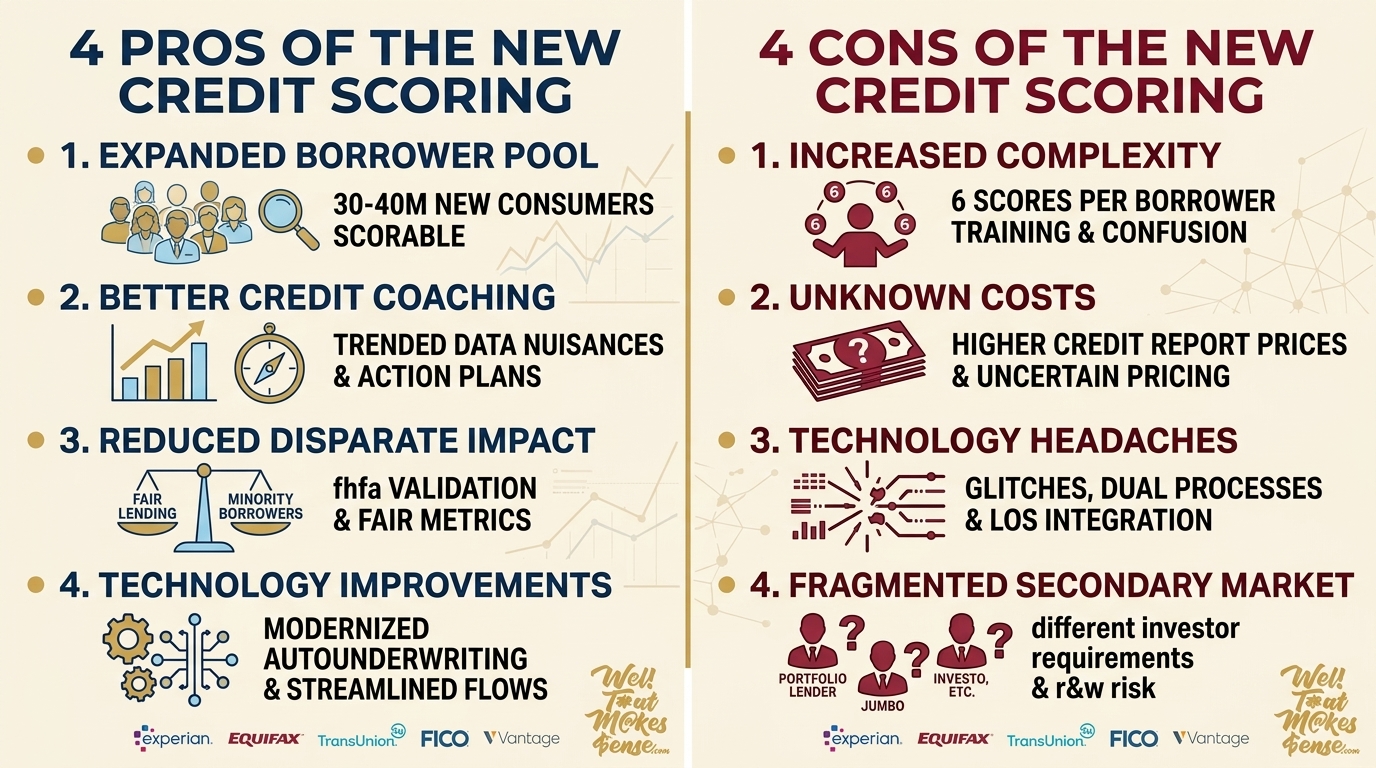
Pro #1: Expanded Borrower Pool and Competitive Advantage
The most significant opportunity is access to borrowers who were previously unqualified or marginally qualified under the old scoring models. FICO 10T and VantageScore 4.0 are both designed to evaluate a broader range of credit behaviors, particularly benefiting borrowers who have improved their credit management over time or who have limited traditional credit history.
VantageScore 4.0, in particular, can generate scores for approximately 30-40 million consumers who were previously “unscorable” under traditional FICO models. These are people with thin credit files—perhaps recent immigrants, young adults, or individuals recovering from financial setbacks who haven’t yet rebuilt extensive credit histories. When alternative data like rent and utility payments are fully integrated, this number could grow even larger.
For loan officers, this translates to real opportunity. Those referral partners who’ve been sending you borrowers that “just missed” qualification? You now have a legitimate reason to revisit those applications. The borrower who had a 615 FICO score six months ago might score 635 under the new models if they’ve been demonstrating positive payment behavior. That’s the difference between an approval and a decline.
Early adopters who master these new scoring models will have a competitive edge. While your competitors are still figuring out how to explain the changes to borrowers, you can be closing loans with people they’re turning away. The originators who educate themselves first, build relationships with underwriters who understand the nuances, and can confidently explain the new scores to borrowers and real estate agents will capture market share.
Pro #2: Better Credit Coaching and Borrower Guidance
The trended data component of both FICO 10T and VantageScore 4.0 creates a new opportunity for loan officers to provide more sophisticated credit coaching. Under the old models, you’d tell borrowers to pay down balances and avoid new inquiries. That advice still applies, but now you can provide much more nuanced guidance.
Because the new models reward consistent payment behavior over time, you can work with borrowers who are 6-12 months away from qualifying to develop specific action plans. A borrower who’s been making minimum payments on credit cards? Show them how consistently paying more than the minimum for six months could boost their score significantly under FICO 10T, even if their overall utilization doesn’t change dramatically.
This transforms your role from simple transaction facilitator to trusted financial advisor. Borrowers who receive this level of guidance become clients for life—and referral sources. The loan officer who helped someone improve their credit score by 40 points and qualify for a home doesn’t just earn one commission; they earn a relationship that produces referrals for years.
Additionally, because you’ll be seeing both the new and old scores during the transition period, you can identify specific credit behaviors that are helping or hurting borrowers under each model. This creates legitimate value-add conversations with borrowers that differentiate you from competitors who are just running credit and hoping for the best.
Pro #3: Reduced Disparate Impact and Fair Lending Benefits
From a compliance and business development perspective, the new scoring models potentially reduce fair lending risk. The FHFA’s validation process specifically examined whether FICO 10T and VantageScore 4.0 reduce disparate impact on protected classes compared to the classic FICO models.
The data suggests that both new models produce higher scores on average for minority borrowers, particularly Black and Hispanic applicants, compared to the old FICO models. This isn’t about lowering standards—it’s about more accurately assessing creditworthiness by incorporating more sophisticated analysis of payment behavior over time.
For mortgage companies, this means potentially better fair lending metrics and reduced regulatory risk. For loan officers, it means more opportunities to serve diverse communities and expand into markets that may have been underserved by traditional lending criteria.
This also creates partnership opportunities with housing counseling agencies, community development organizations, and affordable housing initiatives. Organizations that work with first-time homebuyers and underserved communities will be looking for lenders who understand and can leverage the new scoring models to maximize approval rates. Position yourself as that expert, and you’ve got a referral pipeline that competitors can’t easily replicate.
Pro #4: Technology and Automation Improvements
The infrastructure investments required to implement the new scoring models are forcing the entire industry to modernize. Fannie Mae’s Desktop Underwriter and Freddie Mac’s Loan Product Advisor are being updated with more sophisticated algorithms that can better evaluate the new scores in context.
For lenders willing to invest in their technology stack, this creates opportunities to streamline workflows and reduce manual intervention. Better automated underwriting means faster approvals, fewer conditions, and improved borrower experience. In a competitive market where speed matters, these improvements translate directly to closed loans.
Additionally, the credit reporting agencies are enhancing their platforms to deliver the new scores more efficiently. Lenders who integrate these enhanced platforms into their loan origination systems can reduce errors, minimize re-pulls, and provide faster service to borrowers. The companies that view this transition as an opportunity to upgrade their entire credit evaluation workflow—not just swap one score for another—will emerge more efficient and more profitable.
The Cons: Real Challenges You’ll Need to Navigate
Con #1: Complexity and Training Requirements
The most immediate challenge is the dramatic increase in complexity. Instead of one set of FICO scores, you’re now dealing with potentially six scores per borrower (three FICO 10T and three VantageScore 4.0). Understanding which score to use, how to explain discrepancies to borrowers, and how to navigate scenarios where the two models produce significantly different results requires substantial training.
For mortgage companies, this means significant investment in training programs. Every loan officer, processor, and underwriter needs to understand the new models. This isn’t a one-hour webinar situation—this is comprehensive training on credit scoring methodology, fair lending implications, and practical application in underwriting decisions.
For individual loan officers, the learning curve is real. You’ll need to invest time understanding how trended data works, why a borrower might score differently under each model, and how to explain this to borrowers who are already confused by having three different scores from three different bureaus. The borrower conversation just got significantly more complicated.
There’s also the challenge of inconsistent knowledge across the industry. During the transition period, you might understand the new scores perfectly, but the real estate agent, the home inspector, and the closing attorney won’t. You’ll spend time educating everyone in the transaction chain, which slows down deals and creates friction.
Con #2: Increased Costs and Uncertain Pricing
Credit reports are about to get more expensive, and nobody’s quite sure by how much. Under the old system, you paid for a tri-merge report with three FICO scores. Under the new system, you’re getting six scores (or potentially more if lenders choose to pull both old and new scores during the transition).
FICO has historically charged premium pricing for newer score versions. FICO Score 9, for example, costs more than the classic FICO scores. FICO 10T will likely follow the same pattern. VantageScore’s pricing for mortgage lending hasn’t been fully disclosed, but it’s unlikely to be cheaper than current FICO pricing—the credit bureaus didn’t create a competitive scoring model to make less money.
For mortgage companies operating on thin margins, increased credit report costs directly impact profitability. A $10-$20 increase per credit report might not sound like much, but multiply that by thousands of applications annually, and it becomes a significant line item. These costs will either need to be absorbed (reducing profit margins) or passed to borrowers (reducing competitiveness).
There’s also the question of re-scoring and credit supplements. If a borrower’s score is close to a threshold, will you need to pull multiple score types to find the most favorable option? That could mean additional costs per file. The business model for credit evaluation is changing, and the full cost implications won’t be clear until the market settles.
Con #3: Technology Integration Headaches and Operational Disruption
Every system in your technology stack that touches credit scores needs to be updated. Your loan origination system, your pricing engine, your automated underwriting interface, your point-of-sale platform, your customer relationship management system—all of it needs to be reconfigured to handle the new scoring models.
For large lenders with sophisticated IT departments, this is a manageable (if expensive) project. For small to mid-sized mortgage companies and independent brokers, this could be a nightmare. You’re dependent on your technology vendors to update their systems, and those updates won’t all happen simultaneously or smoothly.
During the transition period, expect glitches. Credit reports that don’t populate correctly in your LOS. Pricing engines that can’t interpret the new scores. Automated underwriting findings that contradict each other. Every one of these technical issues creates delays, requires manual intervention, and frustrates borrowers.
There’s also the operational challenge of maintaining dual processes during the transition. You’ll need procedures for handling both old and new score types, training staff on both, and ensuring quality control across both methodologies. This operational complexity increases error rates and slows down production.
For loan officers, this means more time spent on each file troubleshooting technical issues instead of originating new loans. It means more borrower conversations explaining delays that aren’t your fault. It means more frustration with back-office operations that used to be seamless.
Con #4: Uncertain Investor Requirements and Secondary Market Fragmentation
Here’s the challenge nobody’s talking about enough: Fannie Mae and Freddie Mac aren’t the only game in town. Portfolio lenders, credit unions, non-QM investors, and private-label securities issuers all have their own credit score requirements, and most haven’t announced whether they’ll accept the new scoring models.
This creates potential fragmentation in the secondary market. You might have a borrower who qualifies under FICO 10T for a Fannie Mae loan but doesn’t qualify under classic FICO for a portfolio product. Or a jumbo loan investor that only accepts traditional FICO scores while the GSEs require the new models. Suddenly, you need to know which score each investor accepts before you can determine loan eligibility.
For mortgage companies that sell to multiple investors, this complexity is exponential. Your underwriting guidelines become investor-specific not just on debt-to-income ratios and loan-to-value limits, but on which credit scoring model to use. Your pricing becomes more complex. Your quality control becomes more challenging.
For loan officers, this means you can’t make blanket statements about qualification anymore. “You need a 620 credit score” becomes “You need a 620 credit score under the specific scoring model accepted by the investor who will ultimately purchase this loan, which I won’t know for certain until we lock your rate and determine pricing.” That’s not exactly a confidence-inspiring conversation.
There’s also the representation and warranty risk. If you originate a loan using VantageScore 4.0 because it produced a higher score than FICO 10T, and that loan defaults, will your investor claim you should have used the more conservative score? The legal and contractual frameworks for these scenarios haven’t been fully established, which creates uncertainty and risk.
The Bottom Line: Navigating the New Normal
The credit scoring changes are neither the disaster some fear nor the panacea others promise. Like most industry shifts, they create winners and losers based primarily on how quickly and effectively companies and individuals adapt.
The loan officers and mortgage companies that will thrive are those who:
• Invest in comprehensive training early rather than waiting until they’re forced to
• View the expanded borrower pool as a genuine opportunity and build systems to capitalize on it
• Upgrade their technology infrastructure proactively rather than reactively
• Develop expertise in credit coaching and borrower guidance using the new models
• Build strong relationships with underwriters and operations staff who understand the nuances
• Communicate transparently with borrowers about the changes and what they mean
The companies that will struggle are those who treat this as a compliance checkbox—update the system, check the box, move on. The complexity and opportunities embedded in these changes reward expertise and punish complacency.
For individual loan officers, this is a career-defining moment. The originators who become known as the “credit score experts” in their markets, who can help borderline borrowers qualify through strategic credit coaching, who can navigate the complexity and explain it clearly to borrowers—those people will build businesses that competitors can’t easily replicate.
The changes are coming whether you’re ready or not. The question isn’t whether to adapt—it’s whether you’ll adapt quickly enough to capture the opportunities or slowly enough that you’re just catching up to competitors who moved faster.
The mortgage industry moves fast, and staying ahead of changes like these is the difference between leading your market and chasing it. Subscribe to Well That Makes Sense at WellThatMakesSense.com for analysis that cuts through the complexity and gives you actionable insights before your competitors figure it out. Because in this business, knowledge isn’t just power—it’s profit. And occasionally, it’s the thing that keeps you from explaining to a borrower why they have six different credit scores and none of them make sense.