
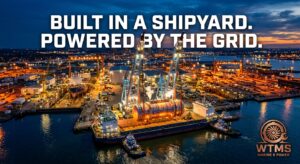
They’re Building Nuclear Power Plants in Shipyards. Yes, Really.
If you’ve ever watched a massive cargo ship get assembled at a shipyard — thousands of workers, mountains of steel, precision engineering on an almost incomprehensible scale — you already understand the core idea behind Blue Energy. This week, the MIT-rooted startup announced it raised $380 million in equity and debt financing, led by VXI Capital, to do something nobody in the nuclear industry has seriously tried before: build grid-scale nuclear power plants in shipyards, then ship them to their installation sites via barge. Their first project is a 1.5 gigawatt plant slated to begin construction later this year in Texas.
Here’s the clever part — Blue Energy isn’t designing a new reactor. They’re rethinking how reactors and power plants are built. The company uses proven light water reactor technology (the same kind that has powered naval submarines for decades) and focuses its innovation on the construction process itself. Their approach aims to slash capital costs from over $10,000 per kilowatt down to $2,000 per kilowatt, and compress build times from 10 years to just 2 years — by moving the work off chaotic, one-of-a-kind construction sites and onto the kind of repeatable, precision assembly lines that shipyards already excel at.
Why This Actually Matters
The world has a serious electricity problem that isn’t going away. Global electricity demand is accelerating, driven by AI data centers, electric vehicles, manufacturing reshoring, and population growth in developing nations. Renewables like solar and wind are expanding fast, but they have a fundamental limitation: the sun doesn’t always shine and the wind doesn’t always blow. Storing that energy at scale remains expensive and technically challenging. What the grid increasingly needs is something renewables can’t provide on their own — large amounts of clean, always-on power that shows up whenever it’s needed.
Nuclear is the obvious candidate, but its track record in the modern era has been rough. Nuclear energy’s expansion has stalled at roughly 19% of U.S. electricity production, burdened by decade-long construction timelines and multi-billion dollar cost overruns. Recent high-profile projects — like the Vogtle plant in Georgia — came in years late and billions over budget, shaking investor confidence and making utilities hesitant to commit. The industry has talked about modular reactors and prefabricated designs for years, but few have made the leap from whiteboard to construction site with a credible financing plan behind them.
Blue Energy’s $380 million raise changes that narrative in an important way. The company has been engaged with large infrastructure funds and major project financing banks, which signals that serious institutional capital believes this approach is financeable — the highest bar any infrastructure project has to clear. Globally, countries from France to South Korea to Japan are revisiting nuclear as a cornerstone of their long-term energy strategies. A credible American company demonstrating that nuclear can be built faster and cheaper doesn’t just matter for Texas — it could become a template for energy development on every continent that has a coastline or a navigable river.
What About the Alternatives?
Solar and wind remain cheaper to build per unit of capacity today, and they’ll continue to grow. But utilities and grid operators are increasingly honest about the fact that a grid running on renewables alone requires enormous investment in battery storage, long-distance transmission lines, and backup generation — costs that often don’t show up in the headline price comparisons. Natural gas fills that gap today, but it comes with fuel price volatility and carbon emissions. Advanced fission startups like TerraPower and X-energy are working on next-generation reactor designs that could eventually offer even more flexibility, but most are still years away from commercial deployment. Blue Energy’s approach isn’t a moonshot — it’s an attempt to make proven technology actually affordable, which may be the more practical near-term path.
The Case For It
- Cost and speed that actually pencil out. By moving construction to shipyards with existing skilled workforces and assembly infrastructure, Blue Energy targets build times of two years versus the industry’s painful decade-long norm — a difference that transforms the financial math entirely.
- Reliable, always-on clean power. Unlike solar or wind, nuclear generates electricity continuously regardless of weather, making it a strong backbone for a grid that’s under increasing demand pressure from AI infrastructure, EVs, and industrial electrification.
- Scalable from day one. Blue Energy’s compact, prefabricated design allows sites to start with a single reactor and scale to gigawatts over time — giving utilities flexibility rather than forcing them to commit to a massive all-or-nothing bet upfront.
The Case Against It
- Regulatory uncertainty is real. Even with a proven reactor design, nuclear projects face lengthy NRC licensing processes. Faster construction doesn’t automatically mean faster approvals, and any regulatory snag can unwind the schedule advantages Blue Energy is banking on.
- Barge delivery limits where it can go. Moving completed plant modules via barge limits the total number of viable sites — landlocked regions without access to major rivers or coastal ports simply aren’t on the map, which caps the addressable market.
- It’s still never been done at this scale. The shipyard manufacturing model is logical and well-reasoned, but Blue Energy hasn’t built one yet. The gap between a compelling pitch and a functioning 1.5 gigawatt plant in Texas is where most ambitious energy startups have historically stumbled.
Think this is the kind of story worth following? So do we. Head over to WellThatMakesSense.com and subscribe — we translate the big tech and economic shifts into plain English, every Tuesday and Thursday. No jargon, no fluff. Just the stuff that actually matters.