
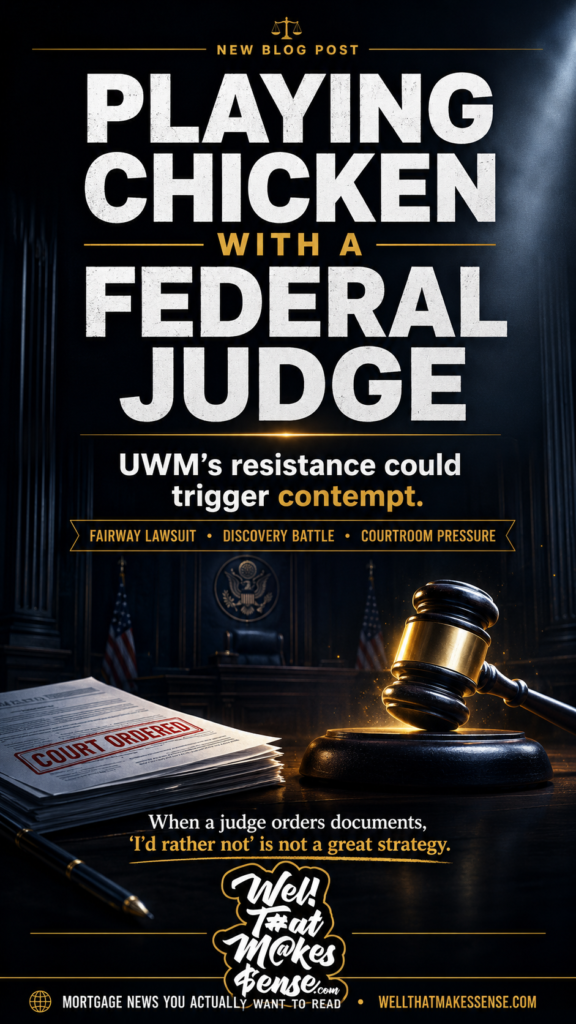
UWM’s Courtroom Drama: When “I’d Rather Not” Meets a Federal Judge
Mat Ishbia’s mortgage empire is playing chicken with contempt charges, and the stakes just got spicier than your compliance officer’s nightmare
Picture this: You’re United Wholesale Mortgage, the self-proclaimed “#1 wholesale lender in America,” and you’ve just been told by a federal judge to hand over documents. Your response? Basically, “Nah, we’re good.” Now that judge is considering holding you in contempt of court, and suddenly that swagger feels a little less comfortable. Welcome to the legal equivalent of finding out during a rate lock that your borrower’s been hiding three collections accounts and a tax lien.
If you’ve been too busy chasing refi leads to follow the drama, here’s the CliffsNotes version: UWM is embroiled in a lawsuit with Fairway Independent Mortgage Corporation over alleged anticompetitive practices. Fairway claims UWM’s infamous “All In or All Out” policy—which forced brokers to choose between working with UWM or their competitors—violated antitrust laws. The court ordered UWM to produce certain documents during discovery, and UWM has been about as cooperative as a self-employed borrower asked for two years of tax returns. Now the judge is threatening contempt charges, and things are getting spicy.
What Even Is Contempt of Court? (Besides What Your Processor Feels for You on Fridays)
Let’s break down contempt of court, because it’s not just something that happens on Law & Order reruns. Contempt comes in two delicious flavors: civil and criminal. Civil contempt is the court’s way of saying, “Do the thing we told you to do, or we’ll make your life expensive and annoying until you comply.” It’s coercive—designed to force compliance. Think of it as the judicial equivalent of your operations manager standing over your desk until you finish that conditions list.
Criminal contempt, on the other hand, is punishment for disrespecting the court’s authority. It’s the “you’ve been bad and now you’re getting spanked” version, complete with potential fines and even jail time for individuals involved. In corporate cases like this, criminal contempt can mean significant financial penalties and serious reputational damage—the kind that makes your marketing department break out in hives.
In UWM’s case, we’re looking at civil contempt proceedings. The judge wants those documents, and UWM’s resistance is being viewed as obstruction of the legal process. The court has essentially said, “We asked nicely. Now we’re asking less nicely.” For a company that’s built its brand on being bold and disruptive, this is the kind of disruption nobody ordered.
The Document Dilemma: What’s UWM So Afraid Of?
Here’s where it gets interesting for those of us in the mortgage trenches. What could possibly be in these documents that’s worth risking contempt charges? Let’s speculate responsibly, shall we?
First up: internal communications about the “All In or All Out” policy. If there are emails, Slack messages, or meeting notes where UWM executives discussed the competitive impact of forcing brokers to choose sides, that’s discovery gold for Fairway’s legal team. Imagine messages like “This will definitely hurt Rocket and Fairway” or “Brokers will have no choice but to drop our competitors.” That’s the kind of smoking gun that makes plaintiff attorneys do a happy dance.
Second: data on broker behavior and market impact. UWM likely has detailed analytics on how many brokers chose them over competitors, which brokers left their platform, and how the policy affected market share. This data could prove Fairway’s claims that UWM’s actions harmed competition. It’s one thing to say “our policy was just good business”; it’s another when your own spreadsheets show you systematically kneecapped your rivals.
Third, and this is the juicy one: communications with brokers that might show coercion or pressure tactics. If UWM representatives strong-armed brokers into compliance, threatened to cut them off, or made the choice feel less than voluntary, those communications could transform this from a “spirited competition” narrative into something that looks a lot more like market manipulation. Nobody wants their sales team’s “motivational” emails read aloud in federal court.
There’s also the possibility of financial projections and strategic planning documents that explicitly outline the policy’s intended competitive damage. Corporate strategy documents tend to be refreshingly honest about intentions—after all, they’re meant to be internal. “Destroy the competition” sounds great in a boardroom; less great when a judge is reading it to a jury.
Why This Matters to You (Yes, You, Scrolling on Your Phone Between Calls)
You might be thinking, “Cool story, but I’m just trying to close loans and hit my numbers. Why should I care about UWM’s legal drama?” Fair question. Here’s why: this case could reshape the wholesale mortgage landscape you work in every single day.
If Fairway prevails and UWM is found to have violated antitrust laws, it could open the floodgates for other lenders and brokers to file similar suits. More importantly, it could force UWM to abandon or modify policies that restrict broker choice. For brokers, that means more flexibility. For account executives, that means the competitive landscape could shift dramatically. The “All In or All Out” era might be coming to an end, whether UWM wants it to or not.
There’s also the broader industry implication: how much power should wholesale lenders have over their broker partners? This case is essentially asking whether a lender can force brokers into exclusivity arrangements in a market that’s supposed to thrive on competition and consumer choice. The answer could set precedent for years to come.
And let’s be real—there’s also the schadenfreude factor. UWM has never been shy about its aggressive marketing and competitive tactics. Watching a company that’s spent years loudly proclaiming its dominance now squirm in court has a certain entertainment value. It’s like watching the high school bully get called to the principal’s office. We’re all professional enough not to enjoy it. Mostly.
The contempt proceedings add another layer of intrigue. If UWM is held in contempt, it’s not just about this one case—it’s about their willingness to cooperate with legal processes. That raises questions about corporate culture and governance that could affect everything from investor confidence to broker relationships. Nobody wants to hitch their wagon to a company that plays fast and loose with federal judges.
As this drama unfolds, mortgage professionals across the industry will be watching closely. Will UWM finally produce the documents? Will they be held in contempt? And most importantly, what will those documents reveal about how the wholesale mortgage game has really been played? Grab your popcorn, folks. Discovery season is just getting started, and somebody forgot to redact the good parts.
Want to stay ahead of the mortgage industry’s juiciest drama without spending your lunch break doom-scrolling legal filings? Subscribe to Well That Makes Sense at WellThatMakesSense.com for the mortgage news that actually matters, served with a side of snark and zero compliance violations. We promise to make industry news way more entertaining than your company’s quarterly compliance training. (Low bar, we know.)