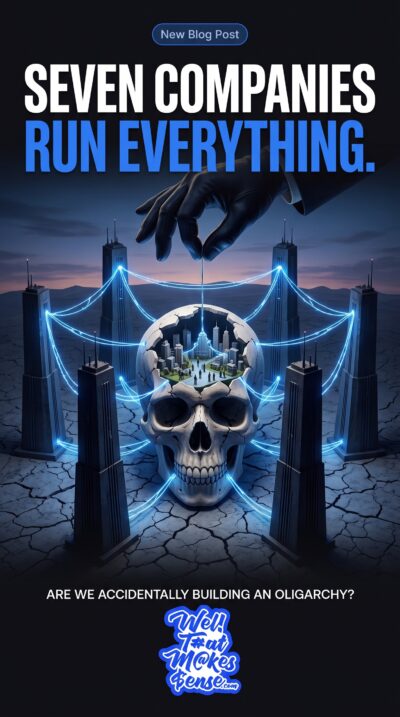

When Seven Companies Run Everything: Are We Accidentally Building an Oligarchy? (Spoiler: Maybe)
AI, trillion-dollar tech giants, and the uncomfortable question nobody wants to ask at the mortgage closing table
Let’s talk about a word that makes Americans uncomfortable: oligarchy.
It sounds like something that happens in other countries—places with suspicious elections and leaders who refuse to leave office. But here’s an awkward question worth exploring: When seven companies control $25 trillion in market value, drive the entire stock market’s performance, and increasingly determine how we communicate, shop, work, and think… what exactly do we call that? Because “free market capitalism” is starting to feel like calling a tidal wave “a little moisture.”
Before your eyes glaze over thinking this is some political rant that has nothing to do with mortgages and real estate, stick with me. The concentration of economic power in fewer and fewer hands has direct implications for housing, lending, and whether the average person can still achieve that quaint old dream called homeownership. When the economy increasingly serves seven companies and their ecosystems, everyone else—including the housing market—is operating in whatever space is left over. And that space is shrinking.
Oligarchy 101: It’s Not Just a Fancy Insult
An oligarchy, stripped of its political science jargon, is simply a system where power—economic, political, or both—is concentrated in the hands of a small group. Not a single dictator, and not broadly distributed among many participants (that’s democracy or competitive capitalism), but somewhere uncomfortably in between. A small group calls the shots, influences policy, controls resources, and essentially runs the show. Meanwhile everyone else participates in an economy increasingly designed AGAINST their interests.
Historically, we’ve seen oligarchies form around inherited wealth (aristocracies), natural resources (oil states), or industrial monopolies (the robber baron era). Today’s version is more sophisticated and wears a hoodie instead of a top hat, but the mechanics are strikingly similar. When a handful of companies dominate not just their industries but entire sectors of the economy—and when their combined worth approaches the GDP of the entire nation—we’re at minimum flirting with oligarchic structures, even if we don’t want to use that word at dinner parties.
The Magnificent Seven aren’t just big companies; they’re ecosystem creators. Amazon doesn’t just sell products; it controls the infrastructure that other businesses depend on through AWS. Google doesn’t just offer search; it determines what information billions of people see. Meta doesn’t just run social networks; it shapes political discourse and cultural trends. Microsoft, Nvidia, Apple, and Tesla each dominate critical technological infrastructure. These aren’t just market participants—they’re market makers, and increasingly, they’re the market itself.
AI: The Oligarchy Accelerator Nobody Ordered
Now add artificial intelligence to this mix, and things get really interesting (or terrifying). AI development requires three things that only massive companies possess: enormous computing power, vast amounts of data, and billions of dollars in capital. Notice who has all three? Yep, our Magnificent Seven. This isn’t a coincidence. It’s a moat so wide that potential competitors need a spacecraft to cross it, not a boat.
The AI revolution is being built almost entirely by these seven companies. They’re training the models, setting the standards, controlling the infrastructure, and determining how AI integrates into every aspect of life and business. This isn’t like previous technological shifts where multiple players competed and innovated. This is more like if one company had owned all the railroads during westward expansion, or if a single entity controlled all electricity generation during industrialization. The concentration of control over transformative technology is historically unprecedented.
Here’s where it connects to your world: As AI becomes embedded in everything from mortgage underwriting to property valuations to how homes are marketed and sold, who controls that AI matters enormously. If a handful of companies determine the algorithms that assess creditworthiness, predict property values, or match buyers with homes, they’re not just tech companies anymore—they’re gatekeepers to homeownership itself. That’s not speculation; it’s already happening. The question is whether it accelerates into something more concerning.
The Oligarchy Case: Why This Could Go Very Wrong
Let’s make the uncomfortable argument first: Yes, we could be building an oligarchic economic structure, and AI is cementing it into place. Here’s the case:
* These seven companies already exert massive influence over policy through lobbying, campaign contributions, and the revolving door between Silicon Valley and Washington.
* They shape public opinion through platforms they control.
* They determine which businesses succeed or fail based on algorithm changes, platform policies, or competitive decisions.
* And increasingly, they’re the primary drivers of economic growth, meaning what’s good for them gets defined as “good for the economy,” even when it’s not good for most people in it.
The AI component makes this worse because it creates technical barriers to entry that are essentially insurmountable. Starting a competitor to Google or Amazon was already nearly impossible; starting a competitor in the AI age is laughable. The data advantages, computational resources, and talent concentration these companies possess create a self-reinforcing cycle. >They get better at AI > which makes them more profitable > which lets them invest more in AI > which makes them more dominant > which concentrates more power. Rinse, repeat, oligarchy.
For real estate and mortgages, an oligarchic structure means less competition, less innovation that serves consumers, and more extraction of value toward these dominant players. Already, we see Amazon entering real estate services, Google dominating property search, and AI tools from these companies being integrated into lending decisions. If this trend continues unchecked, the housing market could become another sector where a few tech giants mediate every transaction, collect rents (literally and figuratively) on every deal, and optimize everything for their benefit rather than for buyers, sellers, or communities.
The Counter-Argument: Why This Might Not Be Doom and Gloom
Now the optimistic case, because fair is fair: Maybe this isn’t oligarchy; maybe it’s just really successful capitalism, and the hand-wringing is premature. These companies got big by creating products people genuinely wanted and solving real problems. Nobody forced consumers to use Google, buy iPhones, or shop on Amazon. They won in relatively fair competition. Their size reflects value created, not just power seized.
Moreover, history shows that dominant companies don’t stay dominant forever. IBM was once unassailable; where is it now? Microsoft was the unstoppable monopoly of the 1990s, yet Apple surpassed it. MySpace owned social networking until it didn’t. Markets evolve, technologies shift, and today’s giants become tomorrow’s cautionary tales. The Magnificent Seven might look invincible now, but that’s what people said about every dominant company before disruption arrived. Assuming permanent oligarchy might be giving them too much credit and underestimating human innovation.
Additionally, regulatory frameworks are evolving. Antitrust enforcement is getting more aggressive, both in the U.S. and globally. The EU has already implemented significant regulations on tech giants. American lawmakers are increasingly skeptical of Big Tech’s power. It’s possible—maybe even likely—that we’re at peak concentration, and the next decade brings fragmentation rather than further consolidation. Breaking up these companies, or at least constraining their power, could restore more competitive dynamics before oligarchy solidifies.
In the real estate context, technology could actually democratize rather than concentrate. AI tools might lower barriers to entry for new mortgage lenders, make property information more accessible, and reduce costs for consumers. Blockchain and decentralized technologies (yes, they exist beyond crypto hype) could create alternatives to centralized platforms. Innovation often comes from unexpected places, and assuming the current power structure is permanent might be premature. The same AI that empowers the Magnificent Seven could empower their competitors or replacements.
So… Oligarchy or Not? (And What It Means for Your Mortgage)
The honest answer is: We’re somewhere in between, and the direction we go isn’t predetermined. We have oligarchic tendencies—concentrated economic power, policy influence, and market control in few hands—but we haven’t fully crossed into oligarchy as a system. The next five to ten years will be decisive. If current trends continue unchecked, if AI development remains concentrated, and if regulatory efforts fail, then yes, we’re building an economic oligarchy whether we call it that or not.
But it’s not inevitable. Markets can be reformed, companies can be regulated, and competition can be fostered through policy choices. The question is whether there’s sufficient political will to do so, or whether the benefits of having extremely profitable companies driving stock market returns will outweigh concerns about concentration. That’s ultimately a societal choice, not an economic inevitability.
For those of us in real estate and mortgages, the stakes are tangible. An oligarchic economy tends to increase wealth inequality, reduce opportunities for average people to build wealth, and make essentials like housing less affordable. Homeownership—the traditional path to middle-class wealth—becomes harder when economic power and gains flow predominantly to a tiny group at the top. The housing market doesn’t exist in isolation from these broader economic structures; it reflects and reinforces them.
The good news? Awareness is the first step. Understanding that the “booming economy” might be more accurately described as “seven companies booming while everyone else treads water” helps set realistic expectations. It helps mortgage professionals counsel clients more honestly about affordability challenges. It helps buyers understand they’re not failing when homeownership feels out of reach—they’re navigating an economy increasingly tilted away from their success. And it helps all of us demand better: better policy, better competition, better distribution of economic gains.