**WTMS Blog Today = What’s up in Mortgage Today (AM) – 10/29/2026**
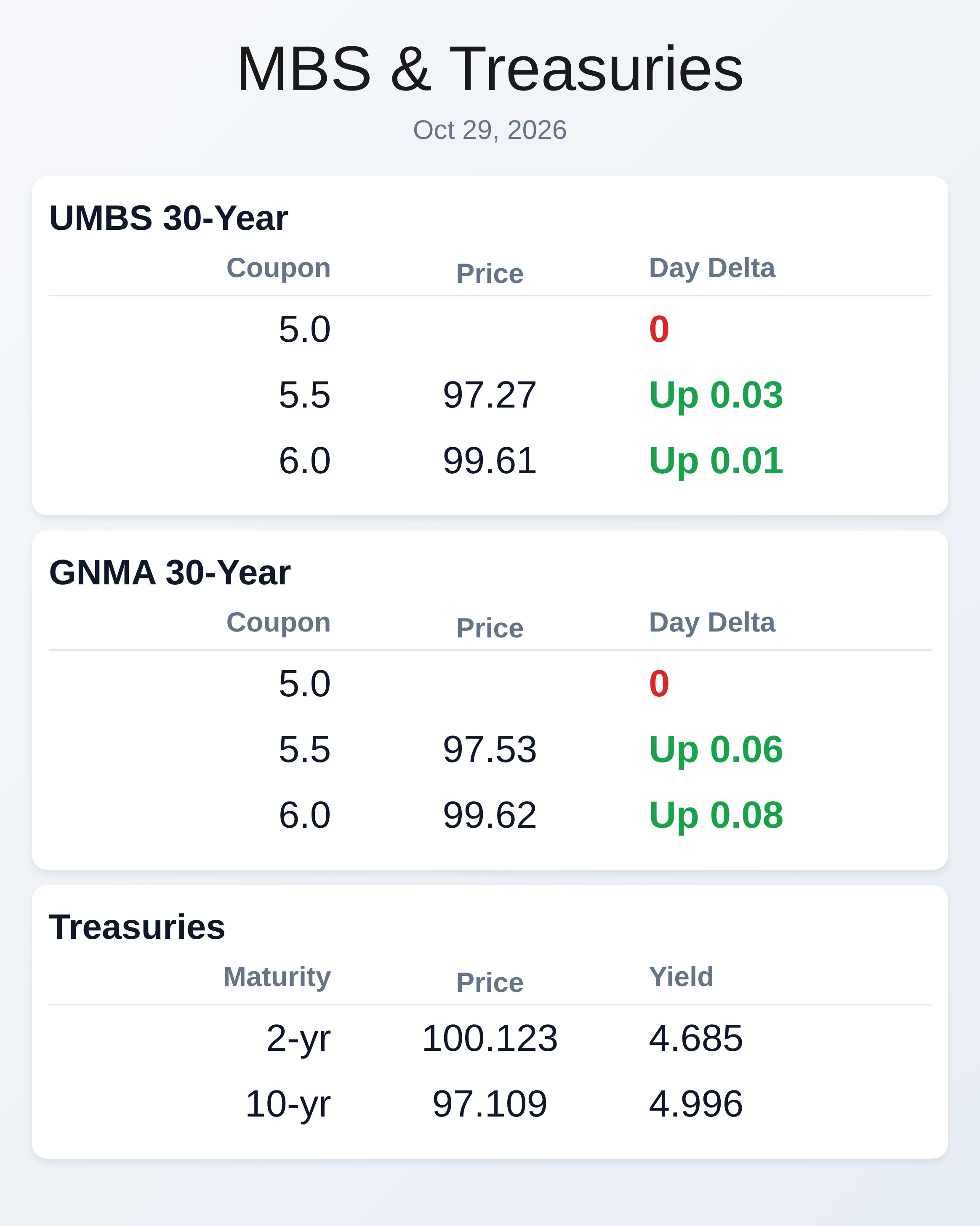
Mortgage applications rose for the second straight week as rates edged lower, yet purchase demand remains 18 percent below year-ago levels and refinancing is down 61 percent, revealing persistent affordability headwinds in a market where half of borrowers already hold sub-4 percent first mortgages. The Federal Reserve held rates steady this week at 3.75–4.00 percent as expected, but Chair Warsh’s noncommittal messaging and dismissal of forward guidance sparked volatile repricing in 2-year yields as traders scrambled to cover short positions and reassess December rate expectations. UMBS 6.0 securities weakened from mid-week highs after the Fed announcement, ending the week around 99.60 as 10-year Treasuries ranged from just under 5.00 percent to above 5.04 percent, with safe-haven flows from technology selloffs occasionally offsetting inflation worries tied to crude oil near $100–$115 per barrel.
Non-QM production continues to grow despite elevated rates, with lenders expanding product suites across bank statements, DSCR, and expanded credit-box offerings as conventional conforming pricing loses share in a market where buyers increasingly hunt for product flexibility to qualify. The Fannie Mae–Freddie Mac complex reported strong third-quarter earnings—Fannie Mae earned $4.2 billion and Freddie Mac earned $3.2 billion—while both entities announced pilots and guide updates including streamlined income calculations, property data standardization, and occupancy verification enhancements that will reshape origination workflows. Homebuilder confidence fell to its lowest level since June 2012, with new home sales sliding 0.6 percent to an annualized 676,000 units as elevated mortgage rates, high construction costs, and labor shortages continue to compress builder margins and incentivize price cuts and concessions rather than traditional financing inducements.
Lenders are reporting compressed margins and tightening competition across jumbo and home-equity channels, with some independent mortgage banks capping loan officer compensation on jumbo loans to compete with credit unions and banks operating under different cost structures. Mortgage apps remain challenged despite slight weekly gains, with purchase volume flat year-over-year and refinancing down double digits as homeowners lack refinancing incentives and household purchasing power erodes from inflation that outpaced wage growth for the sixth consecutive month. UAD 3.6 appraisal standards, effective November 2, are raising AMC fees from historical $525 to $625–$700 per report, imposing new costs that add friction to already-strained closing processes and prompt lenders to invest in AI-assisted appraisal review tools to minimize manual underwriting delays.
Employment pressure is mounting as the MBA forecasts 2027 production will fall 5 percent below $2 trillion, prompting lenders to evaluate loan officer retention strategies, shift staff to part-time status, and invest in technology to handle reduced headcount without sacrificing throughput. ARM products are gaining share as borrowers seek rate relief, with 5/1 ARM rates near 6.41 percent and ARM share reaching 11.3 percent, the highest in more than a year, signaling renewed buyer appetite for product flexibility over fixed-rate certainty. Geopolitical tensions, elevated oil prices, AI funding concerns, and midterm election uncertainty are keeping Treasury yields volatile and mortgage spreads unpredictable, while persistent delinquency risks among lower-FICO borrowers and those with high debt-to-income ratios continue to weigh on credit expectations and MSR valuations in a market where traditional safe-haven demand no longer reliably support bond prices.
**Locking vs Floating**
Pressure has built on lock positions as buyers remain cautious and rate movements introduce reprice risk for aggressive pricers. Short-covering and safe-haven flows have produced tactical rallies, but sustainability depends on whether tech-sector stabilization or new inflation signals dominate. Loan officers should balance competitive pricing against hedge losses and borrower fallout, particularly with an election week ahead and PCE data likely to rattle positioning.
**Today’s Events**
October 29, 2026: Advance Q3 GDP, September Personal Income, Personal Spending, PCE Prices, Core PCE Prices, Initial Claims, Continuing Claims, 7-year Treasury note auction, ECB monetary policy decision.
**Bond Pricing**
**UMBS 30 yr**
| Coupon | Price | Intra-Day Change |
**GNMA 30 yr**
| Coupon | Price | Intra-Day Change |
**Treasuries**
| Term | Yield | Price | Intra-Day Yield Change |