**WTMS Blog Today = What’s up in Mortgage Today (AM) – 11/03/2026**
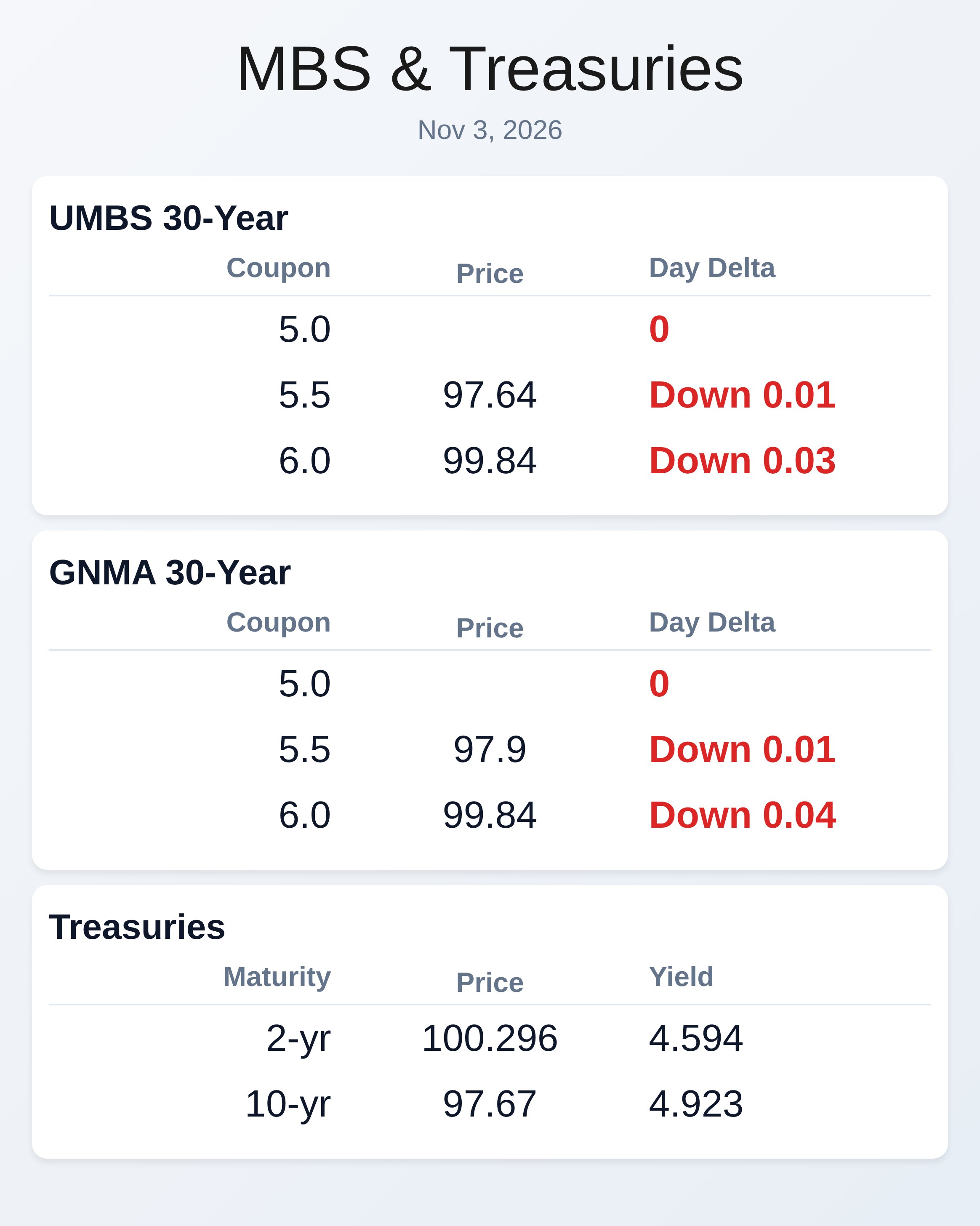
Mortgage rates held steady this week as Treasury yields declined nearly 50 basis points in October despite persistent inflation concerns. The 10-year Treasury yielded 4.93% as of Tuesday morning, down from 5.24% at month-end, driven by a flight-to-quality trade as equity market volatility spiked and artificial intelligence valuations faced scrutiny. Origination activity improved slightly, with total mortgage applications rising 3.4% last week, though purchase volume remained 18% below year-ago levels and refinancing plunged 61% year-over-year.
Non-QM and ARM products continued gaining share as borrowers searched for rate relief—non-QM climbed to 12% of production while ARM usage reached 14%, its highest level since 2019. Oil prices declined sharply on optimism around U.S.-Iran diplomatic negotiations, reducing inflationary pressure and supporting Treasury rallies that benefit mortgage-backed securities. Fannie Mae and Freddie Mac reported strong third-quarter earnings despite industry headwinds, with Freddie Mac posting $3.2 billion in net income—up 17% year-over-year—as both GSEs trimmed workforce expenses.
Accessible home equity reached $13.2 trillion in Q2 2026, but 88% of that pool remained locked behind mortgage rates below current prevailing rates, creating a significant gap between available equity and borrower refinancing incentives. UAD 3.6 appraisal format requirements take effect November 2, forcing lenders and AMCs to adopt new review policies and risking pipeline disruptions for those unprepared. The MBA released an “Affordability in Action” policy roadmap calling for reduced credit fees, lower FHA mortgage insurance premiums, and expanded use of automated valuation models and AI-assisted underwriting.
President Trump’s executive order directing agencies to lower mortgage and refinancing costs represents limited near-term impact, as implementation depends on FHFA and federal lender guidance still in development. Dark Matter acquired House Numbers’ agentic artificial intelligence platform for mortgage lending, integrating proven AI agents directly into the Empower LOS to automate document recognition and workflow intelligence. Optimal Blue acquired mortgage CRM platform Usherpa, expanding its reach into lead generation and borrower engagement while maintaining ecosystem openness for independent LOS integrations.
Newrez and eXp Realty launched Revenos Mortgage, a joint venture designed to serve eXp’s 25,000-plus agents and their clients through Newrez’s lending and servicing infrastructure. CrossCountry Mortgage sent cease-and-desist letters to at least 25 former loan officers, citing two-year non-solicitation agreements and demanding 75 basis points on each refinanced borrower loan, signaling aggressive enforcement of non-compete clauses. These industry consolidations and vendor partnerships reflect lenders’ focus on operational efficiency, lead generation automation, and integrated technology ecosystems amid compressed margins.
The mortgage industry absorbed employment uncertainty as midterm elections proceeded Tuesday, with investors cautious ahead of policy outcomes affecting fiscal spending and interest rate trajectory. Lender loan officer productivity, compensation structures, and retention strategies became focal points as independent mortgage bankers shed approximately 100 net originators in the first nine months of 2026 while broker and non-delegated channels gained 327 LOs and $7 billion in production volume. MBA Homebase launched as a new education and coaching initiative for loan officers, providing professional development and advocacy regardless of lender affiliation—signaling industry recognition that LO support and retention directly impact production stability.
September mortgage origination costs held steady around $10,700-$12,600 per loan, according to MBA data, creating pressure on profitability as volumes declined and competition for qualified borrowers intensified. Compliance requirements expanded with California and Iowa moving toward Mortgage Compliance Dataset (MCD) implementation in 2027, requiring lenders to prepare electronic transaction files in standardized format for regulatory examinations.
**Locking vs Floating**
Pipeline hedgers face two-sided risk as uncertainty persists over whether duration extension and convexity-related selling have peaked.
Further rate increases could widen mortgage spreads, while a Treasury rally could shorten MBS duration and force costly hedge adjustments. The next inflation readings and Fed’s response will shape both Treasury direction and mortgage-market stability, with basis volatility, hedge positioning, and origination profitability remaining key concerns. Strong earnings from tech and AI companies could reinforce expectations that the economy can withstand tighter financial conditions, keeping yields elevated.
Conversely, weakening demand, margin compression, or cautious guidance could expose delayed economic impact of higher rates and support Treasury recovery.
**Today’s Events**
September Business Inventories
September JOLTS Job Openings (expected 7.10M vs. 7.079M prior)
September Factory Orders
Election Day: Midterm voting underway
**Bond Pricing**
**UMBS 30 yr**
| Coupon | Price | Intra-Day Change |
**GNMA 30 yr**
| Coupon | Price | Intra-Day Change |
**Treasuries**
| Term | Yield | Price | Intra-Day Yield Change |