**WTMS Blog Today = What’s up in Mortgage Today (AM) – 11/04/2026**
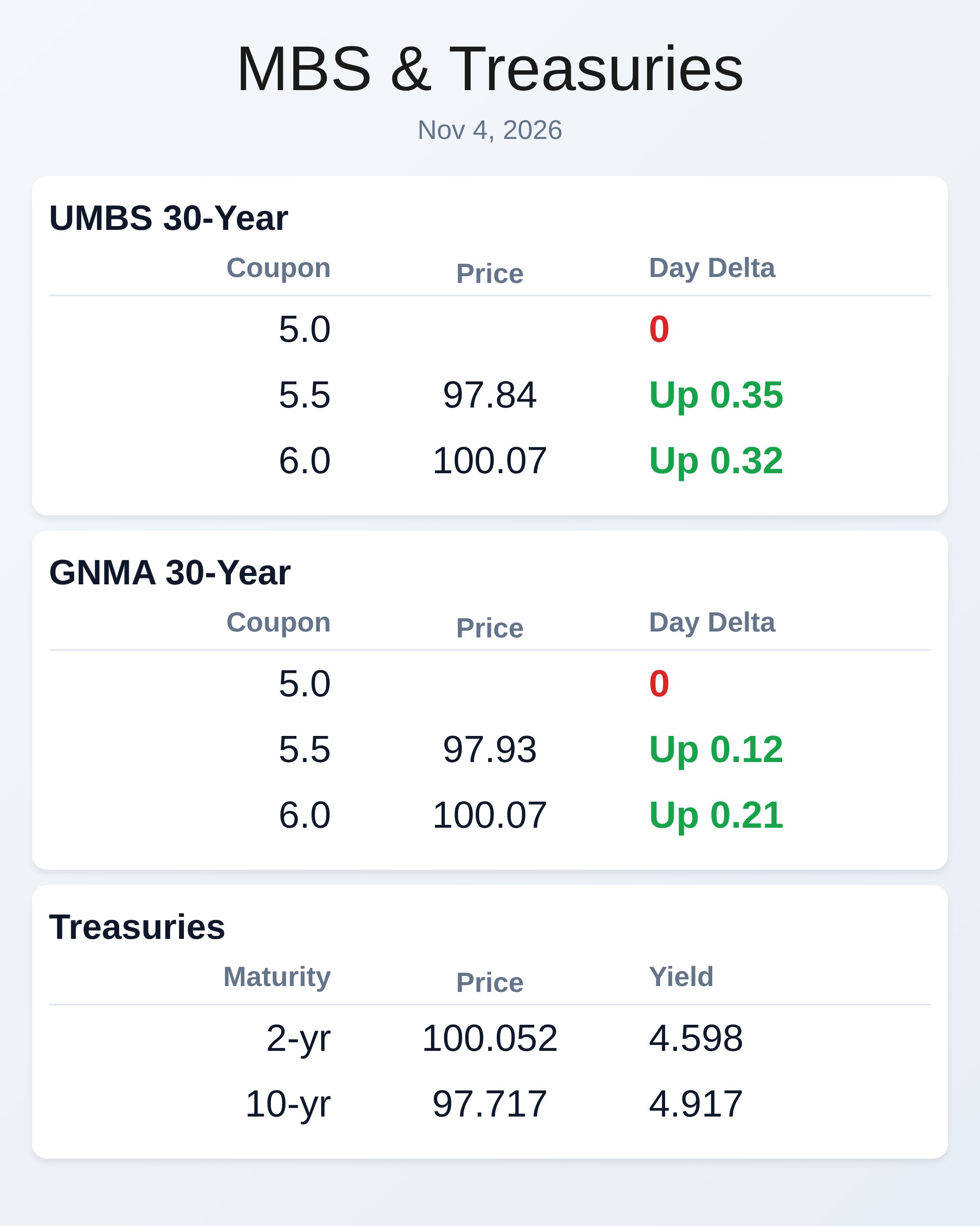
Democrats swept the midterm elections, and mortgage markets responded decisively as Treasury yields plummeted and MBS prices rallied sharply lower. The 10-year Treasury yield fell 51 basis points to 4.91 percent, driven by expectations that Democratic control of Congress will limit additional fiscal stimulus and reduce deficit-financed spending concerns. UMBS 6.0 and other agency mortgage-backed securities recovered ground as investors fled equity risk and sought safety in fixed income.
This marked a significant reversal from pre-election uncertainty, with oil prices also declining nearly 3 percent on reduced geopolitical tensions. Bond markets are now pricing in diminished likelihood of expansionary policies that would otherwise push Treasury yields higher. For mortgage lenders and originators, lower rates create an opportunity to re-engage borrowers on purchase activity and refinance conversations that have stalled since rates climbed above 7 percent.
The election outcome effectively ended months of political uncertainty that had kept markets in defensive postures. Bill Pulte’s absence from the MBA National conference last week signaled mounting friction between the FHFA and industry leaders, yet the Democratic sweep may reshape housing finance priorities away from executive directives toward legislative negotiation. Meanwhile, the industry is accelerating product mix shifts: ARM usage hit 14 percent of lock volume in September, non-QM climbed to 12 percent of production, and home equity products gained traction as cash-out refinancing remains viable despite higher rates.
Fannie Mae reported third-quarter net income of $4.2 billion, up 17 percent year-over-year, while both GSEs continue trimming staff amid transformation efforts. These dynamics underscore how lenders are adapting their playbooks across conforming, non-Agency, and home equity channels to capture opportunities in a structurally changed market. October softness in purchase applications down 19 percent year-over-year reflects persistent affordability headwinds that a 60-basis-point rally in Treasuries alone cannot solve.
Property taxes, insurance premiums, and utility costs now drive housing expense as much as interest rates, yet remain underweighted in loan qualification models. With 65.6 percent of outstanding mortgages carrying rates below 5 percent, homeowners anchored to their current loans are becoming landlords instead of moving up or relocating. Lenders who focus on borrower education around total cost of ownership, not just rate comparisons, are positioning themselves to win volume when rate expectations stabilize.
The MBA’s “Affordability in Action” roadmap and comparable industry initiatives are beginning to address closing cost reduction through appraisal waivers, title insurance pilots, and loan-level price adjustment reforms. Tech-enabled automation and AI-assisted underwriting continue reshaping mortgage operations as volumes persist below historical averages. Dark Matter’s acquisition of House Numbers’ agentic AI platform, Optimal Blue’s Usherpa integration, and widespread UAD 3.6 appraisal format adoption are examples of how lenders are modernizing fulfillment to compete on speed and customer experience rather than rate alone.
Fannie Mae’s new AI governance requirements and Freddie Mac’s mortgage compliance dataset initiative are establishing guardrails for responsible AI deployment across the industry. Lenders who invest now in auditable, explainable AI systems will gain operational advantage and regulatory confidence heading into 2027. The shift toward AI-assisted decisioning is compressing cycle times and reducing manual exceptions handling, a material efficiency gain for lenders managing leaner staffs.
Warehouse lending platforms remain critical infrastructure, with lenders like Wintrust emphasizing stability and customized capital strategies during market volatility. Independent mortgage banks have struggled with loan officer retention as production tightens, with the gap between top performers and the bottom 80 percent widening measurably. MBA Homebase, a new initiative providing loan officer education and professional development regardless of company affiliation, signals the industry’s commitment to workforce strengthening even as hiring demand has softened.
STRATMOR data shows the mortgage M&A market is heating up, with roughly double the number of sellers and four times the number of qualified buyers signaling consolidation momentum heading into 2027. For loan officers and lender leadership, this environment rewards disciplined cost management, product diversification, and borrower-centric value creation over volume chasing. Credit scoring competition is accelerating as UWM and other major lenders adopt VantageScore 4.0 across production channels, challenging traditional FICO-only models and creating new opportunities for borrowers previously excluded by conventional thresholds.
eLEND’s new 500 credit score floor on FHA cash-out loans and expanding non-Agency programs demonstrate how competitive pressure is broadening credit access. Zillow’s new down payment assistance for FHA borrowers, offering up to 3.5 percent DPA through a five-year forgivable second mortgage, signals retail lenders are aggressive on market share. CrossCountry Mortgage’s cease-and-desist letters to former loan officers over customer refinances underscore the sharper enforcement of non-compete and non-solicitation agreements in a tightening labor market.
For originators, understanding which credit scoring model your investor network prefers, and when alternative credit options genuinely expand origination capacity, is foundational to pricing competitiveness and profitability.
**Locking vs Floating**
Mortgage originators face two-sided hedge risk as duration extension concerns compete with convexity dynamics. If rates continue rising, mortgage spreads may widen and offer better execution opportunities; if Treasuries rally further, MBS duration shortens and forces costly hedge rebalancing.
Borrowers should lock now if they plan to close within 30 days, as the election-driven rally may prove temporary absent sustained disinflation signals. Pipeline hedgers should monitor whether the Fed’s December rate hike probability continues moderating and whether inflation data confirms momentum is breaking. Overall, this remains a fluid environment requiring disciplined hedging discipline and real-time market adaptation.
**Today’s Events**
10-year Treasury yield at 4.91 percent, down 51 basis points overnight following Democratic sweep of midterm elections. 30-year UMBS 6.0 trading around 99.90, better than Friday close by approximately 125 basis points. Core CPI reading of 0.335 percent versus 0.2 percent forecast triggered initial market sell-off before reversal.
Agency MBS prices improving as flight-to-quality demand offsets earlier inflation concerns.
**Bond Pricing**
**UMBS 30 yr**
| Coupon | Price | Intra-Day Change |
**GNMA 30 yr**
| Coupon | Price | Intra-Day Change |
**Treasuries**
| Term | Yield | Price | Intra-Day Yield Change |