**WTMS Blog Today = What’s up in Mortgage Today (AM) – 11/05/2026**
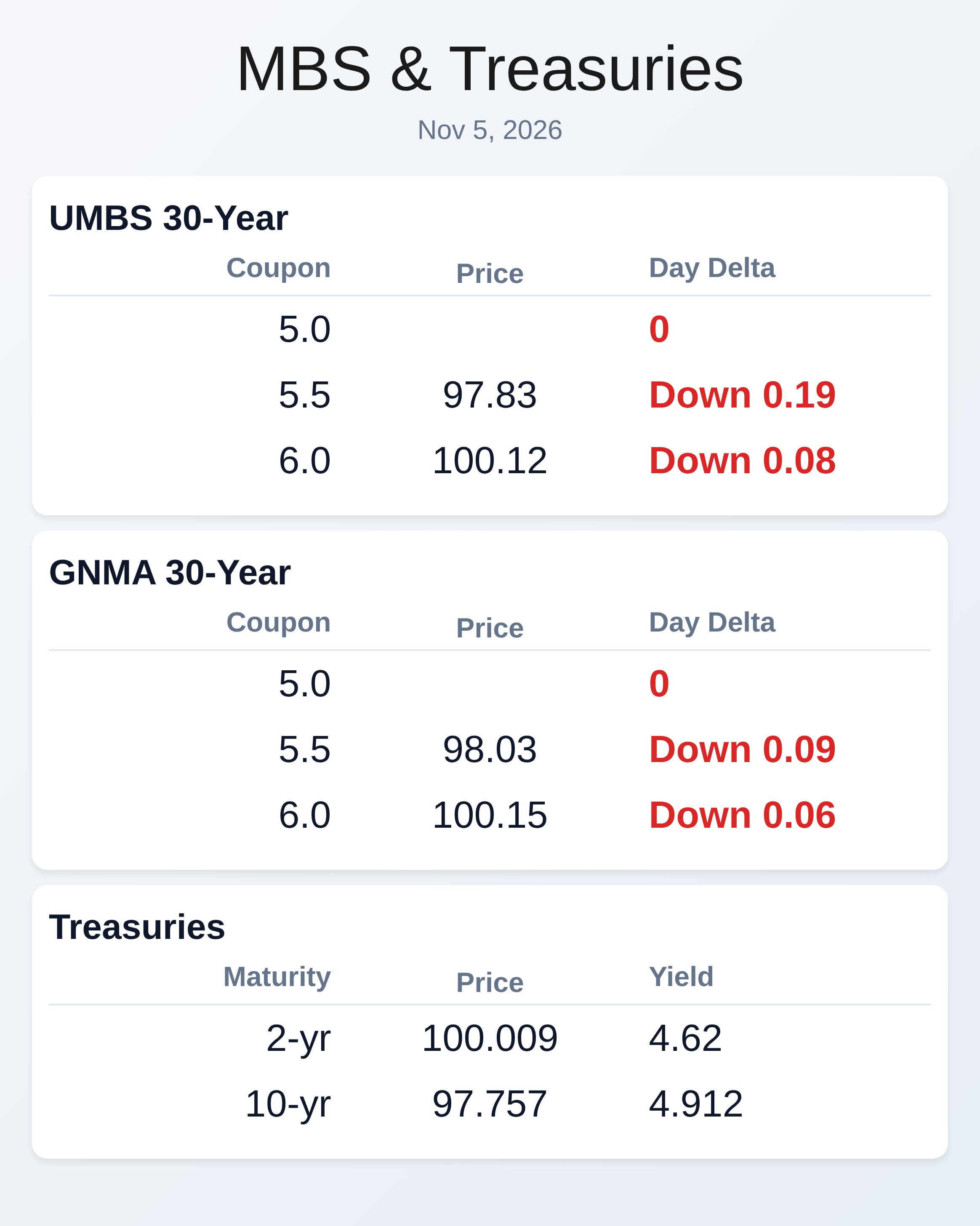
UMBS are taking a breather after last week’s rally, with 30-year UMBS 6.0 down 7 ticks to 100.14 as the open skews risk-off ahead of Friday’s jobs report. Ginnie 6.0s are off a smaller 3 ticks at 100.18, and production coupons are mixed into the first hour. The 10-year hovers near 4.90 percent, still roughly 40–50 bps below early-October peaks.
Yesterday’s post-election bid faded as corporate supply and stronger labor prints nudged yields higher. Rate sheets should reflect mild morning weakness, with lender dispersion driven by coupon mix and convexity. Several cross-currents explain the pause: initial claims fell to 189k (below all estimates), unit labor costs cooled with Q3 productivity up 3.6 percent, oil bounced after a two-day skid, and mega-cap corporate issuance added duration to dealer balance sheets.
Even so, Wednesday’s bull-flattening on a Democratic sweep left term yields near eight-week lows as markets priced less fiscal impulse and lower oil risk. Net: the path of least resistance is choppy range-trading into Friday’s NFP. GNMA performance is modestly firmer versus conventionals this morning, with Ginnie 6.0s down less than UMBS on the day.
Mortgage supply remains light, and the recent rally tightened primary/secondary spreads only modestly as lenders held back pass-through. Watch for coupon leadership: 6.0s and 6.5s still carry the liquidity baton, while deeper-discount shelves remain more volatile on intraday reprices. Servicers should continue monitoring VA and FHA prepay cohorts with cash-flow sensitivity as rate volatility stays elevated.
Treasuries sit in a holding pattern: the 10-year trades around 4.90–4.93 percent, the curve a touch flatter after yesterday’s rally, and the Street digesting a steady quarterly refunding path. With midterms clearing a headline overhang and crude easing from last week’s highs, term premiums compressed but remain jumpy into payrolls. Expect near-term direction to hinge on Friday’s jobs data, oil headlines tied to Iran de-escalation prospects, and any renewed strain in AI/data-center funding.
On the origination desk, borrowers remain highly rate-sensitive: purchase apps fell 2 percent week-over-week and sit 19 percent below last year, while refi volume is essentially flat. ARM usage climbed to 11.3 percent, the highest in over a year, as buyers trade term for payment relief. Equity remains the bright spot—HELOC/second-lien execution is competitive and fast—while Zillow’s 3.5 percent FHA down-payment assistance (via a forgivable second) in many states raises the bar on first-time-buyer competitiveness.
Tactical takeaway: lenders should expect two-sided risk into NFP with spreads sticky and production coupons prone to intraday swings. Borrowers focused on payment can benefit from ARM ladders, buydowns, and targeted equity solutions. Sales teams should prep for quick turnarounds and reprices today and keep borrowers informed that tomorrow’s labor print could reset the tone for next week’s rate sheets.
**Locking vs Floating**
The late-October bond rally has stalled at a logical resistance area, leaving two-way risk elevated and favoring discipline over complacency. With headline sensitivity (oil/AI credit) high and major data (PCE/GDP now past, NFP due Friday) steering the tape, floating only makes sense with time and price cushion. Near-term bias leans defensive: lock gains on loans inside 15–20 days, especially in production coupons, and reserve floats for files with longer buffers and clear rate-improvement triggers.
Be nimble around tomorrow’s jobs report, and respect intraday reprice risk if supply or headlines hit.
**Today’s Events**
October Challenger job cuts (5:30 AM ET) and Initial/Continuing Jobless Claims (8:30 AM ET) set the tone ahead of Friday’s payrolls, with Fed speakers later in the day keeping headline risk alive.
**Bond Pricing**
**UMBS 30 yr**
| Coupon | Price | Intra-Day Change |
**GNMA 30 yr**
| Coupon | Price | Intra-Day Change |
**Treasuries**
| Term | Yield | Price | Intra-Day Yield Change |