**WTMS Blog Today = What’s up in Mortgage Today (AM) – 11/18/2026**
Mortgage rates are holding above 7% while builder confidence plunges to a 14-year low, signaling a sharp deterioration in housing market sentiment as affordability pressures mount across the nation. The 30-year fixed-rate mortgage sits at 7.35%, near three-week highs, with application volume falling 2.3% last week as hotter-than-expected inflation data and persistent Federal Reserve hawkishness keep borrowers sidelined and lenders wrestling with thin production margins. The NAHB Housing Market Index dropped four points to 25 in November—the lowest reading since April 2012—with 46% of builders cutting prices and 68% offering sales incentives, the highest incentive share since the COVID-19 pandemic.
Buyer traffic collapsed to 16, its lowest level in 15 years excluding the pandemic’s initial shock, while current sales conditions fell six points to 28 and future expectations slipped to 30, reflecting mounting concern about affordability and consumer demand. Mortgage rates above 7%, softer consumer confidence, immigration-driven labor shortages, elevated fuel and material costs, and an uncertain economic outlook are all conspiring to squeeze builder margins and borrower purchasing power simultaneously. The index has fallen 13 points year-over-year, underscoring the structural challenge that persistently elevated financing costs and housing prices present to both supply and demand.
Production losses for independent mortgage banks (IMBs) reached an average of $30 per loan in the third quarter of 2026, compared to a profit of $973 per loan in the second quarter. Per-loan production costs climbed to $11,615 in Q3 while revenues fell to $11,585 per loan, narrowing the margin to nearly zero as production volumes remain well below historical averages. The MBA noted that mortgage servicing income held up better, more than doubling net servicing financial income as prepayments slowed and mortgage servicing rights valuations increased, yet only 59% of lenders generated a profit when combining production and servicing operations.
Without servicing to offset production losses, only 44% of mortgage companies would have been profitable, exposing the structural fragility of lenders dependent solely on origination business in a high-rate environment. Federal Reserve officials are increasingly signaling additional interest rate hikes are forthcoming, with St. Louis Fed President Alberto Musalem stating that “several” rate increases are likely needed by spring 2027 and Governor Christopher Waller urging consideration of a 50-basis-point December hike rather than a quarter-point move.
Fed funds futures are now pricing in a 25-basis-point increase in December, with roughly 90 basis points of additional tightening expected through September 2027, keeping mortgage rates elevated and limiting refinancing opportunities. The inflation-adjusted real policy rate may need to rise by approximately one percentage point by spring, according to Musalem, though New York Fed President John Williams cautioned that such dramatic moves are unnecessary, creating divergent messaging that keeps markets uncertain about the path ahead. Credit score migration continues to accelerate, with over 170 lenders now pulling VantageScore 4.0 on agency loans, yet adoption remains uneven with only 8% of loans actually priced using VS4 in October despite 20% pulling the new score.
Rocket and United Wholesale Mortgage are driving nearly all VS4 pricing adoption, accounting for 95% of loans priced with the new model, while other lenders able to pull the score use it on just 1% of their loans. The gap between VS4 and FICO scores averages about 43 points higher on VS4, illustrating that migration requires not just technical capability but fundamental changes to pricing models and lender operations that most industry participants have yet to implement. Today’s economic calendar brings October pending home sales data, weekly crude oil inventory reports, the October FOMC minutes, and a Treasury auction of $16 billion in 20-year bonds, all of which will be scrutinized for clues on inflation durability and Fed resolve.
Housing starts came in stronger than expected at 1,309k annualized units, up 9.9% month-over-month, though building permits fell 7.4% to 1,295k, suggesting builders are pulling back on new construction orders despite the larger start number. These conflicting signals underscore the tension between housing supply fundamentals and near-term affordability pressures that are keeping borrowers out of the market and limiting purchase origination volumes to levels 26% below 2016–2019 averages.
**Locking vs Floating**
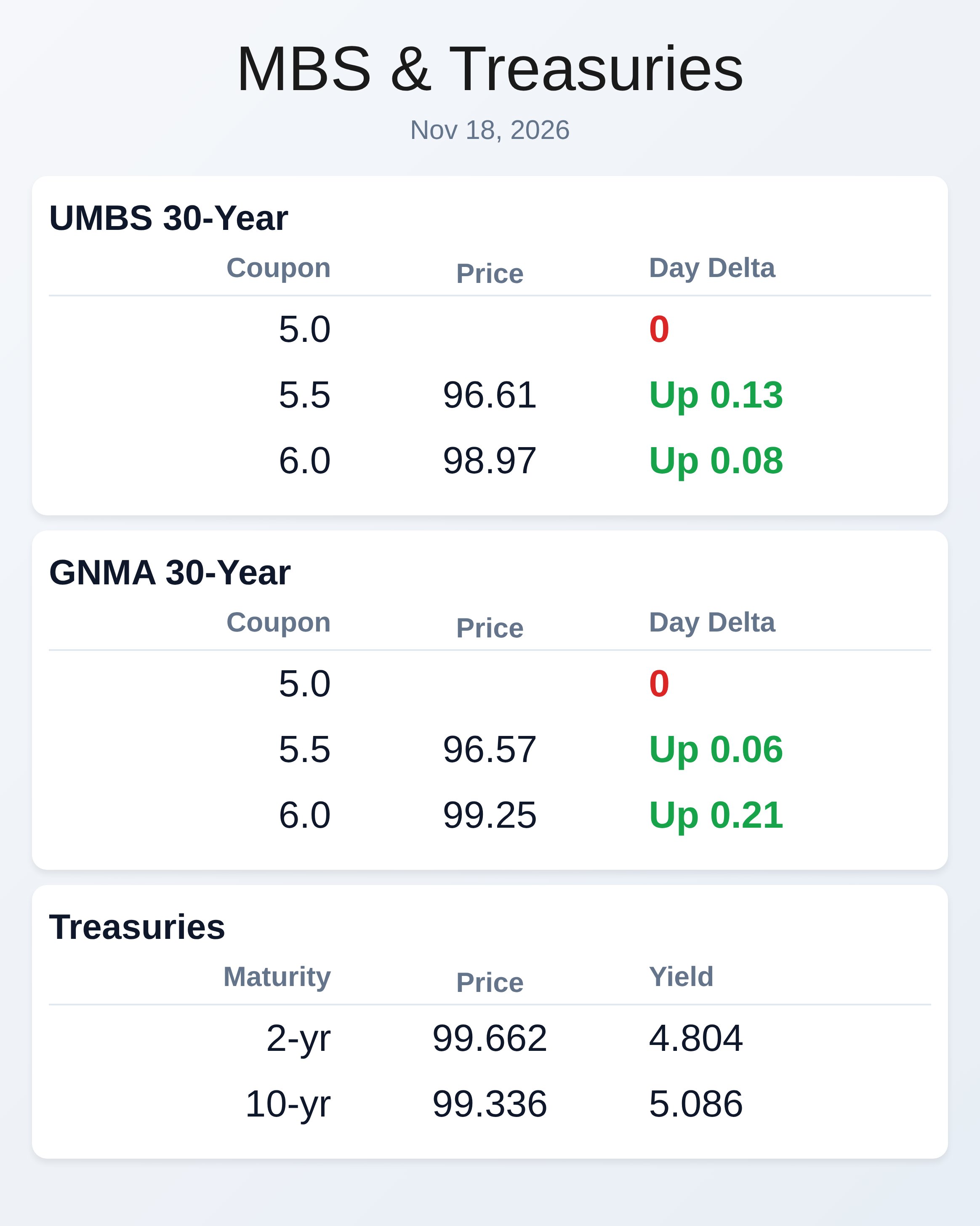
With the Fed signaling additional hikes and Treasury yields holding elevated around 5.1%, borrowers facing rate quotes above 7% have limited incentive to float—locking now protects against potential further gains in Treasury yields driven by hawkish Fed communication or inflation data surprises, while the probability of meaningful rate relief before year-end remains low given the central bank’s inflation focus.
**Today’s Events**
October Pending Home Sales, weekly crude oil inventory, October FOMC Minutes, $16 billion Treasury 20-year bond auction.
**Bond Pricing**
**UMBS 30 yr**
| Coupon | Price | Intra-Day Change |
**GNMA 30 yr**
| Coupon | Price | Intra-Day Change |
**Treasuries**
| Term | Yield | Price | Intra-Day Yield Change |