**WTMS Blog Today = What’s up in Mortgage Today (PM) – 11/16/2026**
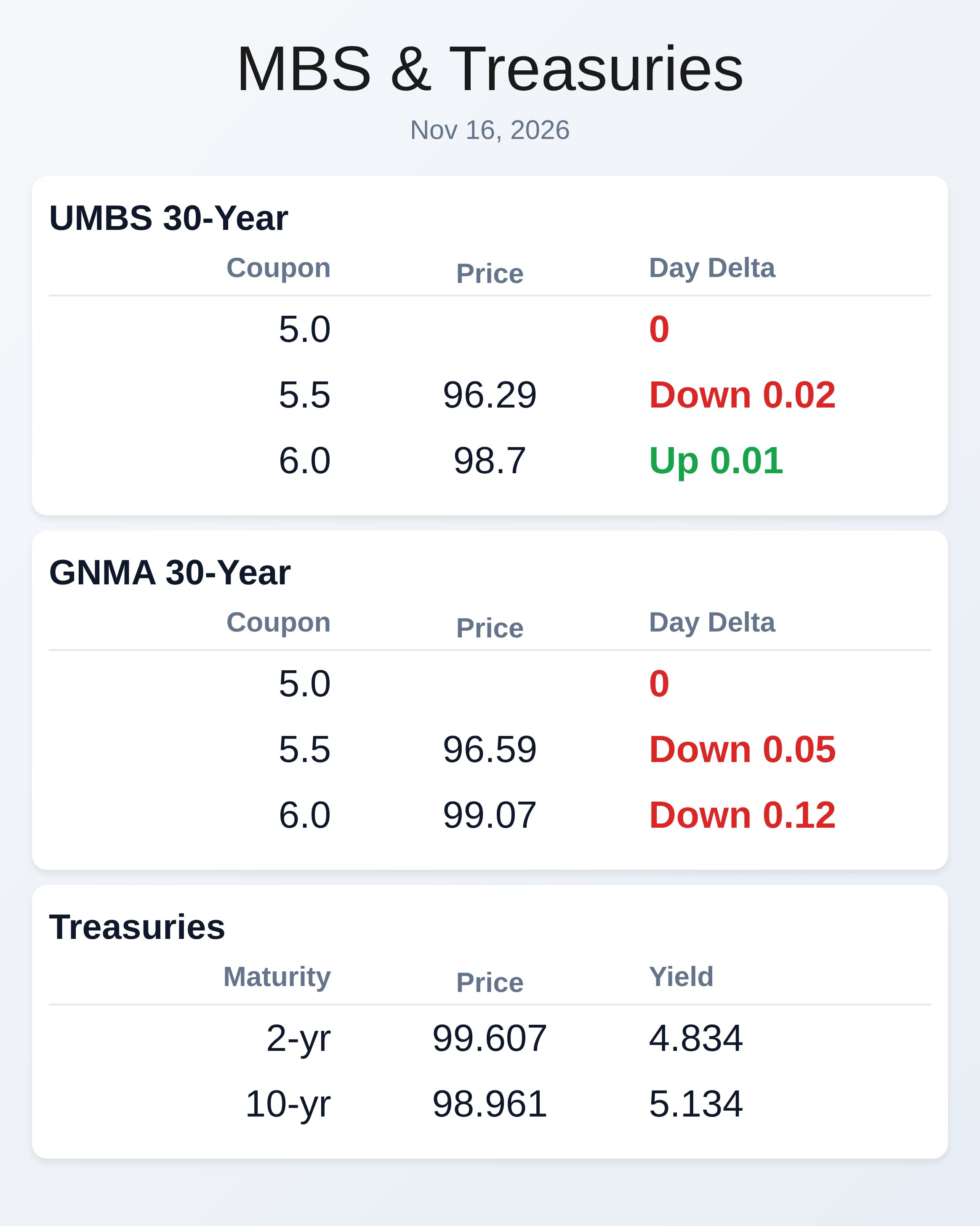
Mortgage-backed securities turned sideways Monday, failing to gain traction from declines in oil prices and an equity sell-off that would normally support bond demand. UMBS 6.0 finished essentially flat at 98.70, while the 10-year yield dipped just 1.2 basis points to 5.130%, signaling market indecision ahead of this week’s Federal Reserve minutes release. Traders attributed the muted action to the post-Thanksgiving trading lull and lighter liquidity typical of mid-November, leaving bonds unable to capitalize on seemingly supportive catalysts.
Mortgage originations continue bleeding volume as the industry reckons with consolidation and technology exhaustion. STRATMOR Group expects 46 M&A transactions by year-end, with mortgage shop owners now facing a stark choice: sell, merge, or watch profits evaporate. Chief analyst Garth Graham told the market that unprofitable lenders face mounting pressure from warehouse lenders losing patience, vertically integrated giants gaining market share, and the relentless pace of AI adoption consuming capital and mental energy.
Graham noted that some sellers have simply capitulated, saying “I’m out. The pace is too crazy.”
Smaller banks re-entering mortgage M&A represent a surprising bright spot in dealmaking activity, though larger independent mortgage bankers remain the dominant acquirers. Banks with under $5 billion in assets see opportunities to leverage existing customer relationships and expand home equity lines while potentially benefiting from looser regulatory requirements.
However, Graham warned that remaining independent companies must model realistic scenarios instead of betting on “another big recruit or a magical refi boom.” The calculus is brutal: once you’ve cut fixed expenses to the bone, further survival requires burning the furniture just to stay warm. The mortgage servicing flywheel—once an industry darling—may be spinning less powerfully than believed. Despite billions invested in servicing portfolios and recapture technology, servicers retained just 27% of refinancing borrowers in Q3, with rate-and-term retention falling nine percentage points to 30% quarter-over-quarter.
For cash-out refis, retention collapsed to 26%, meaning most borrowers shopping for a new mortgage look elsewhere despite being customers of their current servicer. The challenge is structural: today’s refi market isn’t driven by rate-drop alerts but by homeowners accessing $17.5 trillion in home equity through HELOCs, second liens, and cash-out refinances requiring more sophisticated customer analysis than a dashboard notification. The Federal Housing Administration reported rising delinquencies and foreclosures amid its October 2025 tightening of loss mitigation rules, but the picture is more nuanced than headlines suggest.
Seriously delinquent FHA loans hit 6.51% as of September, up from 4.53% a year earlier, yet nearly 320,000 of these borrowers were previously caught in a “churning” cycle of repeated assistance and redefaults. The revised waterfall now limits borrowers to one home-retention option every 24 months, forcing previously-accommodated defaults into foreclosure rather than cycling them through aid. Encouragingly, six-month redefault rates among borrowers receiving assistance under the new system fell to 17% from 35%, suggesting tougher eligibility may produce more sustainable cures.
Still, 260,000 borrowers became seriously delinquent for the first time in FY 2026, and loss severity jumped to 35.36% as home-price appreciation cooled. The mortgage technology stack’s fragility became impossible to ignore after last week’s Microsoft Office 365 outage, which disrupted email, credit reporting, and document management systems across the industry. Most mortgage shops survived the day-long disruption through WhatsApp, Zoom, and emergency document cramming, though the event exposed what the industry has been slow to admit: decades of digitization and cloud-based integration have created hundreds of single points of failure.
While short-term outages are manageable, extended disruptions to LOSs, PPEs, or closing platforms could trigger cascading problems—missed closing dates, expired rate locks, delayed fundings, and angry borrowers. The irony is biting: massive capital investments in efficiency have made the system simultaneously more productive and more fragile, with employees forced to improvise security workarounds when formal systems collapse.
**Locking vs Floating**
Mortgage professionals remain in a defensive posture heading into the final six weeks of the year.
The October bond-market rally has fully reversed, and 10-year yields have broken above key resistance levels. Any resumption of bullish bond action depends largely on a return of the technology sector volatility that briefly dominated markets in September and early October—a catalyst that has been conspicuously absent over the past five trading sessions. Until that dynamic returns or new data shifts expectations, the guidance remains unchanged: wait and see.
**Today’s Events**
New York Fed Manufacturing Index (November): 7.8 versus 18.0 forecast, 25.5 previous
**Bond Pricing**
**UMBS 30 yr**
| Coupon | Price | Intra-Day Change |
**GNMA 30 yr**
| Coupon | Price | Intra-Day Change |
**Treasuries**
| Term | Yield | Price | Intra-Day Yield Change |