**WTMS Blog Today = What’s up in Mortgage Today (PM) – 11/19/2026**
Stocks sold off aggressively today, pulling bonds along for the ride in what appears to be a strong correlation play that masked underlying weakness in fixed-income markets. MBS and Treasuries started the session in negative territory and only recovered to slightly positive ground because equities declined sharply enough to trigger small-scale flights to safety. The bond market’s dependence on stock weakness is now becoming a structural concern: the last time stock prices were at today’s levels, 10-year yields were 20 basis points lower, and the time before that they were 60 basis points lower.
This suggests bonds are not standing on their own fundamentals but rather riding the coattails of equity volatility. Without continued stock selling, mortgage originators should not expect much technical support from the yield curve. The 10-year Treasury closed at 5.048%, down 2.8 basis points, but this modest move conceals the fact that bonds were only able to turn green because of equity panic rather than fundamental strength.
Treasuries have established a ceiling around 5.27% and a floor near 4.75%, but traders are questioning how durable these levels will be if stock volatility subsides. The concern is that inflation pressures remain unresolved from last week’s data breakdown, which could reassert downward pressure on bond prices once equity fear trade weakens. For mortgage sellers, this means the yield floor may be more fragile than it appears and lock/float strategies should account for the possibility of a snapback higher.
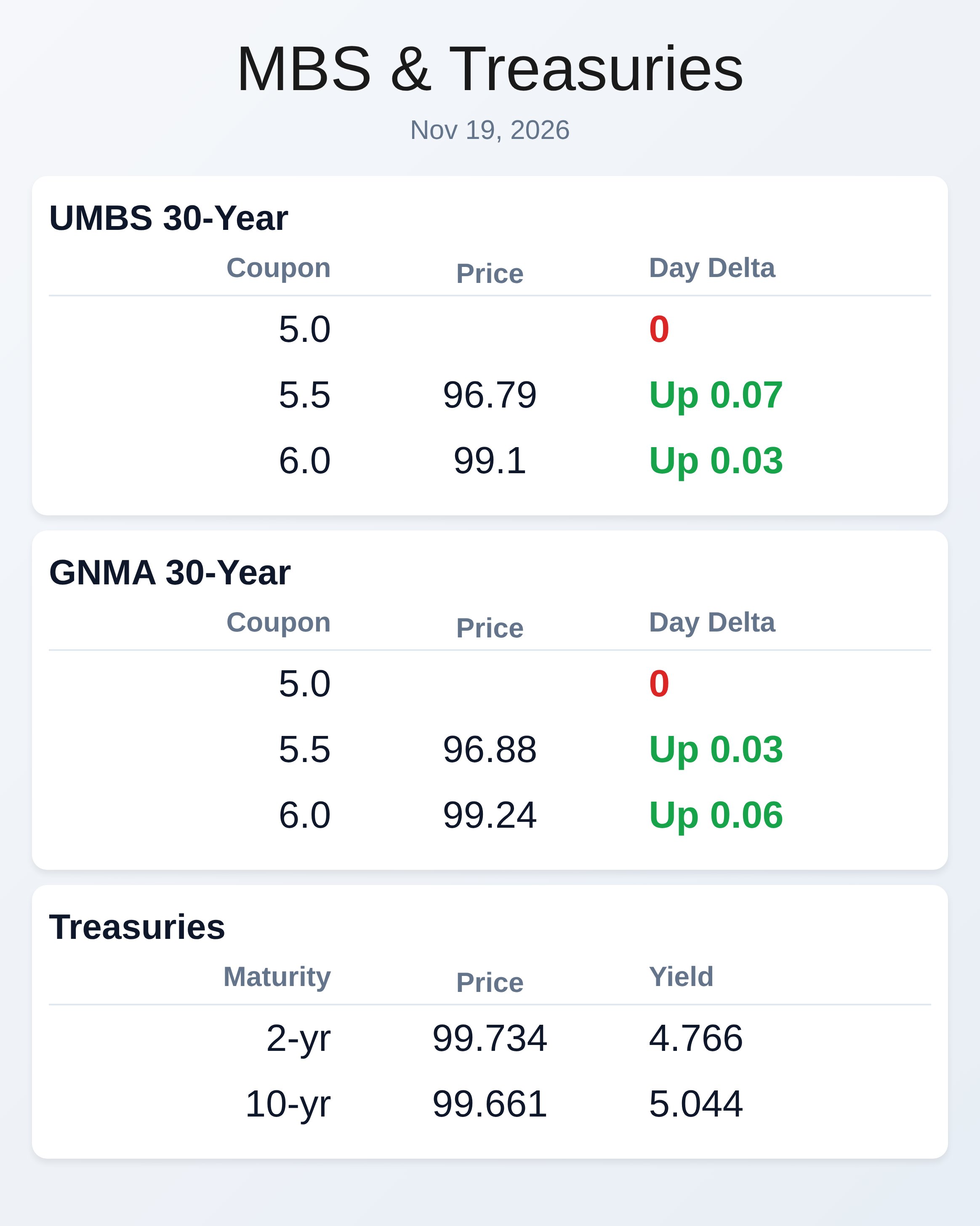
UMBS 6.0 coupons finished at 99.09, up just 2 basis points, while UMBS 6.5s gained 6 basis points to 101.02, showing modest strength concentrated in higher coupons. GNMA 6.0s outperformed relative peers, moving 9 basis points higher to 99.27, suggesting some differentiation between agency mortgage pools based on coupon positioning. The lack of decisive price movement across the board despite stock market turbulence highlights how fragile the current bid is for mortgage securities.
Without a sustained shift in inflation expectations or Fed policy signals, MBS will likely remain tethered to equity gyrations rather than following their own supply-and-demand dynamics. Jobless claims came in at 203,000 versus a 197,000 forecast and 202,000 prior reading, representing a slight deterioration in the labor market data flow. This marginal miss does not constitute a rout, but it adds to the cumulative evidence that employment momentum may be cooling heading into year-end.
For mortgage originators watching pipeline and refi activity, labor weakness could translate into softer purchase demand as consumer confidence takes a hit, though the economic data has not yet reached recession-signaling thresholds. The market remains in a holding pattern waiting for clearer directional signals on inflation and Fed policy rather than reacting decisively to individual economic releases. The technical picture for 10-year yields shows support levels clustered between 4.75% and 4.88%, with resistance overhead at 5.00%, 5.07%, 5.14%, and 5.27%.
Lock triggers remain fluid given the stock-dependent price action, and originators should not rely on technical ceilings as hard stops without confirming the fundamental backdrop has stabilized. If equities stabilize and rally, yields could easily retest 5.27% and push higher, wiping out today’s gains and creating substantial reprice risk for open pipelines. The importance of monitoring both equity and bond correlations cannot be overstated in this environment, as mechanical flows are overwhelming traditional macro analysis.
Looking ahead, mortgage sellers should prepare for continued volatility and uncertain directional bias until the broader macro picture clarifies on inflation and growth. Bond technicals alone are insufficient for making lock or float decisions in an environment where stocks are setting the tone, and that dynamic could persist through year-end if risk assets remain under pressure. Pipeline repricing risk remains material on any snapback in equities, making it prudent to lock longer-duration borrowers sooner rather than later.
Rate predictability has deteriorated significantly, and hedging strategies should reflect the two-way nature of current market risks rather than assuming yields remain anchored to recent support levels. Locking vs Floating
Bonds are receiving temporary support from equity weakness, but this aid is fragile and may evaporate if stock markets stabilize. The last time stocks were at current levels, 10-year yields were 20 to 60 basis points lower, suggesting bonds would be significantly higher if not for flight-to-safety flows.
Lock triggers should focus on technical ceilings (5.27%, 5.14%) as potential repricing zones, but originators should not treat these as hard stops given equity-dependent price action. If stocks stabilize and rally, yields could spike and generate substantial reprices on open pipeline commitments, making earlier locks prudent for longer-duration borrowers facing material rate volatility. Today’s Events
Jobless Claims: 203,000 versus 197,000 forecast, 202,000 prior
Bond Pricing
| Security | Price | Change |
|—|—|—|
| 30YR UMBS 6.0 | 99.09 | +0.02 |
| 30YR UMBS 6.5 | 101.02 | +0.06 |
| 30YR GNMA 6.0 | 99.27 | +0.09 |
| 15YR UMBS-15 5.0 | 97.85 | +0.15 |
| Security | Yield | Change |
|—|—|—|
| 10 YR | 5.048% | -0.028% |
| 2 YR | 4.763% | -0.050% |
| 30 YR | 5.402% | -0.012% |
| 5 YR | 4.858% | -0.028% |
Closing
Stay on top of market shifts and mortgage rate signals—subscribe free at WellThatMakesSense.com.