**WTMS Blog Today = What’s up in Mortgage Today (AM) – 07/20/2026**
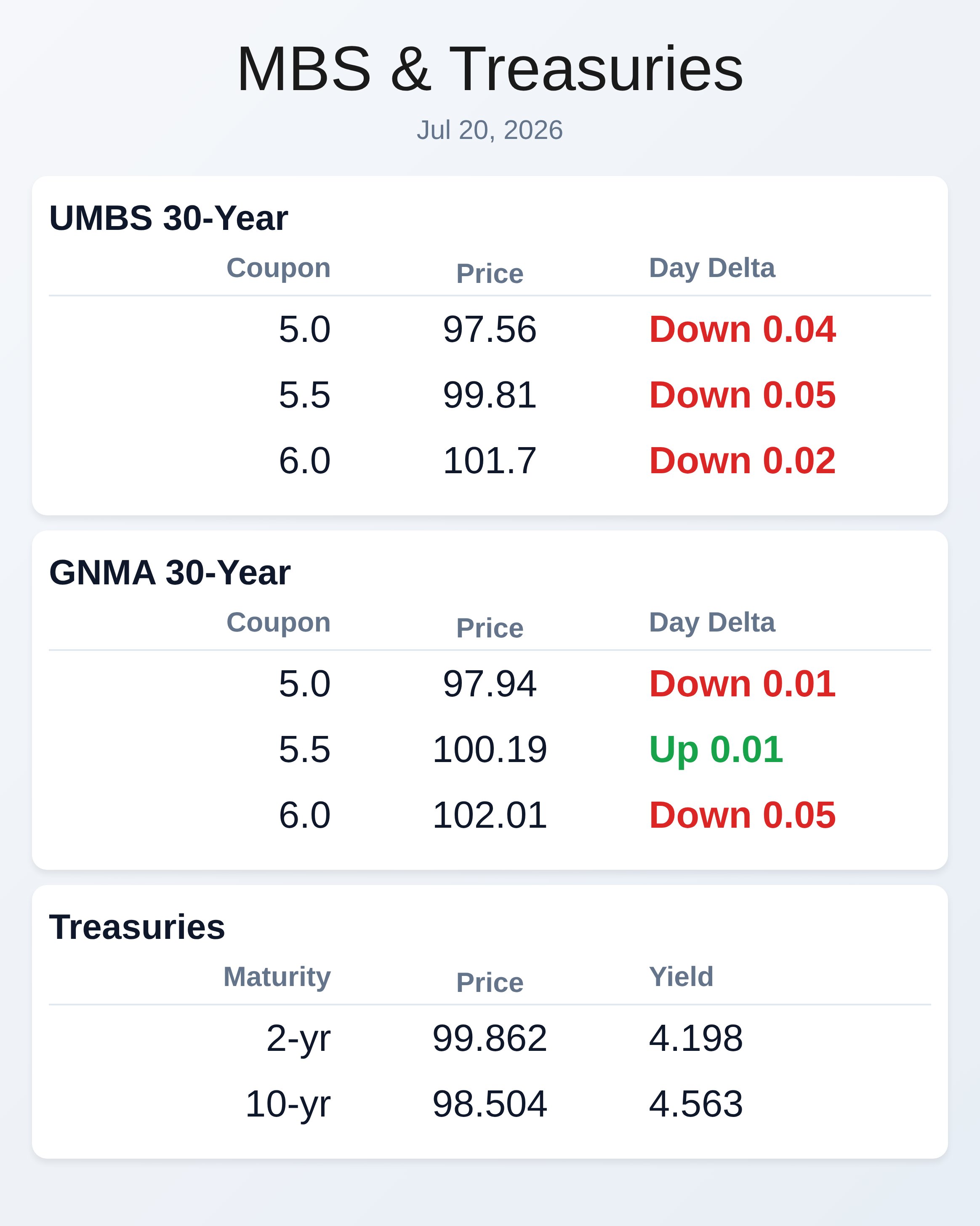
Agency mortgage-backed securities are showing modest weakness this morning as Treasury yields drift higher, with the 10-year yield climbing 2.1 basis points to 4.567 percent in early trading. UMBS 30-year coupons are down slightly across the board, with 5.0, 5.5, and 6.0 coupons each declining between 0.02 and 0.05 points. GNMA securities are tracking similarly, though showing more mixed directional moves in the 5.5 coupon that ticked up 0.01.
The broader bond market remains focused on geopolitical tensions in the Middle East and their potential impact on energy prices, which could fuel inflation concerns that have kept capital markets cautious. Overall volatility remains near multi-year lows, providing some stability for rate traders navigating a quiet economic calendar this week. Risk-averse loan officers should maintain a lock bias until the 10-year Treasury demonstrates stronger technical momentum and can build more serious positive conviction.
The past three days of improvement provide some breathing room, though gas price spikes and extension risk concerns are tempering bullish sentiment. For more aggressive clients comfortable with volatility, yield ranges between 4.52 and 4.62 percent offer tactical opportunities to manage rate risk strategically. Most traders are watching whether bond prices can establish and hold higher floors on any dips, a sign that longer-term support is building.
Current conditions favor disciplined positioning rather than aggressive directional bets in either direction. Mortgage origination leaders are increasingly focused on technology adoption and workforce transformation as they navigate rising competitive pressure and shifting market dynamics. The two major government-sponsored enterprises are tightening artificial intelligence governance standards, with Fannie Mae poised to follow its initial guidance with more prescriptive frameworks that lenders must understand and implement.
Industry consolidation continues to accelerate, with servicing deals and market share battles reshaping how companies compete for borrowers and loans. Lenders that invest now in AI-ready operating models and governance infrastructure will gain durable competitive advantages, while those waiting for external solutions risk reactive rather than strategic positioning. The defining strategic decisions of the next decade will likely occur within institutions themselves, not in Washington regulatory debates.
Borrower retention has become a critical competitive metric as mortgage banks and independent lenders see widening gaps in customer loyalty. Industry data shows that independent mortgage banks retained only 26.9 percent of borrowers in 2025, down sharply from 29.6 percent in 2024, while broker retention fell from 30.6 to 28.4 percent over the same period. Banks and credit unions maintained more stable retention near 48.5 percent, highlighting their structural advantages in customer relationships and cross-selling opportunities.
As refinance volumes remain suppressed and purchase market affordability pressures persist, keeping existing borrowers becomes far more valuable than acquiring new ones. The divergence suggests that lender-agnostic origination channels are losing market position to institutions with deeper borrower relationships and integrated lending platforms. Economic data this week remains light but still carries weight for Fed decision-making as policymakers assess whether inflation risks justify patience on rate cuts.
The Leading Economic Index report arrives today, while the highlight of the week will be Friday’s flash PMI surveys and June new home sales figures that reveal consumer demand trends. Softer-than-expected inflation readings last week reduced expectations for a July Fed rate hike, allowing Treasury yields and mortgage rates to recover most of their losses. However, import price acceleration and Middle East energy risks mean inflation remains the central concern for market participants and policymakers alike.
Bond investors should monitor consumer sentiment and housing data as key signals for where the Fed’s rate path might shift once confidence in price stability strengthens further. The mortgage industry’s strategic focus is shifting from simply automating processes to building governance frameworks that ensure explainability, accountability, and transparency in AI-assisted lending decisions. Regulators and investors increasingly demand clear documentation of how machine-assisted decisions are reached, not just confidence in the outcomes themselves.
Lenders that balance innovation with robust risk management and regulatory discipline will position themselves as the sustainable winners as technology becomes deeper embedded in origination and servicing workflows. The secondary market frameworks set by Fannie Mae and Freddie Mac will shape what technologies can scale across the industry, meaning lenders must stay aligned with GSE standards. Organizations that view governance as a strategic capability rather than a compliance exercise will generate durable competitive advantages in an increasingly technology-driven landscape.
**Locking vs Floating**
Risk-averse borrowers should maintain a lock bias until bond market momentum strengthens and the 10-year Treasury proves it can hold higher technical floors with conviction. The past three days of rate improvement provide opportunity, but recent weakness in overnight trading and extension risk concerns suggest patience remains the wiser strategy. Aggressive clients have a workable range between 4.52 and 4.62 percent yields to execute tactical positioning, though broader market volatility remains constrained and unpredictable.
MBS price stability intraday can guide near-term positioning, but longer-term yield ceilings and floors determine whether the bigger momentum picture is turning favorable for floating borrowers.
**Bond Pricing**
**UMBS 30 yr**
| Coupon | Price | Intra-Day Change |
| 5.0 | 97.56 | -0.04 |
| 5.5 | 99.81 | -0.05 |
| 6.0 | 101.7 | -0.02 |
**GNMA 30 yr**
| Coupon | Price | Intra-Day Change |
**Treasuries**
| Term | Yield | Price | Intra-Day Yield Change |
**GNMA 30 yr**
| Coupon | Price | Intra-Day Change |
|—:|—:|—:|
| 5.0 | 97.94 | -0.01 |
| 5.5 | 100.19 | 0.01 |
| 6.0 | 102.01 | -0.05 |
**Treasuries**
| Term | Yield | Price | Intra-Day Yield Change |
|—|—:|—:|—:|
| 2 yr | 4.198 | 99.862 | 0.023 |
| 3 yr | 4.232 | 99.702 | 0.013 |
| 5 yr | 4.295 | 99.241 | 0.012 |
| 7 yr | 4.421 | 98.98 | 0.013 |
| 10 yr | 4.563 | 98.504 | 0.017 |
| 30 yr | 5.083 | 98.723 | 0.013 |
Subscribe free to WTMS at WellThatMakesSense.com for daily mortgage market insights delivered straight to your inbox.