**WTMS Blog Today = What’s up in Mortgage Today (AM) – 11/23/2026**
A sharp equity selloff has torpedoed mortgage rates, as investors fled tech stocks and sought safety in Treasury bonds this week. The 10-year Treasury yield plummeted 24 to 28 basis points as the artificial intelligence boom lost momentum, dragging the AI-heavy Nasdaq into correction territory. The S&P 500 fell to its lowest level since April, and even Anthropic’s record-breaking $107.3 billion IPO failed to hold most of its opening pop.
For mortgage originators, this Treasury rally has compressed spreads and reduced refinancing incentives to near-historic lows, with fewer than 1 percent of conventional and government-backed borrowers currently positioned to refinance. Mortgage rates bucked the broader yield-curve decline earlier in the week, rising to 7.28% on November 19 as inflation concerns briefly surfaced, but those gains were fully erased as equities crumbled Friday. The 30-year mortgage rate had fallen for four consecutive weeks before this single-week uptick, and now sits higher than a year ago (6.26%), reflecting the persistent hawkish undertone from Federal Reserve officials.
Despite dovish Treasury action, the Fed minutes revealed broad support for additional rate hikes, with some officials open to a 50-basis point move in December, creating tension between financial conditions and policy messaging that is weighing on origination margins. Production losses mounted across the industry as pipeline volume dried up in the third quarter, with the Mortgage Bankers Association reporting that independent mortgage banks posted a $30 per-loan loss compared to $973 profit in Q2. The lack of refinancing activity and tighter-than-normal margins have forced lenders to cut costs, reduce capacity, or pursue M&A, as profitability depends almost entirely on servicing revenue offsets.
Redwood Trust’s stock has fallen more than 50 percent this year, forcing the firm to explore a share exchange offer to manage capital and return value to shareholders in a deteriorating origination environment. Cybersecurity breaches and regulatory settlements continue to plague industry leaders, with Rocket Mortgage and Mr. Cooper (now under Rocket ownership) agreeing to pay a combined $6.75 million to New York regulators for failing to report security incidents within required timelines.
Rocket waited more than a year in some cases to disclose breaches that occurred between December 2019 and August 2021, while Mr. Cooper’s 2023 attack exposed data on substantially all current and former customers. These settlements underscore the operational and reputational costs that weak security infrastructure imposes on originators and servicers, forcing accelerated compliance audits and technology investments.
Quality control defects are rising despite overall improvement, with ACES reporting that critical defects fell to 1.64 percent but income and eligibility defects jumped 15.5 and 60.4 percent respectively in Q2 2026. Appraisal defects also spiked 38.5 percent as property valuations face uncertainty, while refinance volumes carry a disproportionate share of defects even as refi activity shrinks. This suggests that lenders closing fewer loans are leaving higher-risk files in the pipeline, creating downstream servicing and investor overlay issues that add cost to fulfillment.
Non-QM lending has emerged as a critical product line, with lenders and correspondent platforms racing to capture self-employed borrowers, real estate investors, and those with unconventional income documentation. Firms like Verus, Planet, and AmeriHome are expanding non-QM platforms and scenario-desk support to serve borrowers outside agency guidelines, though industry veteran Bill Cosgrove cautioned that stretching debt-to-income ratios and loosening documentation won’t solve the housing affordability crisis. The real fix, Cosgrove argues, requires more homebuilding and neighborhood reconstruction, not looser lending standards that echo 2008.
**Locking vs Floating**
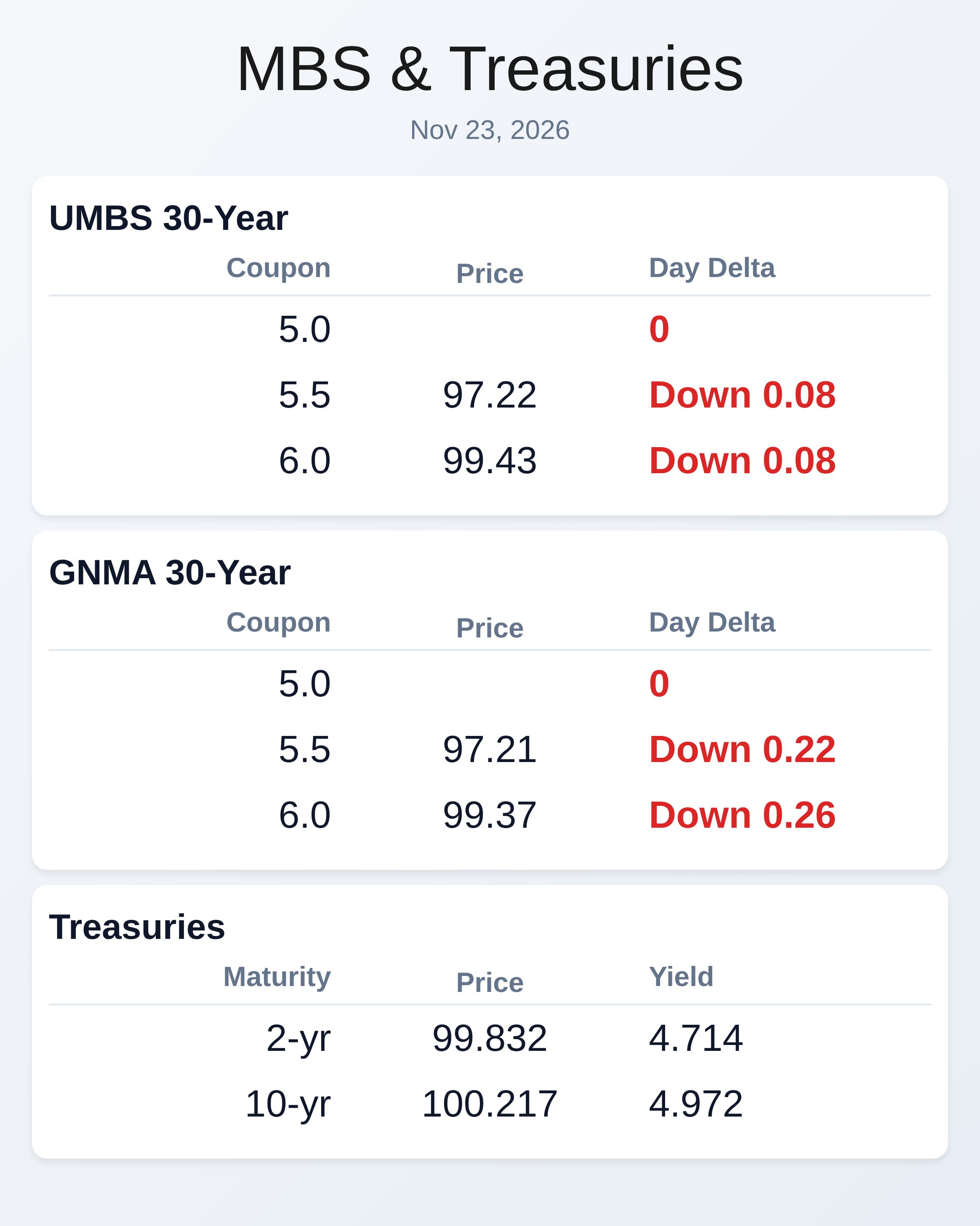
With Treasury yields in freefall from 5.10 percent down to 4.97 percent over three days, the case for floating has weakened considerably. Lock-ready borrowers should evaluate their timeline, as rate locks now carry cheaper pricing but limited downside protection in an uncertain environment. Financial condition deterioration often correlates with further yield declines, favoring locks for borrowers who cannot absorb volatility or need certainty before year-end.
**Today’s Events**
Flash November Manufacturing and Services PMI data release this morning. This week includes October Personal Consumption Expenditures inflation (Wednesday), September home price indexes, November Consumer Confidence, the second estimate of Q3 GDP, October Personal Income and Spending, October Durable Orders, and the November Beige Book. Treasury auctions include $69 billion in 2-year notes, $44 billion in 7-year notes, and $70 billion in 5-year notes.
**Bond Pricing**
**UMBS 30 yr**
| Coupon | Price | Intra-Day Change |
**GNMA 30 yr**
| Coupon | Price | Intra-Day Change |
**Treasuries**
| Term | Yield | Price | Intra-Day Yield Change |