**WTMS Blog Today = What’s up in Mortgage Today (AM) – 11/27/2026**
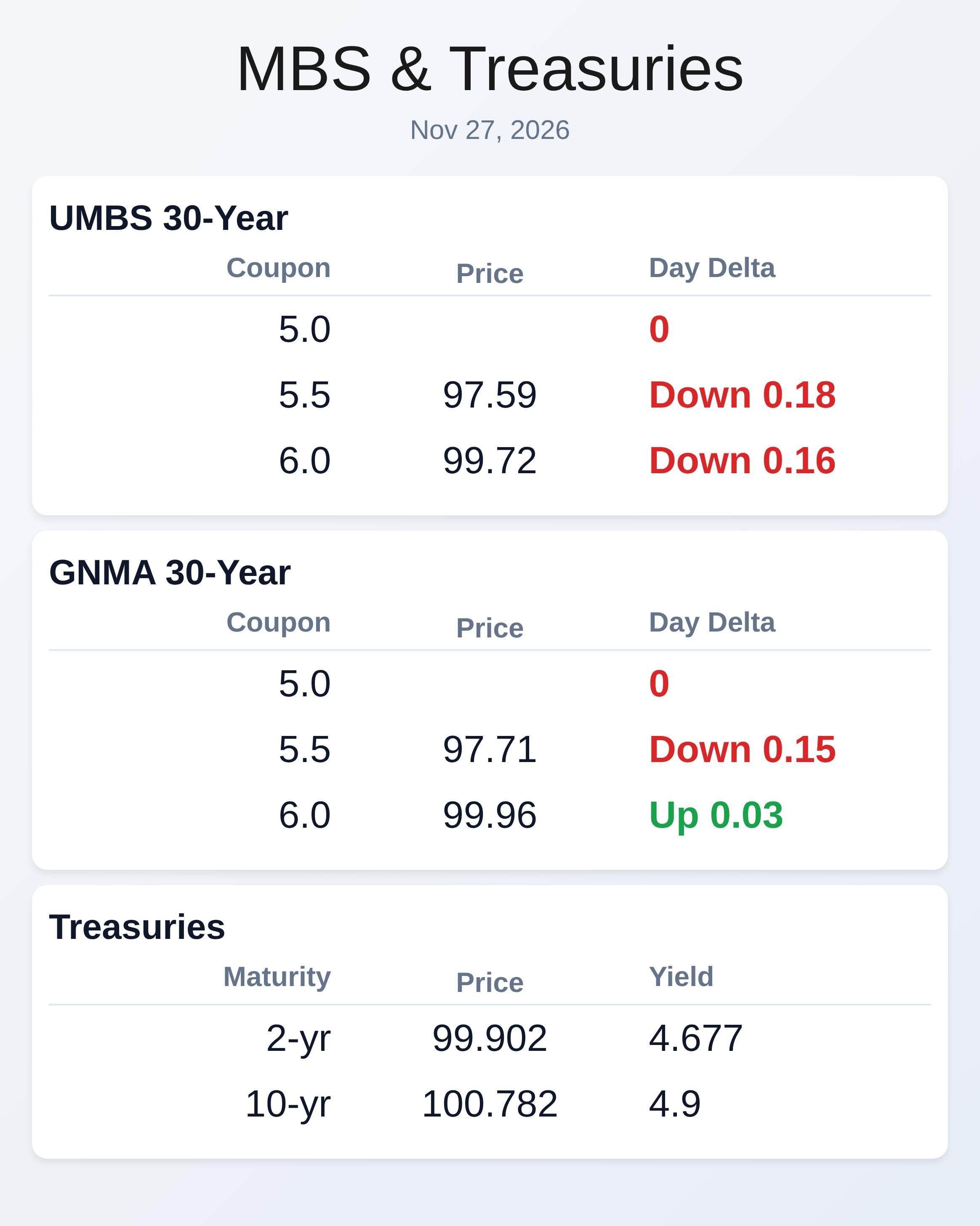
Treasury yields plummeted nearly 83 basis points from Monday through Wednesday as a vicious tech-sector selloff triggered a flight-to-safety rally in bonds, overwhelming the Federal Reserve’s hawkish inflation rhetoric and rate-hike expectations. The 10-year yield dropped from 4.94% to 4.84% mid-week before rebounding slightly to 4.90% by Friday morning, with investors increasingly prioritizing equity-market weakness and financial-condition concerns over persistent inflation near 3.8%. The mortgage basis widened sharply as Agency MBS prices advanced alongside Treasuries but lagged the bond strength, while shorter-dated Treasury futures showed traders are repricing expectations for continued Fed tightening into 2027.
Despite Fed policymakers signaling a December rate increase and potential additional hikes in January and March, Chair Warsh’s reluctance to provide forward guidance amplified volatility and shifted market focus toward what equity weakness might signal about economic resilience. This week’s bond strength proved crucial for lenders managing elevated rate-lock positions and borrowed funding costs tied to shorter-duration benchmarks. The Federal Housing Finance Agency announced the 2027 conforming loan limit at $855,400 for one-unit properties, an increase of $22,650 or 2.72% from 2026, mirroring home price appreciation since Q3 2025.
This marks the smallest year-over-year jump in several years and falls below what many lenders had projected in October when UWM, Pennymac, Rocket, and CrossCountry set interim internal limits ranging from $845,000 to $850,000. High-cost area baselines rise to $1,283,100, while Alaska, Hawaii, Guam, and the U.S. Virgin Islands reach $1,924,650, expanding opportunities in jumbo and high-balance markets alongside weaker price appreciation nationwide.
The modest increase reflects slowing home-price momentum even as nominal values remain elevated, with limited evidence of broad price declines except in the hardest-hit regional markets. For mortgage lenders, this limit expansion provides a marginal boost to conventional conforming volumes but underscores the broader affordability headwinds crushing purchase-mortgage demand across both agency and non-agency channels. VantageScore 4.0 adoption exploded in October, jumping from just 5% market share in September to 20% of mortgages securitized at the GSEs with $9.56 billion in loan volume, even as total mortgage volumes fell 29% month-over-month.
This dramatic acceleration signals lenders’ urgency to comply with the January 1, 2027 FICO sunset deadline, yet Tracey King of Advantage Partners Solutions warns the industry lacks critical clarity on pricing, contract terms, subscription options, and implementation responsibilities between FICO, the credit bureaus, and lenders themselves. Confusion persists around whether annual versus monthly subscription models will apply, which organizations bear responsibility for specific requirements, and whether lenders will have confirmed opt-in and opt-out status before the January 1 hard deadline. Multiple credit reporting agencies and industry groups have requested FICO delay the transition to prevent lenders from being left without scores mid-month, but those requests have been denied.
The uncertainty creates negotiating obstacles for lenders renewing vendor contracts or switching providers, forcing decisions based on incomplete pricing and terms. Lenders are aggressively expanding non-Agency and home-equity product offerings as rising interest rates push borrowers toward alternative financing to avoid giving up low-rate primary mortgages from 2020 and 2021. HELOC balances have surged 50% since 2022 to $481 billion, the highest level in over a decade, with the largest quarterly increase since 2005 occurring in Q3 2026 alone.
Non-QM programs from Plaza, Pennymac, Champions, LoanStream, Onity, and AmeriHome are loosening credit and debt-service-coverage-ratio requirements to capture underserved borrowers, while Symmetry and other lenders push streamlined HELOC products with flexible draw periods and investment-property flexibility. The homeowner equity cushion—now representing 72% of America’s $50 trillion housing market—provides a substantial buffer for lenders seeking to diversify revenue streams and capitalize on cash-out demand, even as overall loan volumes remain pressured. However, this rapid growth in alternative products coupled with looser credit guidelines raises concerns about credit-quality deterioration and mirrors structurally similar market conditions to 2008 that industry observers have flagged.
Mortgage application volume jumped 6.1% week-over-week for the week ending November 20, driven by a robust 10.2% surge in purchase applications—the strongest weekly gain since September—while refinancing activity limped along with just a 0.5% gain. The 30-year fixed-rate mortgage averaged 7.38%, slightly higher than the previous week despite the mid-week Treasury rally, underscoring persistent mortgage-basis expansion and the lag between bond yields and consumer-facing rates. Adjustable-rate-mortgage adoption reached 11.5% of applications, the highest share in over a year, as borrowers seek lower starting payments to offset affordability headwinds and declining purchasing power.
Despite the week’s rebound, purchase applications remain down 16% year-over-year while refinances have cratered 51% compared to the prior-year period, illustrating the depth of demand destruction across both channels. The weak year-over-year comparison suggests the recent application jump reflects seasonal holiday activity and tactical rate-lock decisions rather than sustainable demand recovery. U.S.
homebuilder sentiment collapsed to its lowest level since April 2012 as affordability pressures, elevated mortgage rates, and weakening consumer spending forced builders to slash prices by an average of 6% and deploy aggressive buyer incentives including mortgage-rate buydowns and upgraded finishes. New home sales rebounded 14.2% in October from September lows, but this modest recovery masks deeper structural deterioration as affordability constraints and loan-payment pressures reaching $2,165 per month—more than double late-2010s levels—continue crushing demand among first-time and middle-income homebuyers. Home prices continue rising nominally but lag inflation, with national annual appreciation ranging from just 1.9% to 3.5% across states and limited evidence of price declines outside the most distressed regional markets.
The Federal Reserve’s Beige Book documented modest economic growth with eight Districts expanding and four reporting little to no change, but noted weakness in consumer spending, housing, and construction—sectors critical to mortgage origination. Lenders face a prolonged downturn in purchase-mortgage demand as affordability headwinds, margin compression, and industry consolidation reshape competitive dynamics heading into 2027.
**Locking vs Floating**
Investors fled equity positions mid-week as technology-sector valuations and AI-spending questions triggered a dramatic flight to safety, pulling Treasury yields down sharply before a Friday rebound on renewed risk appetite.
Lock-extension activity likely spiked as originators managed extended rate-lock positions and borrowed-funds costs rose through basis-expansion cycles. Borrowers should monitor year-