**WTMS Blog Today = What’s up in Mortgage Today (PM) – 11/27/2026**
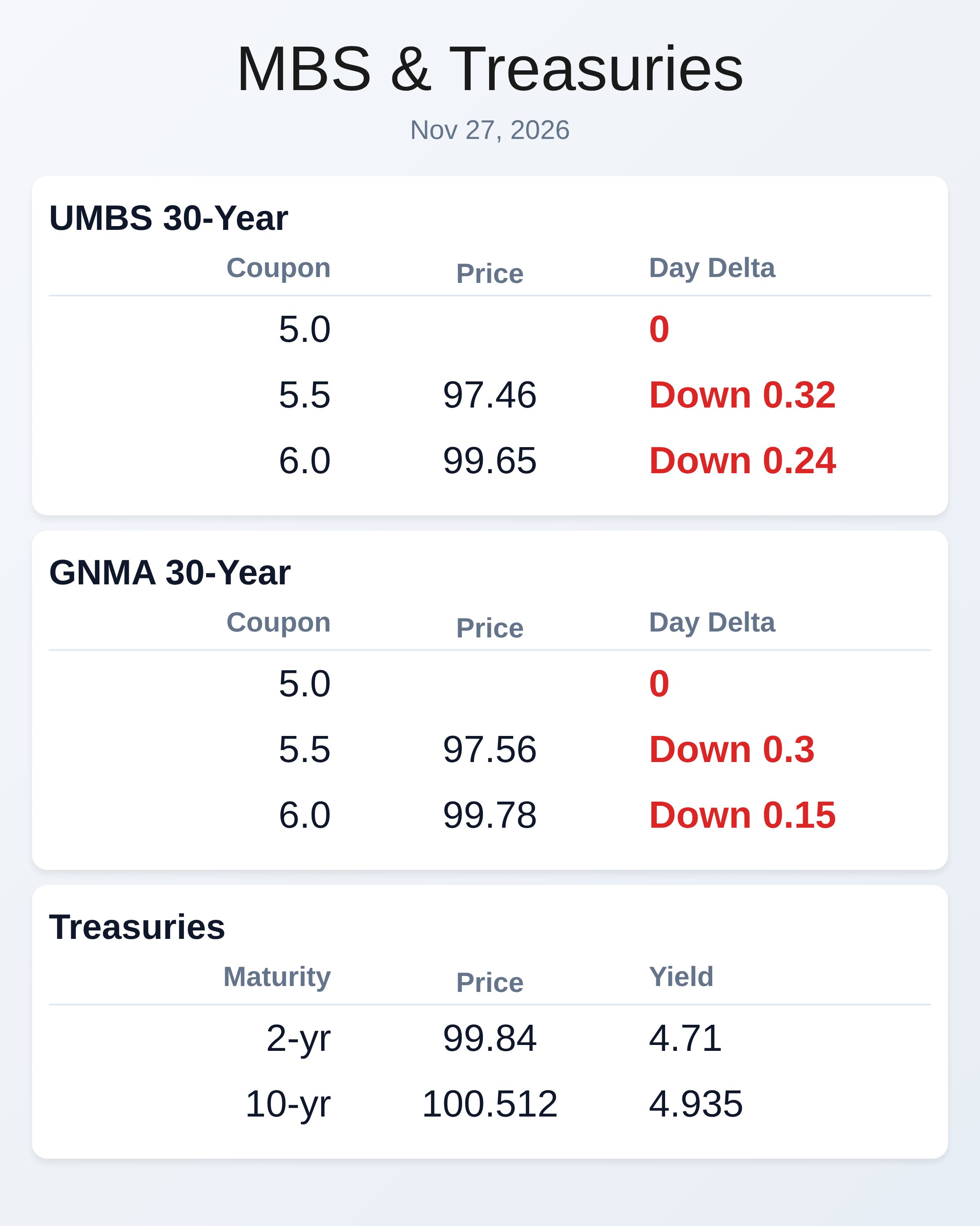
UMBS 6.0 coupons are trading lower heading into the final hours of Friday’s shortened session, with pricing down 16 to 20 basis points through mid-afternoon and sitting at 99.72 as liquidity dries up. The weakness reflects moderate bond market deterioration that mirrors a recovery in equities, typical of holiday-week volatility when fewer traders are participating. Lenders printing conservative rate sheets this morning may still avoid negative reprices despite MBS tracking an eighth of a point below some initial print levels.
The real question is whether this decline represents mean reversion or the start of a larger selloff—but with trading volume at historic lows for the Friday after Thanksgiving, today’s action says more about market structure than fundamental shifts. The 10-year Treasury yield climbed to 4.933 percent, up nearly 7 basis points on the session, as oil prices rose and investors braced for next week’s payroll data. Treasury liquidity remains artificially low because of the holiday calendar, with SIFMA’s decision to keep bond markets open today driven by the need for maximum global Treasury functionality despite minimal participation.
Yesterday’s close at 4.900 was the last point of near-normal liquidity, meaning Wednesday, today, and next Monday should largely be dismissed as noise rather than trend. Fed Chair Warsh’s lack of meaningful guidance on future rate policy continues to unsettle capital markets that are already grappling with AI valuation concerns and equity-market swings. Thanksgiving-week trading conditions are among the worst of the entire year for mortgage professionals trying to make real decisions.
Zero trades occurred in 6.5 coupons as of 9:04 a.m. EST compared to only 10 trades in 6.0 coupons—a volume level so low it barely qualifies as a market. The absence of normal counterparty participation means that price movements driven by thin order flow cannot be reliably interpreted as signals of market direction.
MBS Live commentary noted that today’s opening will likely serve as today’s closing as well, underscoring how few catalysts exist to drive material intraday shifts. Any serious market re-evaluation will wait until Tuesday when traders return and liquidity normalizes. Rate sheets this morning reflected conservative positioning, suggesting that lenders are hesitant to reprice mortgages downward without clearer conviction about week-ahead direction.
The gap between MBS pricing and some lenders’ printed rates created a small window for negative reprices if prices continued declining, but the magnitude remained modest enough that most originators held firm on current rate sheets. This conservative stance protects lenders from locking in losses during a volatile, low-volume window where any rebound would immediately penalize early cutbacks. For mortgage professionals with locks expiring or borrowers on the fence, the message was clear: locking today made sense rather than waiting for Monday when market reopens with unknown overnight developments.
The 2027 conforming loan limit increase to $855,400 provides some structural support for purchase activity and high-balance lending despite persistent housing affordability headwinds that remain the industry’s biggest challenge. Fannie Mae and Freddie Mac’s combined retained portfolios expanded $11 billion to $326 billion in October, signaling that wider Agency MBS spreads are attracting investor capital into GSE paper. However, this technical support exists alongside a deteriorating real estate backdrop: average monthly mortgage payments have more than doubled since the late-2010s, purchase mortgage activity continues declining year-over-year, and homebuilders increasingly rely on price reductions and incentives to move inventory.
The 14.2 percent October rebound in new home sales offered temporary encouragement, but nominal home price appreciation remains modest given the affordability squeeze. The January 1 credit-scoring transition deadline looms with FICO, the credit bureaus, resellers, and lenders still misaligned on implementation requirements, pricing models, and operational responsibilities. 2027 pricing remains unsettled while FICO’s proposed monthly subscription model introduces additional cost layers and separate contract negotiations that lenders lack transparency to evaluate properly.
The risk extends beyond pricing: competing opt-in and opt-out decisions, varying subscription models, and inadequate industry coordination could create operational disruptions so severe that some borrowers become unable to obtain credit scores at all. VantageScore, FICO’s alternative, faces similar uncertainty regarding its competitive positioning and accessibility in a marketplace where coordination has historically been poor. Successful January implementation will require immediate and consistent communication among all parties to avoid the scenario where new technology standards create more friction than the systems they replace.
**Locking vs Floating**
With UMBS pricing down 16-20 basis points on a holiday-shortened trading day dominated by illiquidity, locking mortgages today made more sense than floating into a Monday reopening with unknown overnight developments. Conservative rate sheets suggested lenders were reluctant to absorb repricing risk, meaning borrowers who floated faced potential cost if markets deteriorated further. The thin trading volume and acknowledged illiquidity mean any Monday reprices could move sharply in either direction depending on global markets and news flow over the weekend.
**Bond Pricing**
**UMBS 30 yr**
| Coupon | Price | Intra-Day Change |
**GNMA 30 yr**
| Coupon | Price | Intra-Day Change |
**Treasuries**
| Term | Yield | Price | Intra-Day Yield Change |