**WTMS Blog Today = What’s up in Mortgage Today (PM) – 10/05/2026**
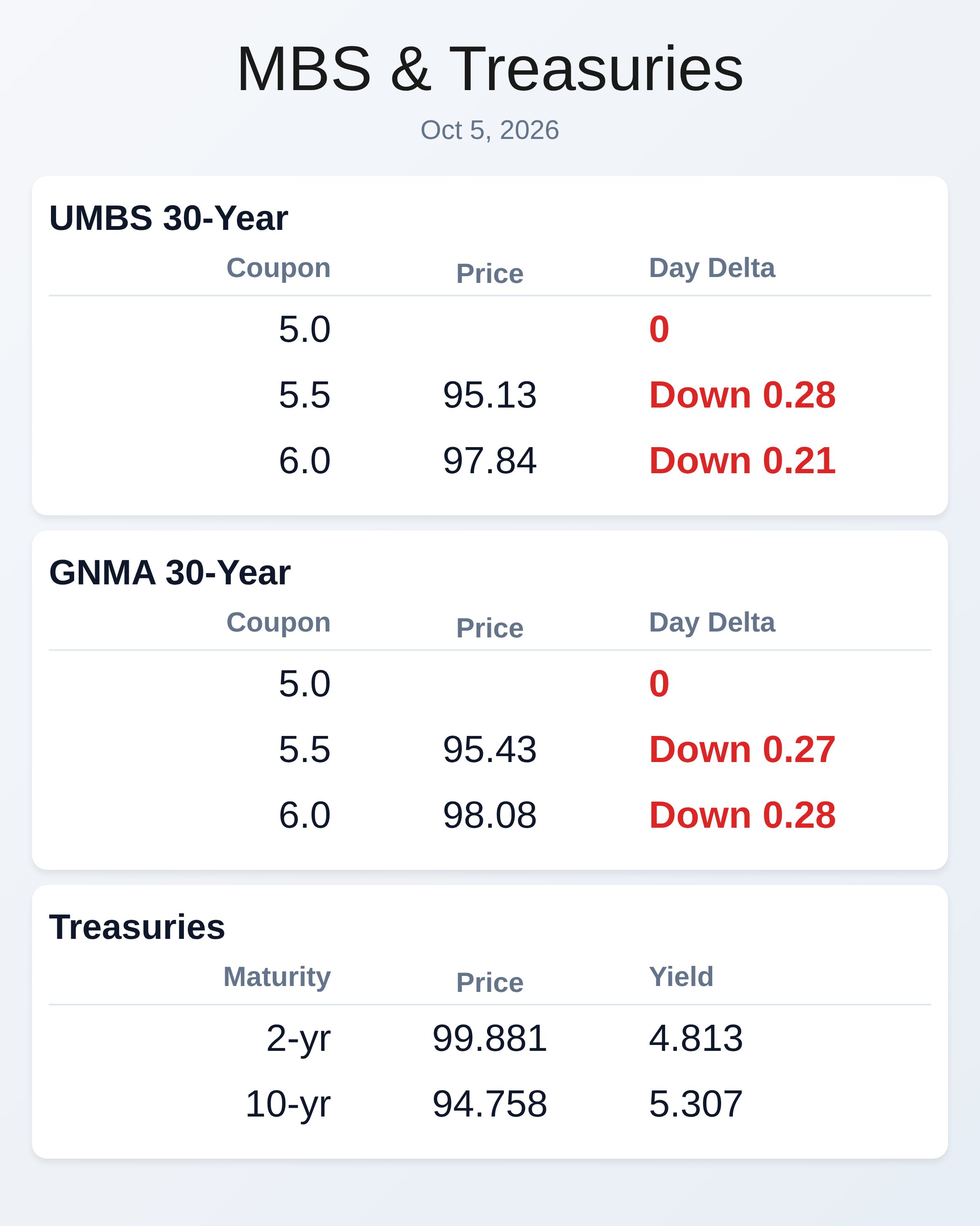
Bonds had nowhere to go but sideways today as traders searched for any reason to bid them higher, ultimately settling for a modest quarter-point recovery off the day’s lows despite no fundamental catalyst for the bounce. The 10-year Treasury closed at 5.309%, up only 3 basis points from morning weakness that pushed yields to 5.334%, while UMBS 6.0 declined 25 basis points to 97.81 as mortgage investors faced relentless selling pressure. September’s ISM economic data painted a mixed picture: business activity fell to 56.5 from 61.7 while services employment unexpectedly climbed to 50.1, suggesting labor markets remain resilient even as manufacturing softens.
Mortgage originators saw intraday reprice risk spike at 11:11 AM, and traders warned that yields may need to fall 6 basis points per day for 2 consecutive days before the bear market trend reverses. The real issue is that nothing has fundamentally changed to stop the bleeding, only that exhaustion and technical levels are providing temporary relief. Multiple structural headwinds continue to fuel higher yields regardless of daily volatility, including persistent war-driven inflation expectations, elevated Treasury issuance from fiscal imbalances, and a Federal Reserve committed to fighting price pressures with rate policy.
Corporate bond issuance and resilient equity markets are competing for investor capital that might otherwise flow into mortgage-backed securities, while foreign demand has weakened gradually due to tariffs and deteriorating trade relationships. Silicon Valley’s sudden enthusiasm for mortgage servicing represents the only genuine bright spot in market sentiment today, as Valon raised $150 million at a $2.3 billion valuation on the promise that boring infrastructure can generate extraordinary returns when backed by $200 million in annualized recurring revenue. The startup has reportedly captured ServiceMac, Carrington, and NewRez as clients, with one in six U.S.
mortgages eventually migrating to its ValonOS platform within the next few years. For mortgage professionals, this signals that legacy technology stacks may finally be facing real competition from well-capitalized fintechs willing to rebuild workflows from scratch rather than patch aging systems. The broader mortgage industry is also wrestling with accountability gaps exposed by the UAD 3.6 implementation delay, where vendors, appraisal management companies, and appraisers all struggled to meet a deadline years in the making.
A senior mortgage executive argues that the voluntary waiver program solves nothing and instead reveals that responsibility for modernization is distributed across too many players without any single party holding authority to execute. Lenders cannot force AMCs to demonstrate readiness with data; instead, service providers merely self-reported their status with no measurable proof, leaving originators unable to manage the transition effectively. The executive advocates for demanding evidence rather than words, reconsidering appraiser compensation models to reflect actual value creation, and ultimately pushing the industry toward operating models that concentrate both responsibility and decision-making authority.
This moment represents an inflection point for mortgage infrastructure, where companies choosing new partners can gain competitive advantage over those defending legacy arrangements. Without structural reform, the next wave of UAD changes will repeat the same dysfunction despite another year of preparation.
**Locking vs Floating**
Rising rate momentum since late August remains relentless, and originators should stay defensive until yields prove they can fall 6 basis points daily for at least two consecutive days to signal a meaningful correction.
Seven factors are driving higher yields in no particular order: war-related inflation concerns and Treasury issuance impacts, elevated Treasury supply from fiscal deficits, corporate bond competition, stronger equities markets, weakening foreign investment due to tariffs, resilient economic data, and an inflation-focused Federal Reserve. Mortgage professionals should monitor the 10-year yield ceiling at 5.41% and 5.34%; breaks below the floor at 5.00% or 4.93% would signal a real trend reversal.
**Today’s Events**
ISM Business Activity (September): 56.5 vs.
61.7 previous
ISM Non-Manufacturing PMI (September): 54.9 vs. 55.4 previous
ISM Services Employment (September): 50.1 vs. 47.8 previous
ISM Services New Orders (September): 59.8 vs.
60.9 previous
ISM Services Prices (September): 74.0 vs. 72.6 previous
**Bond Pricing**
**UMBS 30 yr**
| Coupon | Price | Intra-Day Change |
| 5.5 | 95.13 | -0.28 |
| 6.0 | 97.84 | -0.21 |
| 5.5 | 95.43 | -0.27 |
**GNMA 30 yr**
| Coupon | Price | Intra-Day Change |
**Treasuries**
| Term | Yield | Price | Intra-Day Yield Change |