**WTMS Blog Today = What’s up in Mortgage Today (PM) – 10/13/2026**
The mortgage industry converged in Chicago this week for MBA Annual amid rising rates that have tested originator margins and refinance demand. Rates climbed toward 7.40 percent in recent sessions as persistent inflation, geopolitical uncertainty, and elevated Treasury issuance continued to weigh on bond markets. Fannie Mae and Freddie Mac are absorbing shifting credit-quality dynamics, with more sub-700 FICO loans entering 2026 issuance than any year since 2023.
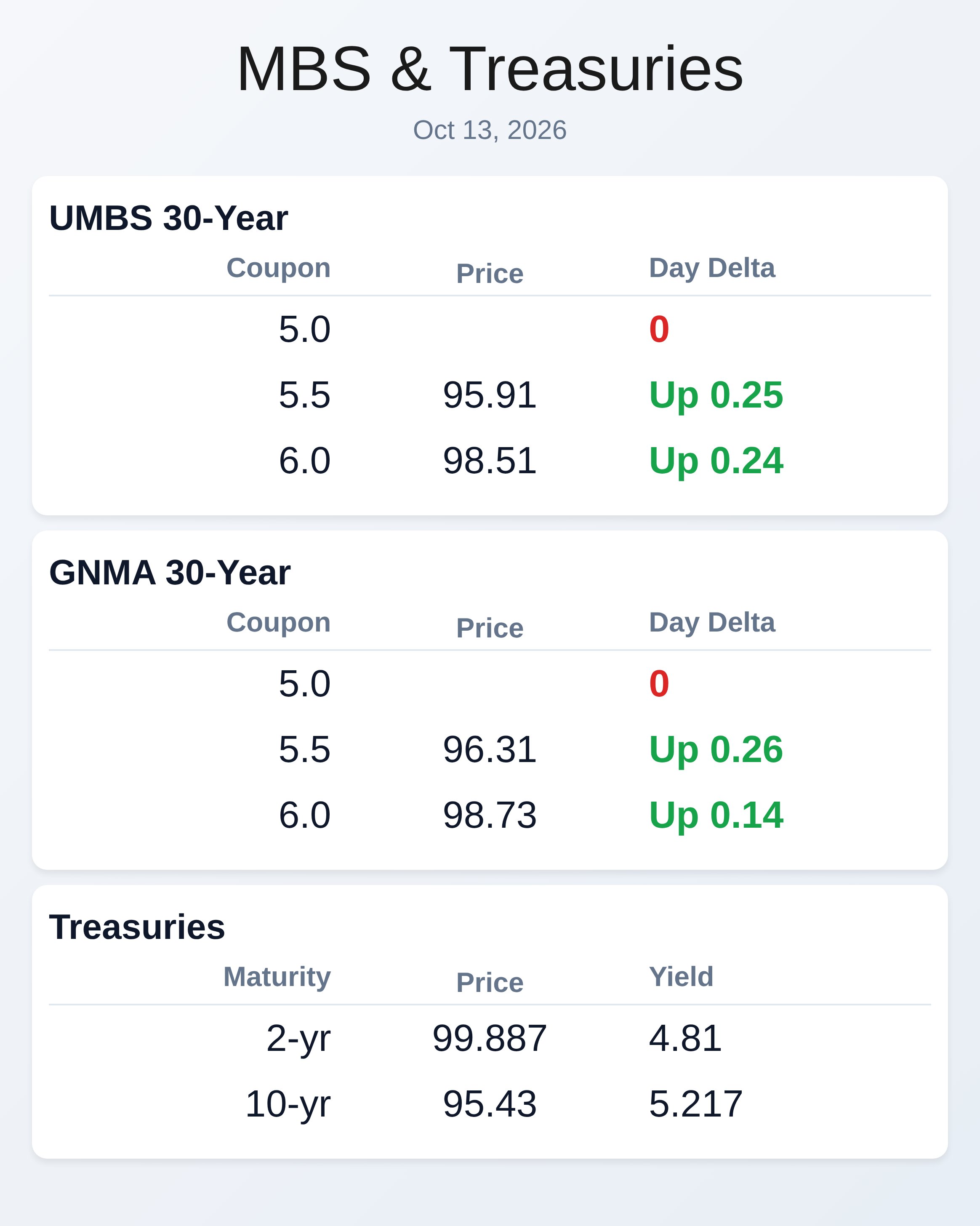
VantageScore 4.0’s broader adoption raises questions about potential underwriting discipline as lenders shift toward more favorable scoring models. The real story: MBA forecasts 2027 origination volumes will drop 5 percent to just under $2 trillion, with purchase originations barely holding while refinance activity plummets 17 percent. MBS experienced late-week volatility but closed stronger, with 30-year UMBS 6.0 finishing Friday’s session at 98.27 after early weakness threatened negative reprices.
Conventional 30-year MBS underperformed Treasuries over the week as the Fannie Mae current-coupon spread widened to 124 basis points over the 5-year/10-year Treasury blend. Mortgage applications declined 4.2 percent week-over-week as affordability pressures mounted and rates remained elevated. Servicer-level prepayment data revealed persistent differences in borrower behavior, with Rocket/Quicken leading fastest prepayers while Idaho HFA remained among the slowest for 14 consecutive months.
These spreads matter for mortgage-backed securities valuations and help investors identify stronger servicing assets. Capital markets executives at MBA Annual discussed hedging, credit access, and technology modernization as industry foundations shift. Wire fraud analytics released by FundingShield revealed 45.9 percent of transactions carried material wire and title-related risks, with CPL discrepancies accounting for 47.8 percent of problematic cases.
UAD 3.6’s November 2 mandate is forcing lenders to stress-test appraisal workflows and train teams now, not later. Polly’s partnership with newly launched F9 Advisors brings seasoned capital markets talent inside lender platforms, allowing hedge operations to scale without system changes. Technology leaders signaled that AI agents and automation will reshape fulfillment, operations, and loan delivery margins this cycle.
Industry consolidation accelerated as expected during softer volume periods, with name changes across vendor rosters and executive transitions visible throughout the conference. JPMorgan Chase sent 69 people to Chicago, representing the largest non-MBA delegation and reflecting institutional confidence in mortgage banking’s future. VantageScore arrived with 16 badges for its first-ever MBA Annual, facing off against FICO’s expanded 22-person contingent in the intensifying credit-score battle.
Credit reporting’s shift from tri-merge to alternative models could save borrowers roughly $151 at closing, or about 1 percent of total closing costs, though questions linger about whether cost savings will offset weaker underwriting visibility. MISMO rebranded with new messaging emphasizing industry collaboration and standards modernization. Originator forecasts show mounting pressure ahead as 2027 approaches with volumes expected down 5.6 percent by loan count to 5.0 million.
September prepayment speeds fell sharply, with Fannie Mae declining 7 percent month-over-month to 6.7 CPR and Ginnie Mae dropping 10 percent to 7.6 CPR. Only 0.5 percent of mortgages remain economically attractive to refinance at current rates, though roughly 29 percent could pop if rates fell 2 percentage points. Mortgage insurers look more resilient than originators because earnings depend less on volume and more on unemployment and home prices.
Sub-700 FICO loans now represent 11.4 percent of 2026 UMBS issuance year-to-date, a three-year high that warrants investor scrutiny over credit performance trends. The week ahead hinges on Wednesday’s CPI data and Thursday’s PPI release, both capable of confirming or derailing the modest bond rally that pushed 10-year yields to 5.22 percent by Tuesday. Analysts expect inflation persistence to keep longer-term rates biased higher even if economic growth moderates, meaning the Fed’s restrictive stance remains intact.
Treasury auctions continue to absorb record issuance, with strong demand providing temporary relief but not solving structural concerns around fiscal imbalances. For mortgage sellers, lock/float decisions should favor selective positioning in this higher-for-longer environment. The industry’s ability to diversify revenue through technology, servicing, and non-Agency channels will separate winners from those struggling under margin compression.
**Locking vs Floating**
Traders suggest treating the bond market’s modest late-week recovery with caution since yields at 5.2–5.3 percent may represent a tactical entry point rather than a confirmed trend reversal. Inflation data this week could either extend the small rally or send yields back toward recent highs, so lock decisions should reflect your pipeline’s actual rate-sensitive revenue exposure. Consider favoring selective, disciplined positioning rather than aggressive new rate bets, as persistent inflation, geopolitical uncertainty, and elevated Treasury supply continue pressuring longer-dated maturities lower.
**Today’s Events**
Existing home sales (expected 3.95M, prior 3.98M)
**Bond Pricing**
**UMBS 30 yr**
| Coupon | Price | Intra-Day Change |
**GNMA 30 yr**
| Coupon | Price | Intra-Day Change |
**Treasuries**
| Term | Yield | Price | Intra-Day Yield Change |