**WTMS Blog Today = What’s up in Mortgage Today (PM) – 10/29/2026**
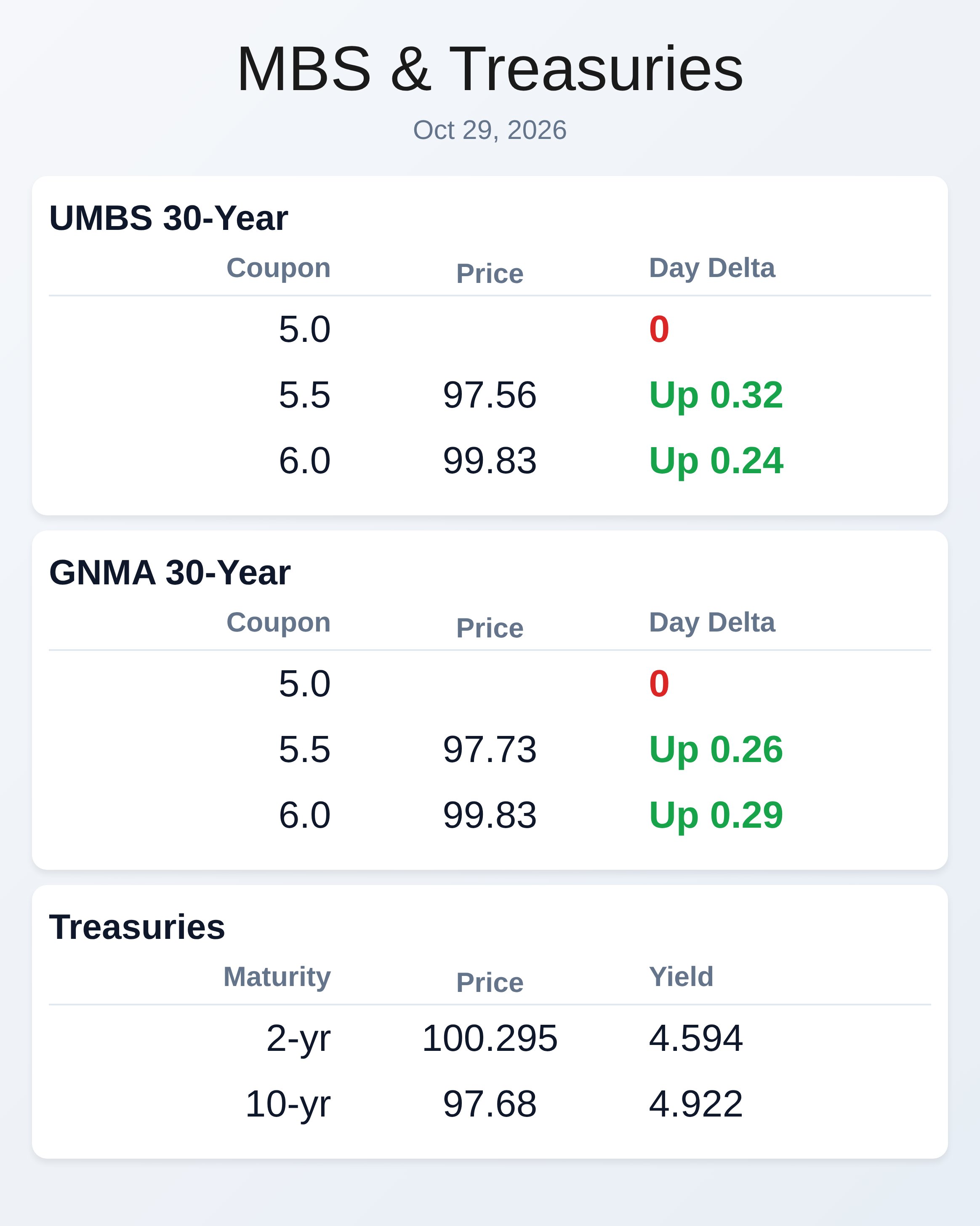
Tech stocks are cratering again, and it’s lifting Treasury yields off their lows—a sign that fear of artificial intelligence losses is temporarily overwhelming hawkish Fed rhetoric. The 10-year yield pulled back from 4.92% as Amazon and Google reported disappointing results Thursday morning, triggering another flight to safety in bonds. Agency MBS gained 25 basis points on the week as persistent concerns about tech sector leverage keep investors buying Treasuries over equities.
Mortgage applications climbed 3.4% week-over-week after two consecutive weeks of rate declines, though purchase and refi volume remain sharply below year-ago levels. The ARM share of new applications hit 11.3%—the highest in over a year—as borrowers desperate for savings gravitate toward adjustable-rate mortgages. The Federal Reserve held rates steady Wednesday at 3.75% to 4%, offering little relief but also no new hikes despite two officials voting to tighten.
Fed Chair Kevin Warsh’s comments suggested patience rather than urgency for future moves, and markets reduced rate-hike bets to single digits through year-end. Third-quarter GDP came in hot at 3.4%, beating expectations and reinforcing the economy’s underlying resilience despite higher borrowing costs. Core PCE inflation matched forecasts at 0.3% month-over-month, suggesting price pressures may be leveling off, though year-over-year core inflation remains elevated at 3.1%.
The mixed signals leave mortgage lenders caught between persistent inflation concerns and growing anxiety about a potential economic slowdown from tech sector weakness. Mortgage originators face brutal economics as volumes decline and pricing pressure mounts. United Wholesale Mortgage is selling $70 billion to $80 billion in mortgage servicing rights to reduce debt, shrinking its $270 billion servicing portfolio and signaling stress across the industry.
Enterprise Bank & Trust exited mortgage origination entirely this week, citing lack of scale—another casualty of higher rates and razor-thin margins. Smaller players are consolidating or disappearing entirely as cost structures become unsustainable without sufficient loan volume. The gap between top-performing loan officers and bottom performers has widened dramatically, with education and relationships now separating winners from those leaving the business.
CrossCountry Mortgage reported that borrowers using VantageScore 4.0 saw average loan-level pricing adjustments drop 62 basis points, translating to roughly $2,500 in savings over the first 60 days of implementation. The lender removed its 80% loan-to-value cap for conventional loans using the alternative score, expanding eligibility and giving borrowers more options to improve pricing. The shift toward VantageScore continues as Fannie Mae and Freddie Mac diverge on artificial intelligence governance standards, complicating compliance for lenders selling to both enterprises.
Fannie’s new Section 4 tightens AI model governance, while Freddie focuses on audits and executive approvals—forcing lenders to double down on policy updates and vendor agreements. The credit scoring battlefield is heating up as competition between FICO and VantageScore intensifies, with real financial consequences for borrowers hunting better rates. Home equity lending is emerging as a survival strategy for originators as cash-out refinancing remains dead despite $11.6 trillion in rate-locked equity.
With roughly half of mortgages carrying sub-4% rates, the refi incentive has evaporated, leaving HELOCs and home equity lines as the only path to tap equity. Buyers are absorbing higher rates by shifting to adjustable-rate mortgages and pushing sellers for concessions rather than price cuts—evidence of the market’s desperation to transact in an affordability crisis. Zillow is packaging down payment assistance aggressively through its lending operation, leveraging its real estate platform to capture purchase loans and deepen customer relationships.
New home sales fell 0.6% in September as the median price dropped 3.9% year-over-year, yet inventory remains tight and affordability gaps persist despite modest price relief. Mortgage rates are holding near 7.3% following the Fed’s pause, but near-term direction hinges entirely on whether tech sector weakness deepens or stabilizes. A sustained sell-off in growth stocks could push Treasury yields lower and provide temporary relief to originators facing margin compression.
Conversely, if market sentiment stabilizes and inflation concerns resurface, the 10-year yield could break back above 5.0%—devastating news for purchase pipelines. Loan officers must prepare clients for volatility and lock in rates aggressively when the opportunity presents itself. The next 30 days will determine whether the tech-driven bond rally is act one of a broader correction or a brief intermission before yields resume climbing.
**Locking vs Floating**
Tech jitters remain the primary driver of near-term rate direction rather than economic data or Fed policy. Bond markets are responding to fears of artificial intelligence investment losses compressing future corporate earnings, creating temporary safe-haven demand. Lenders should treat this rally opportunistically—it could reverse quickly if tech stocks stabilize or if inflation data reignites hawkish Fed expectations.
Lock decisions should account for the possibility that this is a tactical bounce, not the start of a sustained trend lower.
**Today’s Events**
Q3 GDP (release completed): 3.4% vs 3.2% forecast
October 24 Jobless Claims (release completed): 194K vs 199K forecast
September Core PCE m/m (release completed): 0.3% vs 0.3% forecast
September Core PCE y/y (release completed): 3.1% vs 3.1% forecast
7-Year Note Auction (release completed): 5.085%
**Bond Pricing**
**UMBS 30 yr**
| Coupon | Price | Intra-Day Change |
**GNMA 30 yr**
| Coupon | Price | Intra-Day Change |
**Treasuries**
| Term | Yield | Price | Intra-Day Yield Change |