Loading...
HOME2023-01-22T13:43:33-07:00

Damn, there is so much great knowledge out there. Did you know that “BOOKS” are full of smart?? No, I mean like life changing, I-wish-I-knew-that-years-ago type stuff.

I know that I was waaaayyy late to the game figuring it out. And I know that a lot of you are too busy to read as much as you ‘should’. And that is why you need me.

I still remember how it started for me. It started in June of 2008. After 11  years …..Click to continue

Mortgage Today (AM) - 06/29/26 {{catlist}}
June 29, 2026
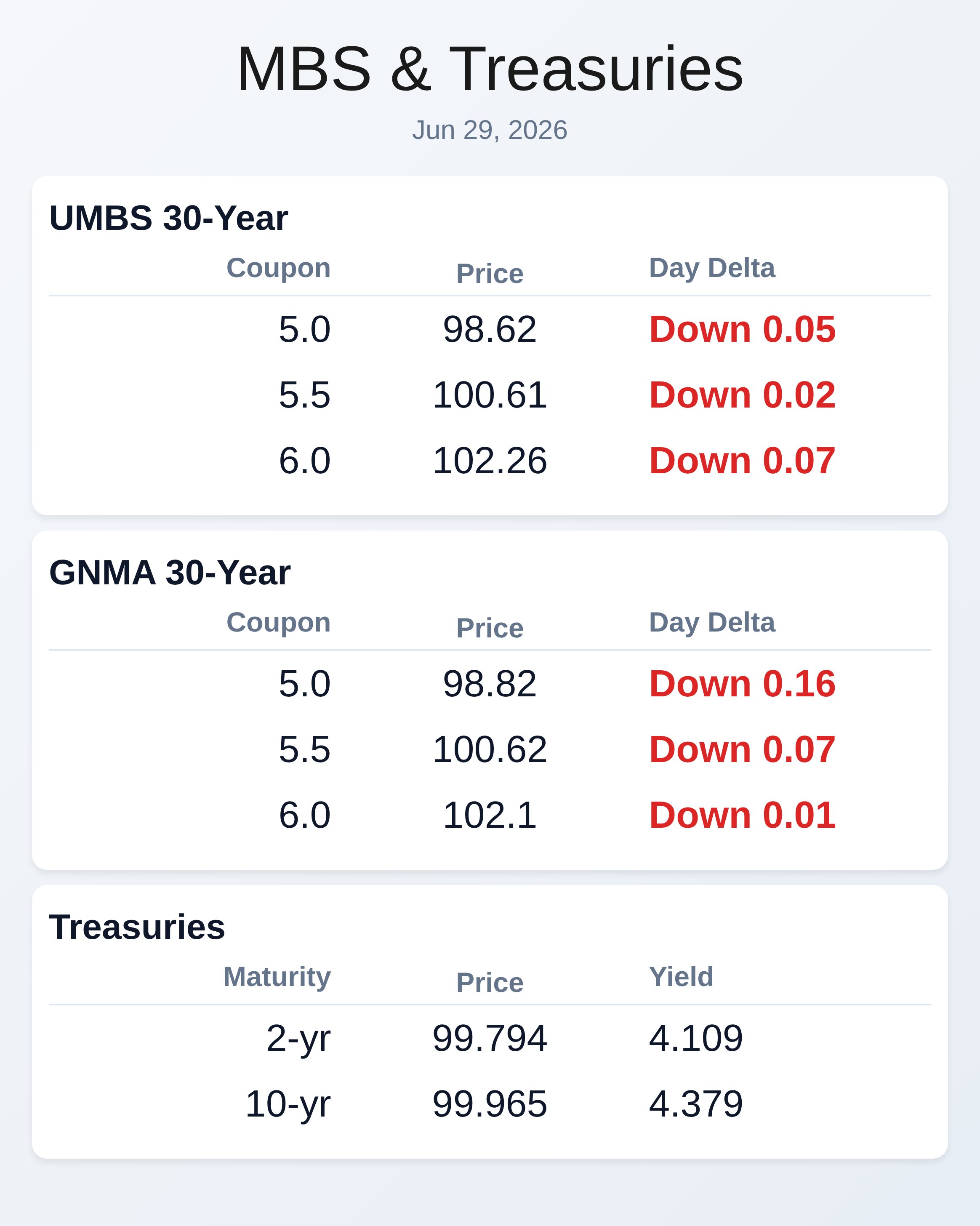
READ MORE **WTMS Blog Today = What's up in Mortgage Today (AM) - 06/29/2026** MBS underperformed to start the week as the 10-year Treasury climbed 1.6 basis points to 4.383 percent while UMBS 6.0 coupon dropped 7 ticks to 102.26. The flat overnight session gave way to mild selling pressure at 8:20 a.m., reflecting typical quarter-end positioning ahead of a quieter holiday week. Intraday volatility remained contained with GNMA securities showing broader weakness across coupons. The broader bond market gained traction last week as easing geopolitical tensions and plummeting energy prices reduced inflation shock concerns. Agency MBS held up better than expected despite falling rates, though originators faced margin pressure from widening primary-secondary spreads without a corresponding boost in loan production. Artificial intelligence adoption continues to dominate mortgage industry conversations, but actual borrower usage remains the true success metric for deployed technology. Industry experts increasingly recognize that technical sophistication alone fails if lenders introduce complexity rather than streamline processes for customers. The most successful technology implementations—like electronic promissory notes—operate invisibly to borrowers while modernizing back-end workflows substantially. Rather than replacing employees, lenders now deploy AI to automate repetitive tasks like document processing and reporting, freeing teams to focus on exception handling and relationship management. First-time homebuyers require education and ongoing communication, while repeat borrowers prioritize speed and minimal touchpoints, pushing lenders to design flexible workflows instead of rigid standardized models. Conventional conforming updates accelerated as Fannie Mae, Freddie Mac, and correspondent lenders announced overlays and policy changes effective immediately through June. Fannie Mae reminded originators to meet the Uniform Appraisal Dataset 3.6 deadline of November 2, 2026, and published guidance on new escrow reporting requirements including expanded loan data and principal-interest remittance procedures. PennyMac issued consecutive LLPA updates on June 23 and June 26, 2026, affecting best-efforts commitments with immediate impact to pricing. Newrez Correspondent updated conventional and government overlay documents effective for pipeline and new applications dated June 25, 2026 forward. These frequent guideline shifts underscore that standard conforming remains the volume game, forcing lenders to stay vigilant on compliance or face sellback risk and operational friction. Freddie and Fannie continue driving the volume game as agency g-fees ratchet higher, pushing lenders toward cash execution and alternative channels for loan sales. The week's marquee economic event arrives Thursday with the June nonfarm payrolls report, where economists expect 115,000 job additions—down from May's 172,000—with unemployment holding steady at 4.3 percent. Tuesday's releases include April FHFA and S&P Case-Shiller housing indices, June Chicago PMI, and Consumer Confidence data. Wednesday brings June ADP employment, manufacturing PMI, May construction spending, and ISM Manufacturing Index before Treasury markets close early at 2 p.m. Thursday. With bond and equity markets closed Friday for Independence Day, this compressed week tests whether resilient economic data keeps Fed tightening alive or signals soft-landing momentum. Capital markets pricing continues to reflect uncertainty on Federal Reserve intentions despite last week's economic resilience data. First-quarter growth relied disproportionately on business investment in AI infrastructure rather than household consumption, raising questions about economic durability if that spending normalizes. Kevin Warsh's hawkish Fed debut and forthcoming ECB Sintra conference remarks this week will reshape rate expectations, though energy price declines reduce tightening urgency and support longer-duration bond demand. The 10-year yield now sits at its lowest level in nearly eight weeks while the 2-year hit lows unseen in over a week, extending the recent rally. Elevated core PCE inflation remains the primary obstacle at the front end of the Treasury curve, though moderating inflation expectations and easing energy costs continue supporting the broader bond market's recent momentum. The industry's quiet pre-holiday week masks strategic conversations about mortgage operations, workforce readiness, and AI governance frameworks now dominating leadership discussions. This week's Chrisman video lineup features Brian Conneen discussing AI and fintech lessons for housing finance, Nicole Nosek on millennial homeownership trends, and panelists examining AI adoption realities beyond hype. Clear Capital data reveals that appraisal modernization adoption remains uneven despite clear efficiency gains, while inspection-based waivers gain traction as cultural and operational barriers slow UAD uptake. The daily mortgage news podcast interviews industry voices on valuation, capital markets, and operational strategy as lenders prepare for second-half execution under continuing regulatory pressure. Subscribe free at WellThatMakesSense.com to stay current on market moves and mortgage industry strategy. **Locking vs Floating** Borrowers should maintain caution heading into quarter-end given random volatility spikes remain possible, though the week's calm finish offered some reassurance on front-end stability. War-related headlines still circulate but require stronger evidence before bond markets react meaningfully. Next week presents larger volatility risks from big-ticket economic data, particularly Thursday's employment report, which will reset rate expectations significantly. **Today's Events** No scheduled economic data released today. Markets open with flat overnight conditions and modest selling pressure established at market open. **Bond Pricing** **UMBS 30 yr** | Coupon | Price | Intra-Day Change | | 5.0 | 98.62 | -0.05 | | 5.5 | 100.61 | -0.02 | | 6.0 | 102.26 | -0.07 | **GNMA 30 yr** | Coupon | Price | Intra-Day Change | | 5.0 | 98.82 | -0.16 | | 5.5 | 100.62 | -0.07 | | 6.0 | 102.1 | -0.01 | **Treasuries** | Term | Yield | Price | Intra-Day Yield Change | | 2yr | 4.109 | 99.794 | 0.014 | | 3yr | 4.11 | 100.041 | 0.014 | | 5yr | 4.145 | 99.912 | 0.017 | | 7yr | 4.251 | 99.992 | 0.017 | | 10yr | 4.379 | 99.965 | 0.013 | | 30yr | 4.861 | 102.181 | -0.007 | Market Data
Mortgage Today (PM) - 06/26/26 {{catlist}}
June 26, 2026
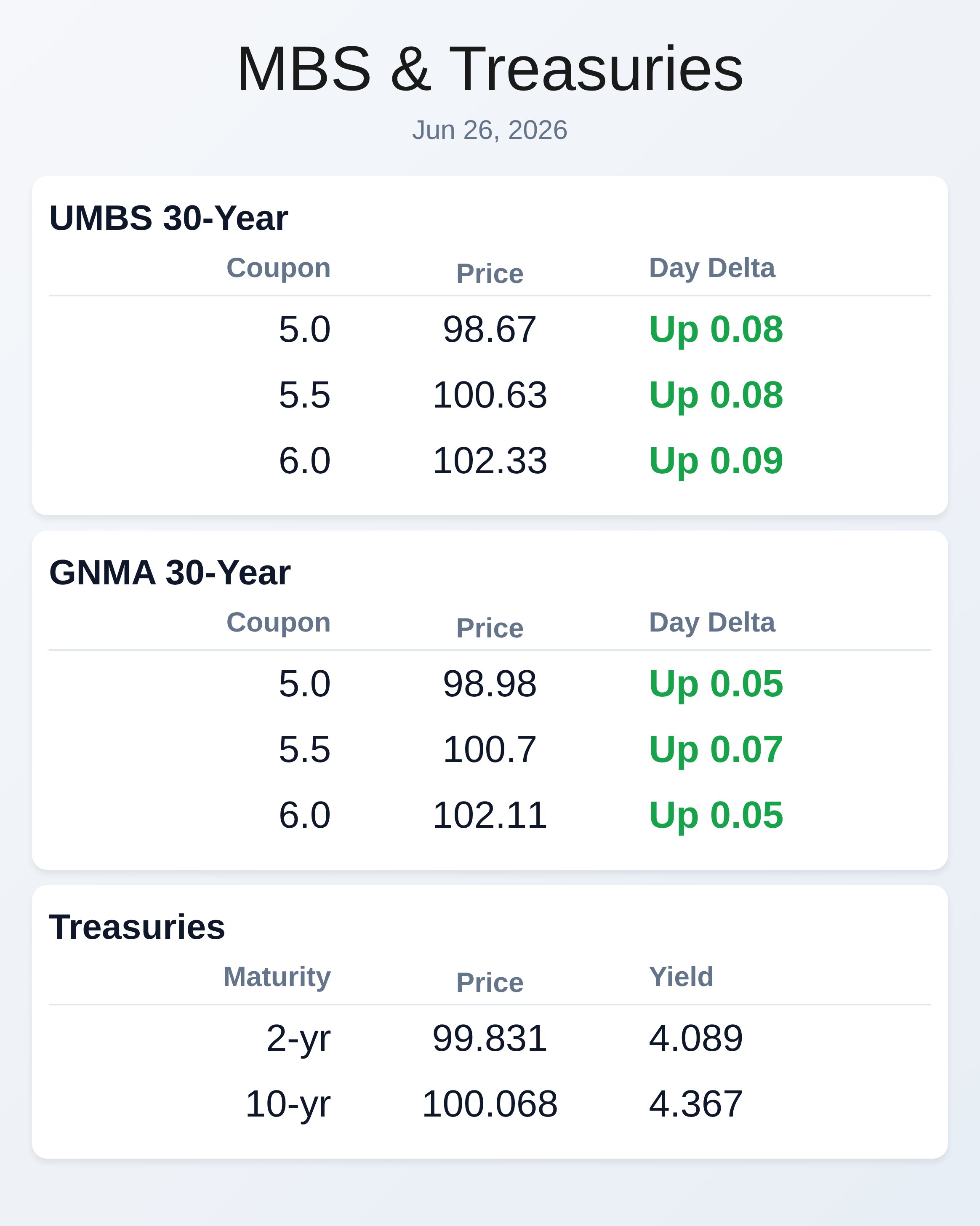
READ MORE **WTMS Blog Today = What's up in Mortgage Today (PM) - 06/26/2026** Friday delivered a textbook case of diminishing returns as mortgage bonds started the day strong, rallied into noon, and then gave back gains in an ultra-quiet afternoon. The 10-year Treasury held in a razor-thin range below 4.38%, while UMBS 5.0 coupons ended just barely positive at 98.63, up only 3 basis points on the day. MBS underperformed relative to Treasuries despite the broader bond market holding firm, signaling mixed sentiment heading into the weekend. The culprit remains quarter-end volatility uncertainty—a reminder that positioning ahead of month-end typically creates choppy, range-bound trading. Technicians note the critical support level at 4.19% in the 10-year, with resistance overhead at 4.43%, 4.51%, and 4.59%. What makes today's action matter for loan officers is the relative weakness in MBS spreads even on an up day. When Treasuries rally harder than mortgage-backed securities, it means mortgage originators face tighter pricing on new locks and funded loans. The technical picture suggests we're bottoming around current levels, but geopolitical headlines—war-related volatility remains a wildcard—could disrupt this fragile equilibrium. Bond market participants are clearly waiting for next week's employment data to set a firmer direction. Until then, expect Friday's pattern to repeat: early strength fading into a drift sideways. Positive Treasury momentum came from the 2-year yield dropping 3.4 basis points to 4.089%, the 3-year falling 3.3 basis points to 4.090%, and the 5-year sliding 3.5 basis points to 4.128%. The 10-year closed 1.6 basis points lower at 4.375%, while the long-end 30-year barely budged, up 0.6 basis points to 4.868%. This curve flattening is typical during risk-off trading, but the move lacked conviction. GNMA 5.5 coupons held at 100.70 (up 0.07), slightly lagging their UMBS equivalents at 100.61 (up 0.06). Spread compression between government-insured and agency pools suggests tight liquidity—not necessarily bullish for mortgage volumes. **Locking vs Floating** Originators should take the calm end to the week as tactical reassurance, not a signal to relax guard. Quarter-end volatility remains a genuine threat, capable of moving 10-year yields 20+ basis points in either direction by Wednesday. War-related headlines, while not yet moving markets significantly, provide a tail risk that bond traders cannot ignore—especially heading into a three-and-a-half-day week due to Independence Day. Next week's job report on Thursday will be the dominant event; stronger-than-expected payrolls could trigger immediate 10yr yield spikes. Current support sits at 4.19% (buy signal) and resistance at 4.43%, 4.51%, and 4.59% (sell triggers). **Bond Pricing** **UMBS 30 yr** | Coupon | Price | Intra-Day Change | **GNMA 30 yr** | Coupon | Price | Intra-Day Change | **Treasuries** | Term | Yield | Price | Intra-Day Yield Change | Market Data
Mortgage Today (AM) - 06/26/26 {{catlist}}
June 26, 2026
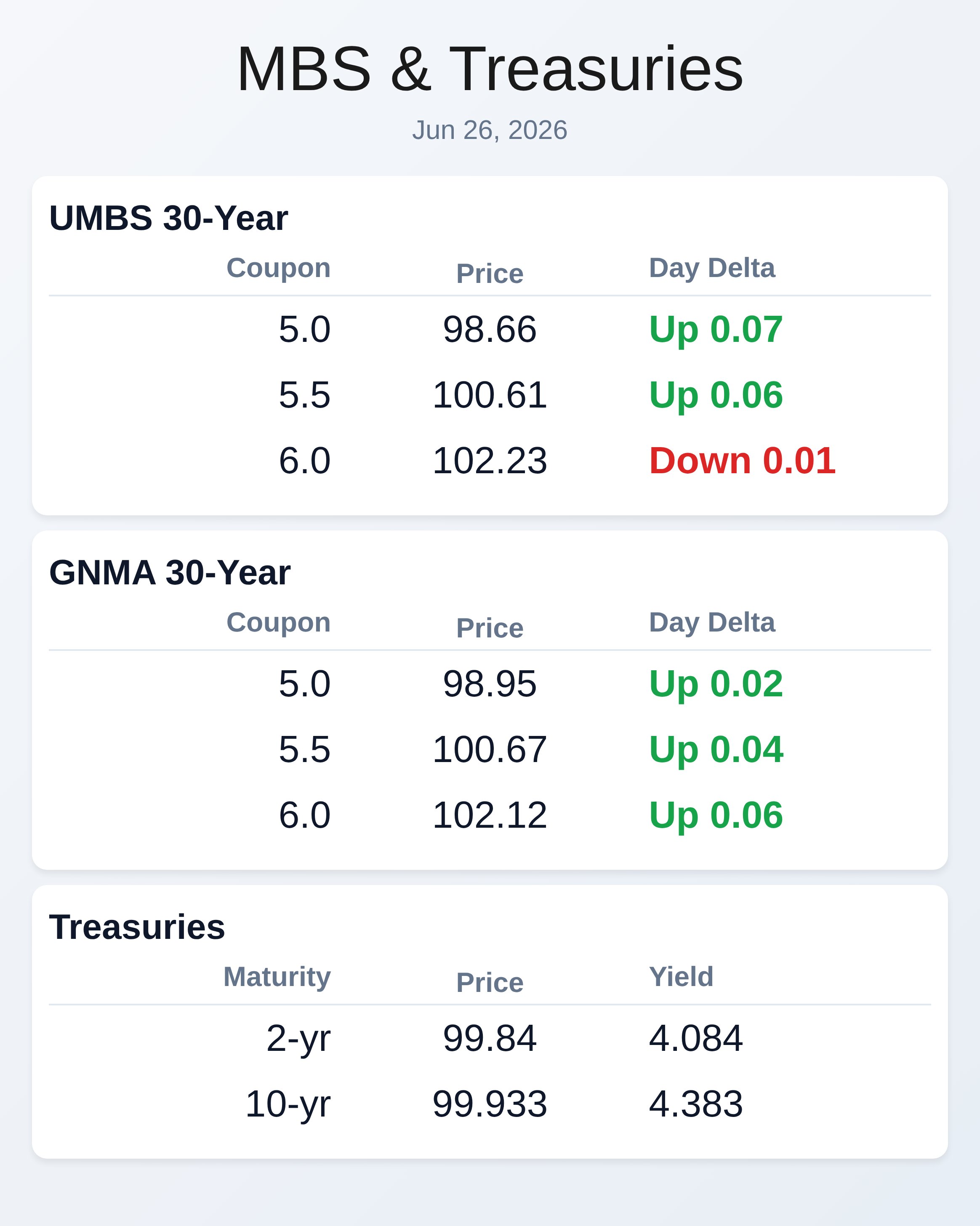
READ MORE **WTMS Blog Today = What's up in Mortgage Today (AM) - 06/26/2026** New home sales collapsed 7.3% in May, marking the lowest pace since January as affordability crises overwhelm buyers and builders alike. The annualized sales rate fell to 580,000 units, well below the 640,000 expected, while inventories spiked to 10.3 months of supply—the highest level since 2009. The West saw the steepest decline at 26.9%, while the South dropped to a seven-year low despite being the nation's largest homebuilding region. Median prices edged up to $424,900 even as developers slashed prices and offered mortgage rate buydowns. This inventory glut is forcing builders to pull back on new construction to clear the backlog. Mortgage payments hit a one-year high in May at $2,198 on new purchase loans, up 2.1% from April and rising for three consecutive months. Affordability collapsed in 33 states as rising rates combined with elevated home prices to push monthly obligations skyward across all loan types. Conventional loan payments jumped to $2,211 while FHA payments surged 2.4% to $1,873. Although current payments remain below last May's $2,211 peak, the recent three-month trend signals sustained pressure on borrowers and originators facing tighter pipelines. Rate hold at current levels would continue dampening origination volumes through the summer. Agency MBS prices started Friday sideways with minimal momentum as the economic calendar remains quiet ahead of weekend quarter-end positioning flows. The 10-year Treasury moved down 1.7 basis points overnight but bounced back near yesterday's close, creating technical uncertainty around the 4.42% resistance level tested this week. UMBS 5.0 coupons sat at 98.62 with intraday gains modest at +0.02, while GNMA 5.0s traded slightly better at 98.94. The broader market awaits the final University of Michigan Consumer Sentiment reading, expected to be revised higher on lower gasoline prices and strong stock-market gains. Quarter-end rebalancing among portfolio managers could trigger random volatility spikes through next Wednesday. Buydown mortgages have become a critical tool for survival, now representing $41.7 billion or 1.6% of the Ginnie Mae universe as affordability pressures persist. Concentrated in FHA and VA lending, these loans temporarily reduce borrower rates for one to three years while requiring qualification at the fully indexed payment. Investors value buydowns for prepayment protection during the subsidy period since borrowers have less incentive to refinance, though activity typically accelerates once the buydown expires. This product segment is likely to remain significant as originators battle higher rate environments and buyer resistance. For lenders, buydowns represent both a competitive necessity and a source of longer-duration cash flow. Fifteen-year UMBS pools continue outperforming their 30-year counterparts despite representing a much smaller market share due to declining refinance activity. The 30-year UMBS universe has exploded 141% since 2019 to $5.3 trillion, while 15-year issuance contracted sharply after rates rose in 2022. Faster prepayment speeds on 15-year pools reflect borrower quality and curtailment behavior that appeals to investors seeking principal return and duration control. The shrinking supply of 15-year pools combined with favorable borrower profiles creates a diversified investment case that compares favorably in higher-rate environments where cash-in-hand carries premium value. Forward issuance trends suggest this relative scarcity will persist, supporting relative value. Global markets are struggling to find footing as technology stock weakness spreads across equities while bond markets gain traction. Nasdaq 100 futures fell 1.3% Friday morning following a New York Times report that OpenAI may delay its public offering until 2027. Investors pulled money from U.S. equities for the first time in three months with record withdrawals from tech, signaling potential rotation away from crowded trades. Oil prices resumed their decline to below $71 per barrel, supporting bond rallies as inflation fears ease. The dollar held onto year-to-date gains as Federal Reserve Chairman Kevin Warsh signaled commitment to price stability, potentially supporting continued accommodative market sentiment. **Locking vs Floating** Rates confirmed a break below the 4.42% technical level Thursday with modest strength, marking the best showing in recent weeks. However, the fragile nature of the breakdown means quarter-end volatility could easily erase gains or push rates higher into next week. MBS price movements remain the most reliable intraday hedging tool, while longer-term momentum direction tracks the 10-year Treasury yield ceiling-floor band that signals bigger market picture trends. **Bond Pricing** **UMBS 30 yr** | Coupon | Price | Intra-Day Change | | 5.0 | 98.66 | 0.07 | | 5.5 | 100.61 | 0.06 | | 6.0 | 102.23 | -0.01 | **GNMA 30 yr** | Coupon | Price | Intra-Day Change | | 5.0 | 98.95 | 0.02 | | 5.5 | 100.67 | 0.04 | | 6.0 | 102.12 | 0.06 | **Treasuries** | Term | Yield | Price | Intra-Day Yield Change | | 2yr | 4.084 | 99.84 | -0.038 | | 10yr | 4.383 | 99.933 | -0.008 | | 30yr | 4.875 | 101.963 | 0.012 | Market Data
LATEST ARTICLES

RECENT ARTICLES

Traction 1

January 10th, 2023|Traction Book|

Post #1 in a mult-part series from the excellent book Traction by Gino Wickman Every Corporation has 6 components. Vision:  You must create a compelling vision and be able to communicate it clearly. [...]

Article Archive

Subscribe

Send me some brain food

Go to Top