Loading...
HOME2023-01-22T13:43:33-07:00

“Damn, there is so much great knowledge out there. Did you know that “BOOKS” are full of smart?? No, I mean like life changing, I-wish-I-knew-that-years-ago type stuff.

I know that I was waaaayyy late to the game figuring it out. And I know that a lot of you are too busy to read as much as you ‘should’. And that is why you need me.

I still remember how it started for me. It started in June of 2008. After 11  years …..Click to continue

Mortgage Today (PM) - 10/28/26 {{catlist}}
October 28, 2026
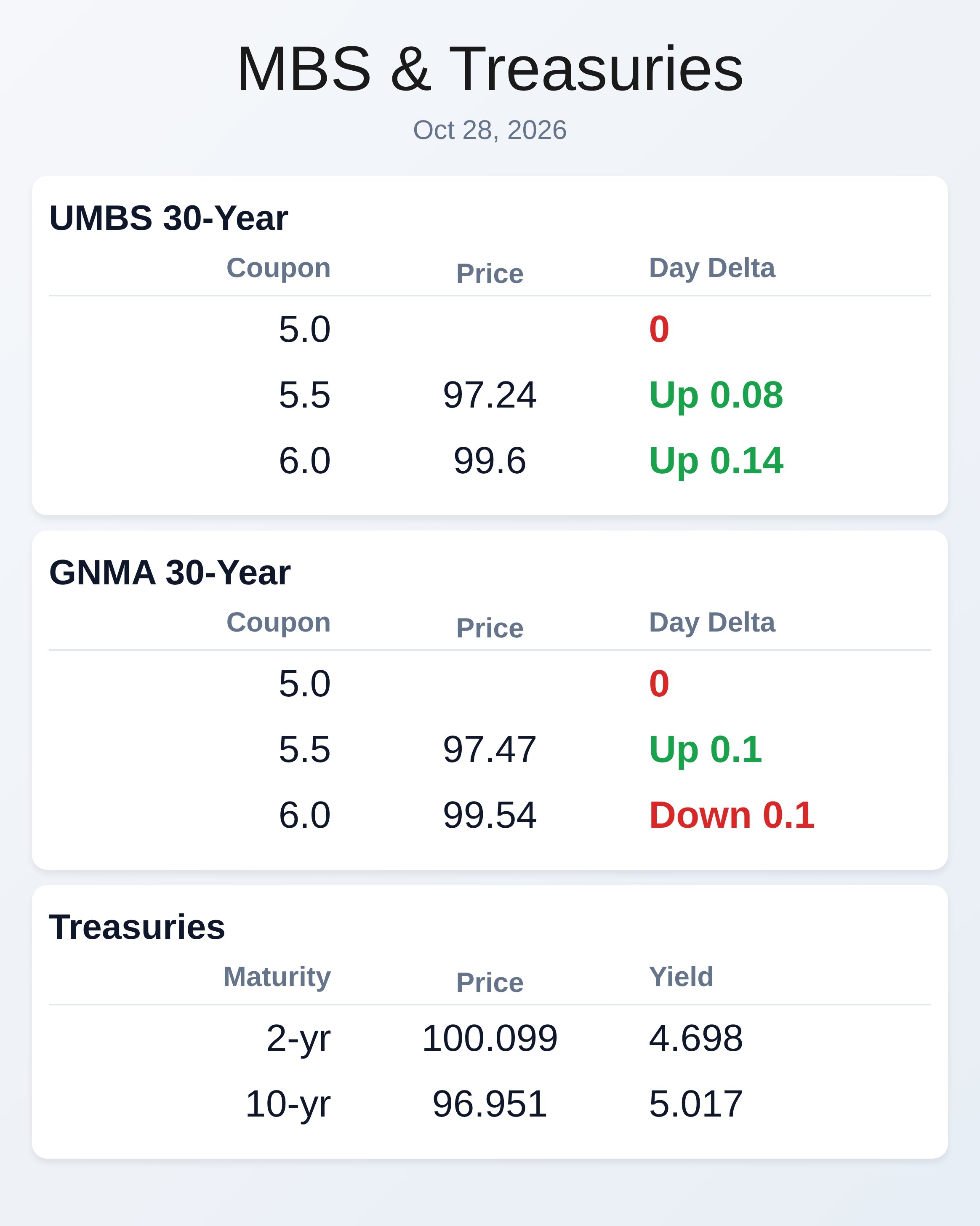
READ MORE **WTMS Blog Today = What's up in Mortgage Today (PM) - 10/12/2026** The mortgage market is holding steady at a crossroads as bond traders wrestle with competing forces: persistent inflation worries, geopolitical tensions pushing oil higher, and growing anxiety about AI-driven debt bubbles. UMBS 6.0 closed Friday at 98.27, while the 10-year Treasury yield sits at 5.243%, after a week of volatile swings between optimism about tech weakness and concern about stubborn price pressures. MBA's economic team downgraded 2027 origination forecasts to just under $2 trillion, down 5% from 2026, signaling origination volume headwinds will persist through year-end and into spring. Sellers now outnumber buyers by 63%—a record gap since 2013—giving real estate agents unprecedented leverage in negotiations even as that market remains starved for qualified borrowers. Mortgage applications fell 4.2% week-over-week last week, and the primary-secondary spread widened to 92 basis points as lenders brace for tighter margins and more selective customer acquisition. The week ahead will test whether mid-October's bond rally holds ground or fades into another round of selling. The Consumer Confidence Index and economic data releases later this week could accelerate a rebound in Treasury yields if they signal the labor market remains too strong for the Fed to pause indefinitely. Wall Street had priced in nearly zero probability of an October rate hike going into this week, but recent inflation prints have traders reconsidering whether the Fed truly has the luxury of sitting pat through year-end. For mortgage originators, the backdrop remains challenging: purchase originations are forecast to gain just 0.8% next year to $1.42 trillion, while refinance volume craters 17% to $571 billion as existing homeowners with sub-5% rates have no rational incentive to touch their mortgages. Technology valuations and AI credit concerns continue to dominate sentiment, with brief periods of weakness in semiconductor stocks triggering sharp bond rallies as investors seek safe havens. The MBA's week in Chicago highlighted just how wide the gap has grown between mortgage banking cost structures and the revenue lenders can generate in this environment, with multiple industry voices warning that traditional retail delivery models are becoming economically unsustainable. Pending home sales hit a 12-year low as higher rates and limited inventory converge to squeeze both demand and supply, leaving brokers and loan officers fighting harder than ever to capture a smaller pool of qualified buyers. Credit remains surprisingly resilient despite affordability pressures, though FHA originations are climbing as borrowers with moderate credit profiles lean on government programs to bridge the down-payment gap. The tension between rate stability and mortgage demand will likely define the remainder of Q4, with lenders forced to optimize cost structures and technology investments to survive margins that show no sign of meaningful improvement. **Locking vs Floating** Traders continue to assess whether last week's tech-driven rally establishes a floor in yields or merely provides another tactical relief bounce before yields resume their climb. The playbook remains hazardous: lock aggressive borrowers facing imminent closings, float only those with genuine pipeline cushion and strong fallback options. **Today's Events** October Consumer Sentiment (preliminary): Forecast 47.6, Prior 48.1 University of Michigan Consumer Sentiment data may provide clues about whether rising rates and economic uncertainty are finally beginning to dent household confidence. **Bond Pricing** **UMBS 30 yr** | Coupon | Price | Intra-Day Change | **GNMA 30 yr** | Coupon | Price | Intra-Day Change | **Treasuries** | Term | Yield | Price | Intra-Day Yield Change |

Market Data
Mortgage Today (AM) - 10/28/26 {{catlist}}
October 28, 2026
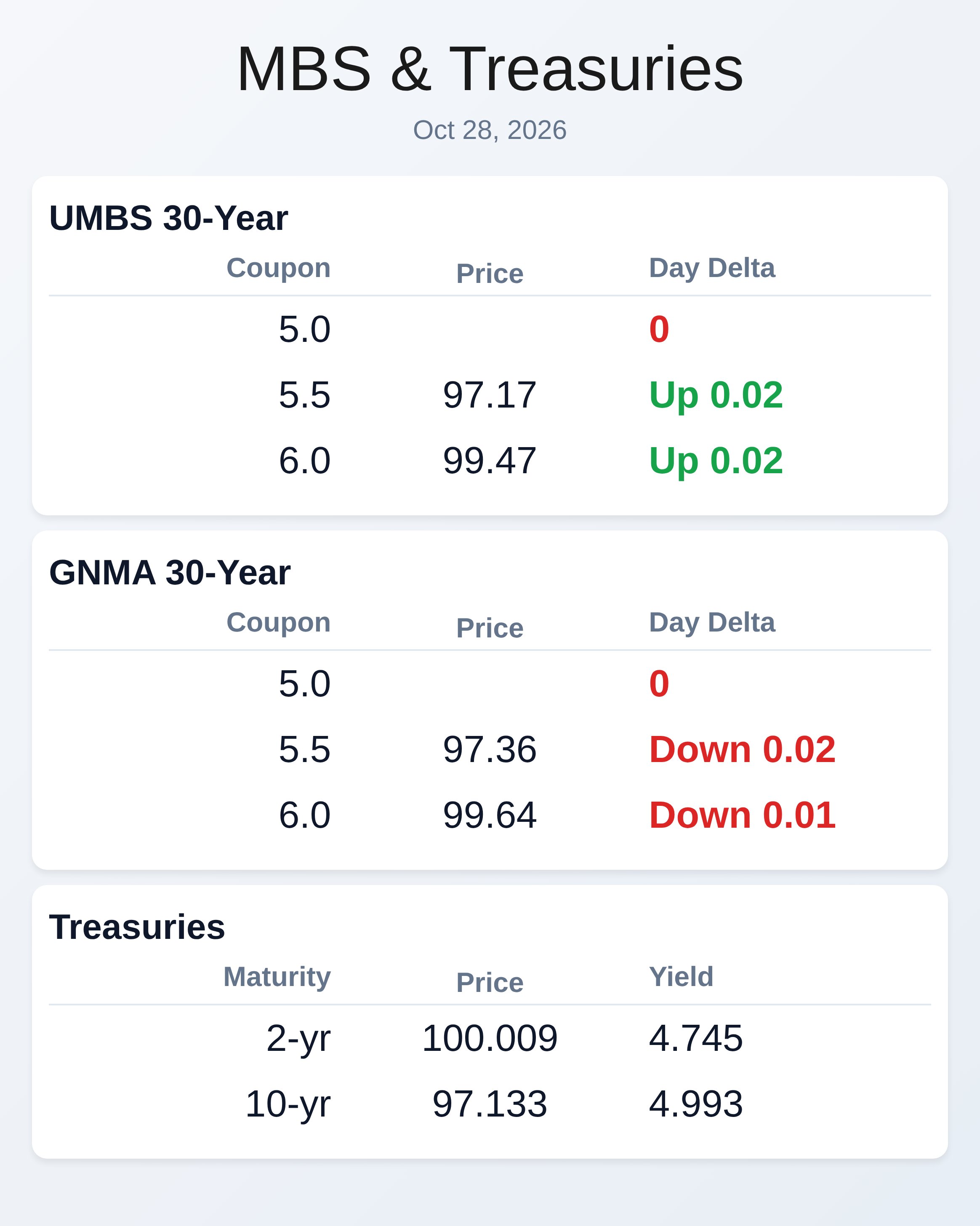
READ MORE **WTMS Blog Today = What's up in Mortgage Today (AM) - 10/28/2026** Mortgage markets are absorbing competing pressures this week as the Federal Reserve holds rates steady while signaling hawkish resolve, oil prices surge past $115 a barrel, and housing demand continues its slide despite modest rate relief. The 10-year Treasury is trading near 5.0 percent, down from 5.32 percent in early October following safe-haven flows driven by tech sector volatility and AI valuation concerns. Fannie Mae reported $4.2 billion in third-quarter net income with a near-$120 billion net worth position, reflecting the Government-Sponsored Enterprise's recovery from the pandemic. Industry layoffs at Freddie Mac and compressed margins across independent mortgage banks signal that the 2027 production forecast—now projected below $2 trillion, down 5 percent year-over-year by the MBA—is reshaping staffing and profitability expectations. Loan officer retention has become a critical concern as many lenders reduce positions or shift originators to part-time status amid the lowest purchase application volumes since the financial crisis. Non-QM and adjustable-rate mortgage products have gained meaningful share as borrowers and lenders adapt to elevated rates and shrinking affordability. Pending home sales collapsed 7.3 percent in September while housing starts fell 5.2 percent, with builder confidence hitting its lowest level since June 2012 as rising financing costs and labor shortages squeeze margins. Home prices remain elevated despite modest appreciation of only 2.7 percent annually, forcing borrowers to choose between adjustable-rate mortgages and scaled-down home sizes. Fannie Mae's occupancy verification flags and UAD 3.6 appraisal reporting requirements launching November 2 add compliance complexity and underwriting time. Mortgage insurance repurchase activity jumped 19.5 percent in Q2 2026, with loans originated six to twelve months prior accounting for 46.5 percent of buyback volume, highlighting emerging credit and documentation concerns. Rocket Mortgage led repurchase share at 9.7 percent while Fannie Mae proved notably more aggressive than Freddie Mac on resolution rates. Treasury auction weakness, Federal Reserve runoff of Agency mortgage-backed securities portfolios, and geopolitical tensions over the Strait of Hormuz keep refinancing activity severely suppressed at 61 percent below year-ago levels. FHFA Director Bill Pulte's executive order directing proactive mortgage insurance cancellation and expanded title insurance waivers drew mixed reactions from MBA, brokers, and insurers, though implementation timelines remain uncertain and dependent on GSE guidance. The order addresses only refinancing relief and overlooks jumbo loan competition from banks and credit unions that cap origination fees and offer adjustable-rate products at more attractive pricing. Credit market stress from AI infrastructure financing concerns, combined with sticky inflation and labor-market questions, creates dual risks for lenders managing pipeline hedges and borrower lock expirations. Markets will closely monitor third-quarter GDP data, PCE inflation readings, and initial jobless claims over the coming days, as every basis point of Treasury volatility translates into lock-and-hold decisions for loan officers caught between aggressive pricing and pipeline risk. Origination profitability remains compressed even as Fannie Mae's solid capital position and reduced regulatory uncertainty provide some long-term confidence. Lenders who succeed in this environment are those investing in operational efficiency, non-Agency product diversification, and AI-assisted underwriting while maintaining disciplined credit and pricing strategies. **Bond Pricing** **UMBS 30 yr** | Coupon | Price | Intra-Day Change | **GNMA 30 yr** | Coupon | Price | Intra-Day Change | **Treasuries** | Term | Yield | Price | Intra-Day Yield Change |

Market Data
Mortgage Today (PM) - 10/27/26 {{catlist}}
October 27, 2026
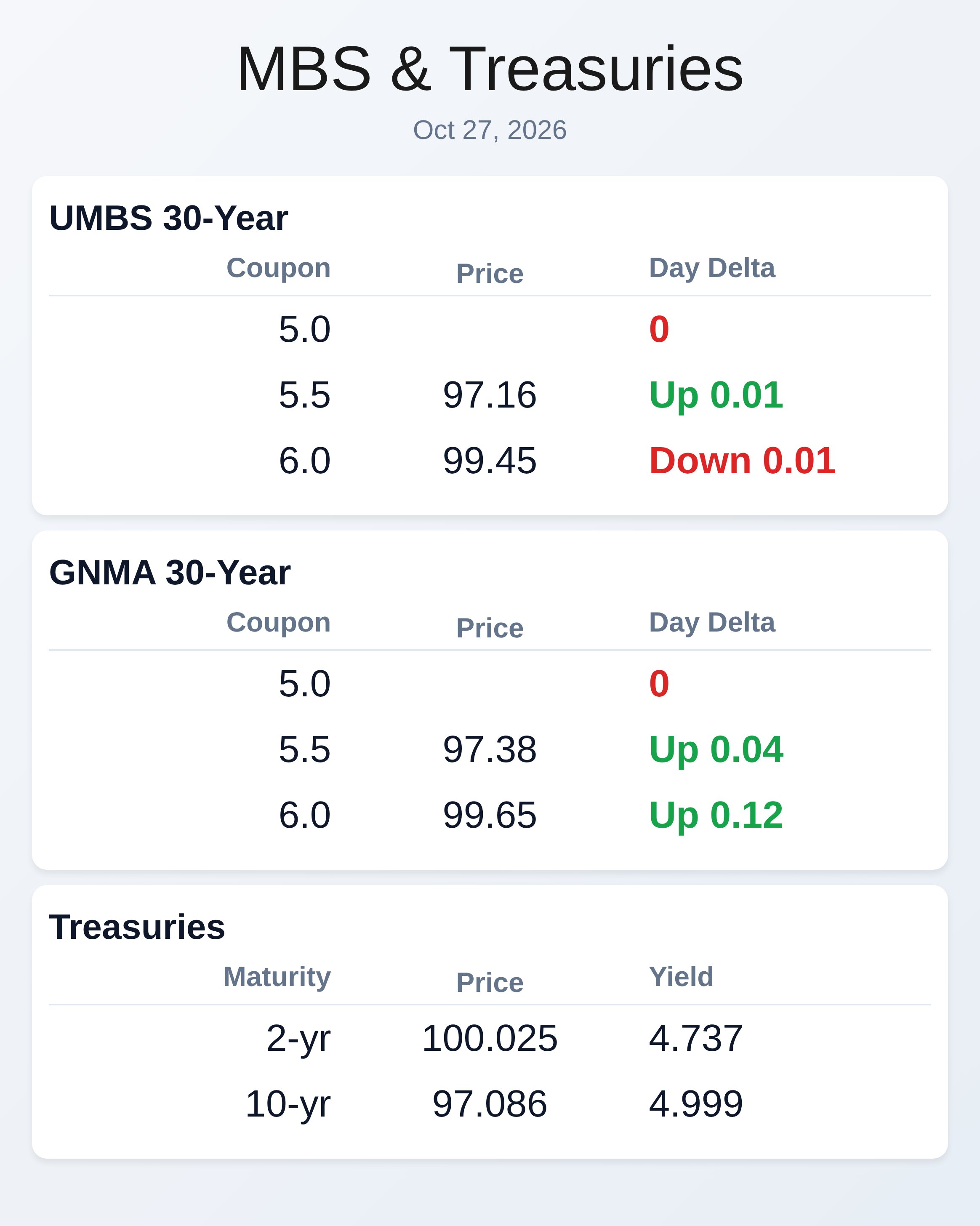
READ MORE **WTMS Blog Today = What's up in Mortgage Today (PM) - 10/23/2026** Mortgage rates delivered their best daily performance since August 2025 this week as technology stock turmoil sent investors scrambling into the safety of Treasury bonds. The 10-year yield plummeted 159 basis points on Thursday alone, with UMBS 6.0 climbing nearly 70 basis points to 99.55 as flight-to-safety dynamics overwhelmed concerns about persistent inflation and elevated oil prices. Artificial intelligence sector weakness, particularly pressure on companies like Coreweave facing funding uncertainties, triggered broad equity selloffs that fundamentally shifted bond market demand. Mortgage origination margins improved noticeably as secondary markets tightened spreads, offering meaningful relief after weeks of constrained gain-on-sale margins. The rally's staying power depends entirely on whether technology credit concerns persist or stabilize, creating genuine uncertainty for locking strategy into early November. President Trump signed a sweeping housing executive order Thursday targeting mortgage insurance cancellation, refinance costs, and GSE fee structures through the FHFA. The order directs proactive mortgage insurance cancellation for eligible borrowers based on current property values, though the pilot applies only to loans originated after the program begins, limiting immediate impact on existing homeowners. Title insurance waiver programs become permanent, potentially saving $500 to $1,500 per refinance while loan-level price adjustments face potential reduction on qualifying rate-reduction refis. However, critics note the proposal favors existing homeowners over purchase borrowers, as savings flow primarily to refinancing and mortgage insurance cancellation rather than addressing home price affordability. The MBA's competing affordability roadmap proposes reducing credit score reporting requirements, lowering FHA insurance premiums, and streamlining refinancing across both GSEs. Origination volume projections worsened measurably this week with the MBA forecasting 2027 total single-family mortgage volume declining 5% to just under $2 trillion, down from $2.1 trillion expected in 2026. Purchase originations face only modest 0.8% growth while refinance volume collapses 17% to $571 billion as rising rates throughout October destroyed refinance economics for the vast majority of borrowers. September funding volume declined 15% year-over-year according to proprietary application data, with retail declining 7% month-over-month despite a 30-year funded rate of 6.58%. Mortgage applications fell another 2.7% week-over-week as rates climbed to 7.5%, their highest level in nearly three years, pushing adjustable-rate mortgage adoption to 10.5% of applications. September prepayment speeds slowed sharply with Fannie Mae speeds falling 7% month-over-month to 6.7 CPR as only 0.5% of mortgages remained economically attractive to refinance. Home sellers outnumber buyers by 63%, the widest gap since 2013, creating a buyer's market across 41 of 50 major metros while just five remain seller-favored. Existing home sales rose 1.5% month-over-month to 3.99 million annually, but still trail year-ago levels by 2.2%, with inventory climbing 4.6% year-over-year to 1.6 million homes representing 4.8 months supply. The median existing home price reached $417,500, marking the 39th consecutive month of year-over-year gains despite affordability pressures crushing demand. Even borrowers willing to put down 20% face an affordability gap, with the median home requiring $90,191 in annual income versus the $79,534 average wage, creating a gap of nearly $11,000. Homes became less affordable than historical averages in 570 of 583 counties analyzed, demonstrating the breadth of the affordability crisis across virtually every market. Wire fraud and defect risk reached troubling levels in the third quarter with FundingShield's analytics showing 45.9% of monitored transactions carrying material wire and title-related risks across a $108.7 billion portfolio. Problematic transactions averaged 2.2 issues each, with 47.8% involving closing protection letter discrepancies, 6% involving wire-instruction defects, and 1.6% involving licensing irregularities. GSE repurchase activity increased 19.5% in Q2'26 with 1,401 loans totaling $465.2 million in UPB repurchased, with loans from Q3'25 and Q4'25 accounting for 46.5% of activity. Rocket Mortgage, United Wholesale Mortgage, and Lakeview Loan Servicing represented the three largest originators by repurchase share at 9.7%, 5.4%, and 2.4% respectively. Fannie Mae also expanded occupancy verification requirements effective November 13, requiring automated valuation model screening to flag potentially inaccurate designations before purchase. **Locking vs Floating** Tech stock weakness created genuine safe-haven demand for bonds, but the rally's continuation depends on whether semiconductor and AI-related credit concerns spread to the broader market or stabilize. Intraday volatility remained elevated as options expiration and thin Friday trading exaggerated moves in both directions, though closing prices held near session highs. Rates appear to have found support in the 5.05% to 5.10% range this week, but another tech recovery could quickly send yields back toward the 5.27% to 5.34% resistance levels recently tested. Lenders should avoid overcommitting to aggressive repricing until Monday's opening establishes confirmation of either continued safe-haven demand or profit-taking reversals. **Today's Events** Import prices September: 1.1% vs 0.8% forecast Industrial Production September: 0.7% vs 0.4% expected Consumer Sentiment October (preliminary): 47.6 vs 48.1 prior Existing Home Sales September: 3.99M vs 3.95M forecast **Bond Pricing** **UMBS 30 yr** | Coupon | Price | Intra-Day Change | **GNMA 30 yr** | Coupon | Price | Intra-Day Change | **Treasuries** | Term | Yield | Price | Intra-Day Yield Change |

Market Data
LATEST ARTICLES

RECENT ARTICLES

Mortgage Today (AM) – 02/27/26

February 27th, 2026|Week In Review|

WTMS Blog Today = What's up in Mortgage Today (AM) - 02/27/2026 Treasury yeilds held steady below 4.0% this morning despite hotter-than-expected inflation data. The 10-year Treasury yield dropped to 3.975%, showing resilience even as [...]

Mortgage Today (PM) – 02/26/26

February 26th, 2026|Week In Review|

WTMS Blog Today = What's up in Mortgage Today (PM) - 02/26/2026 Mortgage-backed securities hit their best levels of the day by late afternoon, with UMBS prices climbing an eighth of a point while the [...]

Mortgage Today (AM) – 02/26/26

February 26th, 2026|Week In Review|

WTMS Blog Today = What's up in Mortgage Today (AM) - 02/26/2026 Mortgage bonds are holding steady near their strongest levels this week, offering originators a rare moment of stability in an otherwise volatile market. [...]

Article Archive

My Reading Notes of “The 5th Agreement”- 14

April 2nd, 2024|0 Comments

WTMS Blog Today= ???? Transform Your Life & Career: The Miraculous Power of The Four Agreements & The Fifth Agreement ???? ???? "Unlock the Secret to Personal & Professional Fulfillment!" ???? Real Estate [...]

Yeah But………..Trigger leads

March 27th, 2024|0 Comments

WTMS Blog today: Yeah But......Trigger Leads >>> This week's topic is Trigger Leads. I hate them. You hate them. Buuuutttt could there actually be an argument AGAINST the laws prohibiting them??? On Yeah [...]

Subscribe

Send me some brain food

Go to Top