
The Great Credit Score Shake-Up: What Just Changed Between the GSEs and the Scoring Giants
FHFA just rewrote the playbook on credit scoring for government-backed mortgages—here’s exactly what happened and when it takes effect
If you’ve been in the mortgage business for more than a hot minute, you know that change comes at two speeds: glacial and “what the hell just happened?” The credit scoring landscape just shifted from first gear to fifth, and if you’re still using your old assumptions about FICO’s monopoly on mortgage lending, buckle up. The Federal Housing Finance Agency (FHFA) just ended a decades-long exclusive relationship, and the ripple effects are about to hit your pipeline.
Let’s break down exactly what changed, who’s affected, and when you need to care about it. No opinions, no hot takes—just the facts about the biggest shift in mortgage credit scoring since Fannie and Freddie started requiring FICO scores in the 1990s.
The FHFA’s Historic Announcement: October 2022
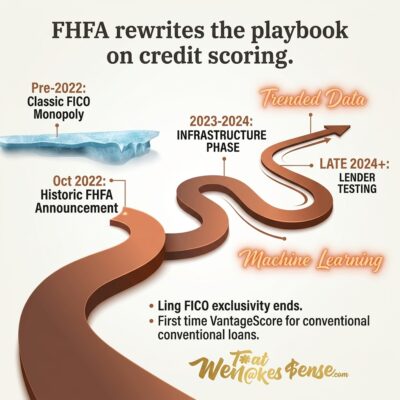
On October 24, 2022, the Federal Housing Finance Agency dropped a bombshell in the form of a press release with the thrilling title “FHFA Announces Validation and Approval of Credit Score Models.” Director Sandra L. Thompson announced that FHFA had completed a years-long validation process and approved two new credit scoring models for use by Fannie Mae and Freddie Mac: FICO Score 10T and VantageScore 4.0.
This marked the first time in over three decades that the GSEs would accept a credit score other than the classic FICO models (specifically FICO Score 5 from Equifax, FICO Score 4 from TransUnion, and FICO Score 2 from Experian—yes, we’ve been using scores from the 1990s). More significantly, it was the first time VantageScore would be accepted at all for conventional mortgage underwriting.
The FHFA’s announcement specified that both Fannie Mae and Freddie Mac would be required to transition to these new models, but implementation would be phased. The stated goals were to increase accuracy in credit risk assessment, expand access to credit for underserved populations, and introduce competition into the credit scoring market.
The Implementation Timeline: Slower Than You’d Think
Here’s where it gets interesting. The October 2022 announcement wasn’t a “flip the switch tomorrow” situation. The FHFA laid out a multi-year implementation timeline:
Phase 1 (2023-2024): Infrastructure Development — Fannie Mae and Freddie Mac were required to work with the credit bureaus and scoring companies to build the technological infrastructure necessary to deliver the new scores. This included updating their automated underwriting systems (Desktop Underwriter for Fannie, Loan Product Advisor for Freddie) to accept and evaluate the new scores.
Phase 2 (Expected late 2024 to early 2025): Lender Testing and Validation — Lenders would begin receiving both the old and new credit scores in a parallel testing environment. This allows lenders to update their own systems, train staff, and validate that the new scores work as expected without disrupting actual loan production.
Phase 3 (Expected 2025): Full Implementation — The new credit scoring models would become the required standard for all loans delivered to Fannie Mae and Freddie Mac. The old FICO models would be phased out entirely.
As of early 2025, the industry is in the late stages of Phase 2, with full implementation expected later in the year. The exact dates have shifted multiple times as the GSEs and lenders work through technical challenges, which is about as surprising as traffic on the 405.
What Changed at the FHA and VA: Spoiler Alert—Not Much (Yet)
Here’s where we need to separate fact from speculation. While the FHFA’s announcement affected Fannie Mae and Freddie Mac, the Federal Housing Administration (FHA) and the Department of Veterans Affairs (VA) have not announced similar changes to their credit scoring requirements as of early 2025.
FHA continues to use the traditional FICO scores (FICO 2, 4, and 5) for loan underwriting. FHA’s minimum credit score requirement remains 500 for maximum financing with a 10% down payment, and 580 for 96.5% financing. FHA has made no official announcement about transitioning to FICO 10T or VantageScore 4.0. Given that FHA operates under the Department of Housing and Urban Development (HUD) rather than FHFA, any changes would require separate rulemaking and validation processes.
VA similarly continues to use traditional FICO scores, though VA doesn’t technically have a minimum credit score requirement—that’s set by individual lenders. VA has not announced any plans to transition to the new scoring models, and as a Department of Veterans Affairs program, it would require its own separate approval process.
However—and this is important—both FHA and VA have indicated they’re monitoring the FHFA’s transition closely. It would be surprising if they didn’t eventually follow suit, but as of now, there’s no official timeline or announcement.
The Technical Changes: What’s Actually Different
Let’s get into the weeds on what actually changed with these new scoring models, because the devil is in the details.
FICO Score 10T (the “T” stands for “trended data”) represents FICO’s most significant update in years. The key differences from the classic FICO models include:
• Trended data analysis: Instead of just looking at a snapshot of credit balances, FICO 10T examines 24-30 months of balance history. A borrower who consistently pays down credit card balances scores higher than one who consistently carries high balances, even if their current utilization is the same.
• Personal loan treatment: FICO 10T treats personal loans (including debt consolidation loans) more negatively if the borrower continues to accumulate credit card debt after consolidation.
• Updated weightings: The relative importance of different credit factors has been recalibrated based on more recent default data.
VantageScore 4.0 takes a different approach entirely:
• Machine learning: VantageScore 4.0 uses machine learning algorithms that can identify complex patterns in credit behavior that traditional models might miss.
• Trended data: Like FICO 10T, it incorporates payment history trends over time.
• Alternative data consideration: VantageScore 4.0 is designed to score consumers with limited credit history by incorporating rent, utility, and telecom payment data when available (though implementation of this feature in the mortgage context is still being finalized).
• Consistent scoring: VantageScore uses the same model across all three bureaus, theoretically producing more consistent scores than FICO, which uses different versions at each bureau.
The Tri-Merge Report Evolution
One practical change that’s already occurring: the traditional tri-merge credit report is evolving. Previously, you’d receive three different FICO scores (one from each bureau using different FICO versions), and you’d use the middle score for underwriting.
Under the new system, lenders will receive:
• Three FICO 10T scores (one from each bureau)
• Three VantageScore 4.0 scores (one from each bureau)
The GSEs have specified that lenders must use the credit score model that produces the lowest score for the borrower when both are available. If only one score type is available, that’s what you use. The middle-score methodology (taking the median of the three bureau scores) remains in place, but now you’re applying it within each scoring model first, then comparing the two models.
Yes, it’s more complicated. No, nobody’s thrilled about it.
What Didn’t Change (But People Think Did)
Let’s clear up some misconceptions that have been floating around:
The credit bureaus themselves didn’t change. You’re still pulling reports from Experian, Equifax, and TransUnion. The data sources haven’t changed. What changed is the mathematical formula applied to that data.
Minimum credit score requirements didn’t automatically change. Fannie Mae’s minimum representative credit score remains 620 for most conventional loans. The new scoring models may produce different scores for individual borrowers, but the underwriting standards themselves weren’t automatically adjusted.
Manual underwriting processes remain available. The new scores are tools for automated underwriting, but they don’t eliminate the ability to manually underwrite loans or provide alternative credit documentation for borrowers with insufficient credit history.
The FCRA didn’t change. Your obligations under the Fair Credit Reporting Act—including providing adverse action notices when credit scores affect loan terms—remain exactly the same.
The Regulatory Context: Why This Happened
Understanding the “why” helps predict what might come next. The FHFA’s decision didn’t happen in a vacuum. It followed:
• A 2019 request for input on credit score models, which received over 7,500 comments
• Extensive validation testing that began in 2020 and continued through 2022
• Congressional pressure to increase competition in credit scoring and expand access to credit
• Criticism that the classic FICO models were outdated and potentially discriminatory in their impact
The FHFA’s stated rationale emphasized three goals: improving credit risk assessment accuracy, expanding access to credit (particularly for minority and first-time homebuyers), and introducing competition to potentially reduce costs. Whether the changes actually achieve these goals remains to be seen, but those were the stated objectives.
What Hasn’t Been Announced (But Everyone’s Watching)
Several significant questions remain unanswered as of early 2025:
Pricing and fees: The FHFA hasn’t specified what lenders will pay for the new credit scores. FICO has historically charged premium pricing for newer score versions. VantageScore’s pricing structure for mortgage lending hasn’t been fully disclosed. This could significantly impact the cost of originating loans.
Investor requirements beyond the GSEs: Portfolio lenders, private-label securities issuers, and other investors haven’t announced whether they’ll accept the new scores. This could create a fragmented market where different loan types require different scores.
Impact on loan-level price adjustments (LLPAs): Fannie and Freddie haven’t finalized how the new scores will affect their risk-based pricing. The LLPA matrices may need to be recalibrated based on how the new scores perform.
Rescission and rep/warrant risk: How will the new scores affect lenders’ representation and warranty obligations? If a loan defaults, will lenders face additional scrutiny over which score they used and why?
Credit scoring changes are just the beginning—the mortgage industry is evolving faster than your compliance manual can keep up. Subscribe to Well That Makes Sense at WellThatMakesSense.com to get clear, factual analysis of regulatory changes delivered before they hit your pipeline. We’ll keep you informed without the jargon-induced headaches. Because the only surprise you should get in this business is when a borrower actually reads the entire closing disclosure.


