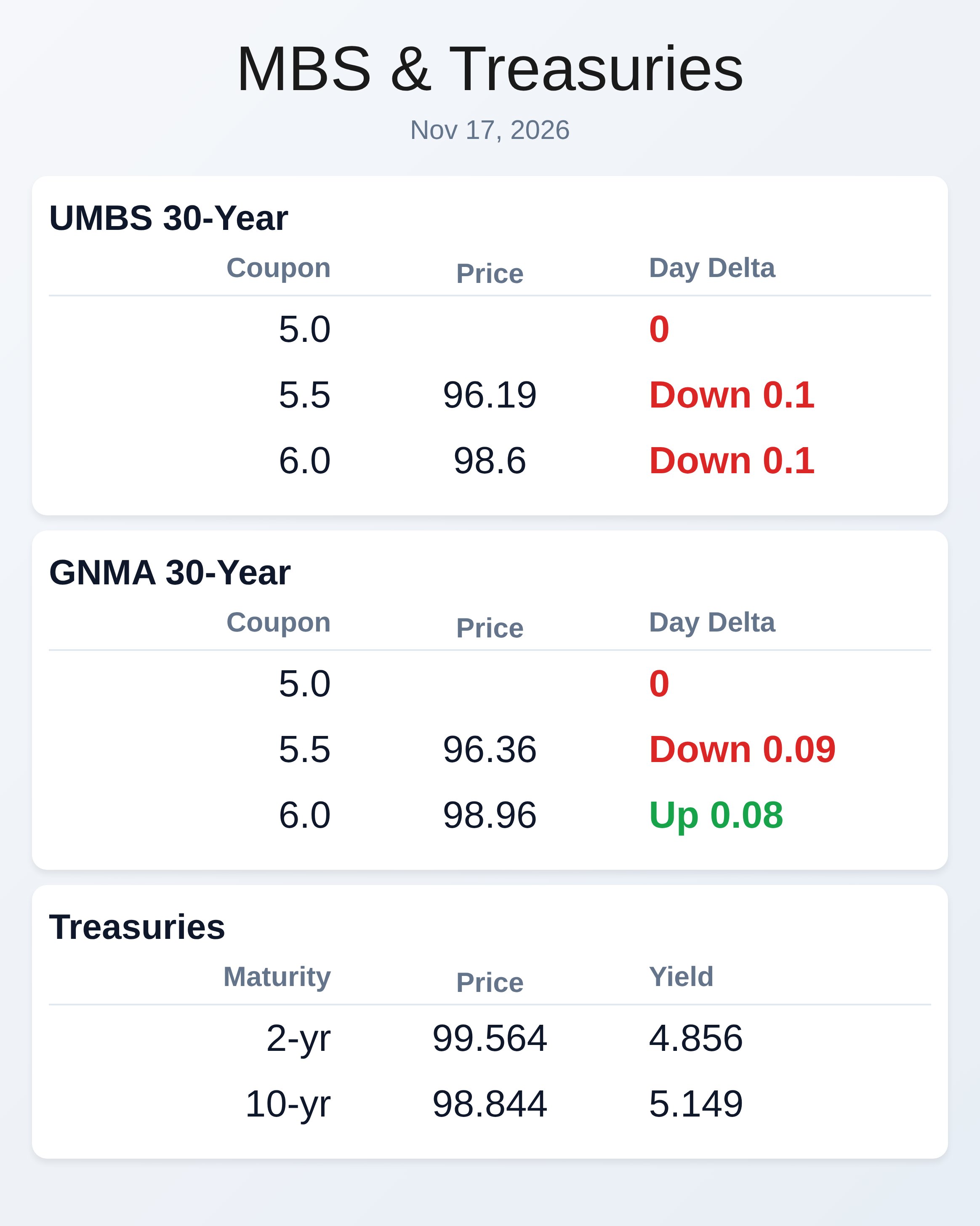
**WTMS Blog Today = What’s up in Mortgage Today (AM) – 11/17/2026**
The Federal Reserve’s hawkish messaging continues to anchor mortgage rates near 7.50%, with multiple Fed officials signaling the need for several additional rate hikes through spring 2027 to bring persistent inflation under control. St. Louis Fed President Alberto Musalem stated that the economy “will likely require several interest rate increases before the spring of 2027 to achieve price stability,” while markets are now fully pricing in a December quarter-point increase and further tightening into early 2027.
The 10-year Treasury yield remains elevated near 5.12%, with the two-year climbing to its worst week since 2024 as traders digest both the Fed’s firmer stance and sticky inflation data that topped expectations earlier in the week. Bond investors are waiting for the December 4 jobs report and December 9 FOMC meeting, but meaningful rate relief appears unlikely until disinflation becomes more evident. This hard-line position on rates has essentially eliminated any near-term refinancing opportunities for lenders, leaving originations dependent almost entirely on purchase activity.
Mortgage rates have jumped to 7.50%, erasing most of the gains accumulated over the past five weeks and signaling that lenders face sustained margin pressure and limited pricing flexibility in the weeks ahead. The sharp move came despite the bond market holding relatively steady on Friday, suggesting that lenders who failed to reprice intraday Thursday ended up building that move into Friday morning’s rate cards. No single trigger drove the move—wholesale inflation data came in line, but persistent pricing pressure simply continued without letup.
For mortgage originators, this means lock expirations will continue to weigh heavily on pipeline economics, while prospective borrowers increasingly face affordability headwinds that keep purchase applications below year-ago levels. Par note rates now sit at approximately 7.37%, placing significant pressure on wholesale pricing and lender margins. The lack of pricing relief suggests that rates may remain sticky near these levels absent a material shift in Fed rhetoric or geopolitical de-escalation.
Existing home sales plummeted to their lowest level since August 2010, dropping 5.5% month-over-month in October to an annualized 3.75 million units and declining 8.8% year-over-year as persistent mortgage rates above 7% and elevated affordability challenges kept buyers on the sidelines. The West region experienced its worst sales pace on record since 1999, while all four major U.S. regions posted year-over-year declines, underscoring the breadth of deterioration.
Realtors characterized the market as a “perfect storm” of a sudden shift in financing costs, pre-election uncertainty, and typical seasonal slowness, though housing supply constraints and years of underbuilding should prevent a sharp nationwide price correction despite the volume weakness. For lenders, this sales collapse directly translates to diminished origination volume and squeezed recapture opportunities, while the decline signals that mortgage servicers face renewed scrutiny over delinquency trends and loss mitigation resources. Without meaningful rate relief or a shift in buyer sentiment, the fourth quarter is likely to remain challenged.
The Nvidia leadership crisis and broader artificial intelligence sector selloff have created significant equity market volatility, with the chipmaker’s stock dropping sharply following Jensen Huang’s ouster and new scrutiny over export controls and China exposure that could weaken future demand for Nvidia’s products. Technology stocks have suffered their steepest reduction in fund manager overweights in two decades, with net positioning in equities falling from net +37% in October to net +12% by mid-November, signaling broad retreat from AI and tech trades. While mortgage origination is not directly exposed to tech valuations, the equities selloff has heightened financial stability concerns across the industry, with the Federal Reserve’s latest Financial Stability Report citing artificial intelligence as the leading concern among 87% of surveyed respondents.
The turmoil has prompted new questions about whether debt-fueled buildout of AI infrastructure is sustainable, and whether secondary market demand for mortgage-backed securities could be impacted by broader deleveraging. Lenders should monitor whether mortgage demand from tech-sector employees moderates as equity compensation declines. October retail sales rose 0.2% month-over-month, slightly beating expectations of 0.1% and signaling that consumer spending continues to show resilience despite persistent inflation and elevated mortgage rates that are suppressing housing affordability.
Retail sales excluding autos and gasoline rose a stronger 0.5%, indicating that core consumer demand remains intact even as home shoppers retreat to the sidelines. The resilient consumer backdrop has actually reinforced the Fed’s hawkish stance, since it removes the central bank’s rationale for cutting rates sooner, and suggests that inflation pressures will linger rather than fade quickly. For mortgage originators, sustained consumer spending means that refinancing demand tied to debt consolidation or home improvement projects may provide some offset to weakening purchase activity, though the high-rate environment makes second liens and cash-out refinances less attractive to borrowers reluctant to give up their existing rates.
Lenders should continue to explore non-traditional loan products and home equity strategies to maintain pipeline volume as purchase originations face structural headwinds. FICO’s January 1 pricing deadline is creating serious implementation and business continuity risk across the industry, with thousands of lenders potentially facing score disruption if credit reporting agencies, lenders, and third-party providers cannot execute pricing transitions and system integrations in time. The Preferred Program’s $10 wholesale per-bureau pricing requires lenders to commit to obtaining FICO scores on every covered report, raising competition and antitrust concerns about whether alternative credit scores represent a genuine choice if Preferred pricing terms are financially coercive.
Alternative subscription models—annual, monthly, or case-by-case arrangements—introduce reconciliation complexity, cash-flow complications, and conflicting terms across bureau distribution channels, with Experian reportedly not offering subscription pricing at all, leaving lenders without a consistent three-bureau strategy. If pricing and system arrangements are not finalized and tested by December 31, the resulting score delivery disruption could prevent lenders from meeting GSE pricing and acceptance requirements, effectively creating a lending risk that extends well beyond a single cost issue. The industry should collectively demand an extension and clear, workable implementation procedures rather than accepting a deadline that may force lenders into uncontrollable operational disruption.
**Locking vs Floating**
With the 10-year Treasury yield holding near 5.12% and Fed speakers continuing to signal multiple additional rate hikes into spring 2027, borrowers face a harsh calculus: locking in now captures rates near 7.50%, but further Fed tightening creates downside risk to refinancing if the Fed eventually pauses or reverses course. Conversely, floating near-term assumes that mortgage rates move even higher before any relief, which remains the base case unless inflation rolls over sharply or geopolitical tensions ease. Most originators should discourage extended floats beyond the typical 10–21 day window, since the probability of material near-term rate improvement is extremely low, and clients who float face the operational risk of lock expiration and re-pricing if closings slip.
**Today’s Events**
October Retail Sales: +0.2% month-over-month (beat expectations of +0.1%)
October Industrial Production and Capacity Utilization (released during market hours Tuesday)
September Business Inventories (released during market hours Tuesday