**WTMS Blog Today = What’s up in Mortgage Today (PM) – 11/17/2026**
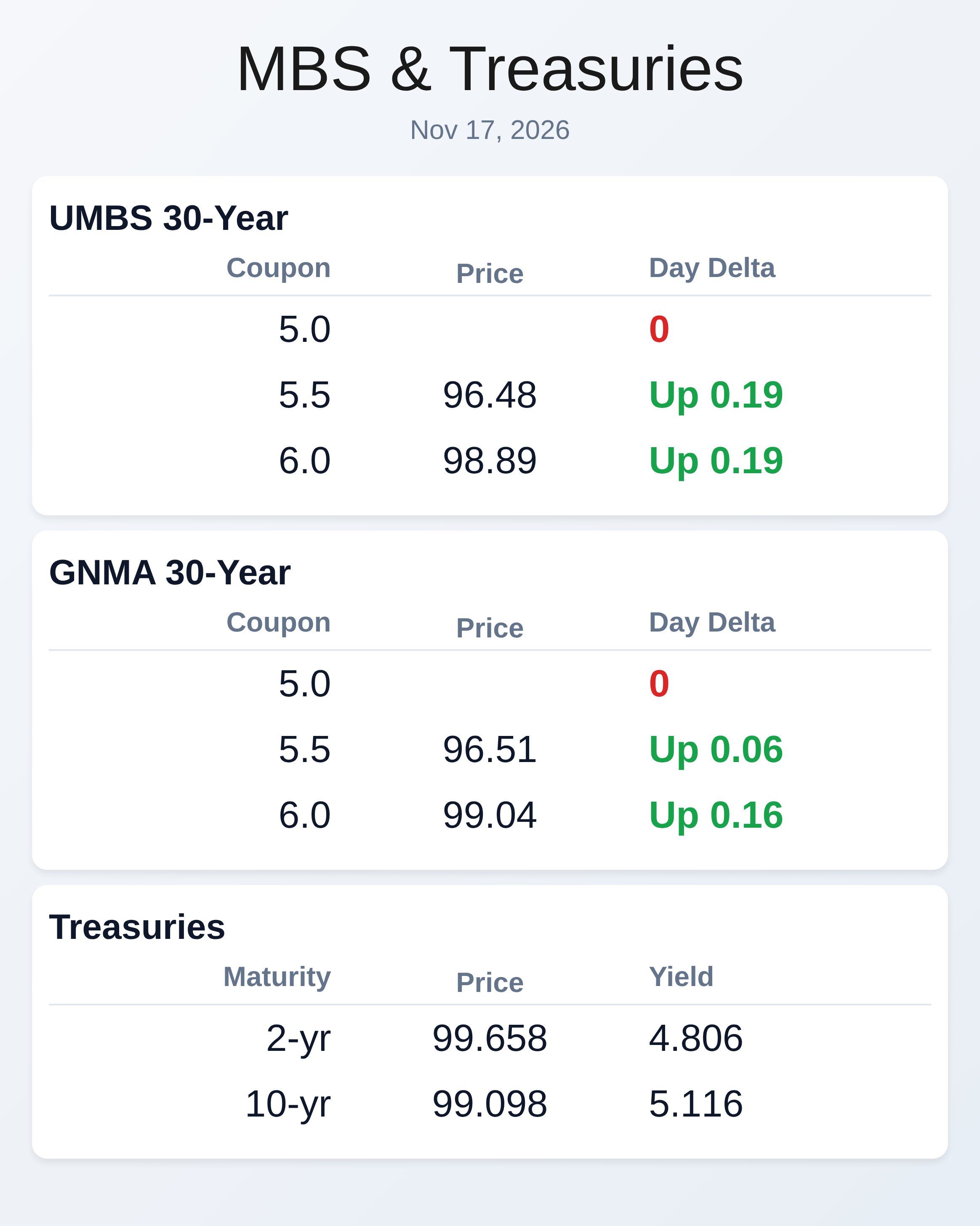
The 10-year Treasury yield dipped below 5.1% today as a bout of risk-off sentiment briefly returned the bond market to positive territory, with tech-related system outages and retail sales data creating pockets of volatility that mortgage lenders must navigate before week’s end. UMBS 6.0 rose 0.16 points to 98.86 as equities sold off on concerns about national security infrastructure, temporarily lifting mortgage bonds even as inflation data remains stubbornly warm. Market movement was dominated by flight-to-safety trades rather than any fundamental shift in the Fed’s outlook, leaving mortgage rates caught between persistent inflation signals and periodic equity weakness.
Homebuilders have widened their competitive moat against independent loan officers by offering borrowers up to 114 basis points in rate incentives when financing new construction purchases. That outsized advantage means LOs competing for builder-channel business face an uphill battle, since many buyers will naturally accept the builder’s preferred lender to lock in those below-market rates. For originators shut out of the builder channel, the path forward requires repositioning around financial planning value and long-term cost analysis rather than trying to match incentive points dollar-for-dollar.
Mortgage Solutions Financial’s shift of its origination platform to Fairway—adding roughly $1.1 billion in annual production to the larger platform—underscores the ongoing consolidation pressure on mid-sized independent lenders. The move preserves the MSF brand while giving the origination team access to Fairway’s scale, compliance infrastructure, and technology resources. This type of strategic combination reflects the growing difficulty for independent originators to maintain competitive cost structures without backing from a larger parent.
The CFPB’s revised mortgage servicing rule is moving closer to implementation after submission to the White House, potentially reshaping loss mitigation eligibility and foreclosure timelines for borrowers in distress. The pending changes are a descendant of earlier controversial proposals but reflect the Trump administration’s approach to balancing servicer burden against consumer protection. Servicers should prepare for possible changes to their playbooks around borrower assistance programs, though specifics remain under wraps pending interagency review.
Fannie Mae’s mandatory rental income rules take effect December 1st, tightening how investors can underwrite cash-out and purchase loans using rental income from held properties. The stricter documentation standards and income-counting limits mean loan officers must educate investor-borrowers now about which properties qualify and how to structure applications to avoid delays or denials. With investor demand still strong despite higher rates, clarity on these new guidelines will help LOs position alternative loan structures.
FHA’s delinquency crisis is showing mixed signals as the agency’s tougher loss mitigation rules, implemented in October 2025, have begun to reduce “churning”—the cycle where borrowers repeatedly cycle through assistance and default. Six-month redefault rates among borrowers receiving help fell from roughly 35% to 17% under the new framework, suggesting that more selective assistance may produce better outcomes. However, serious delinquencies climbed to 6.51% as of September, and foreclosure starts are approaching levels last seen during the 2010s recovery, indicating that stricter loss mit policies are pushing some borrowers toward inevitable defaults rather than sustainable cures.
**Locking vs Floating**
October’s rally in mortgage bonds has clearly reversed course, and market technicals suggest rates have exited their bullish momentum. Defensive positioning remains warranted until bonds show fresh evidence of strengthening, as periodic equity sell-offs alone have not reignited sustained mortgage bond buying.
**Today’s Events**
The day’s retail sales control group came in at 0.6% month-over-month, beating the 0.3% forecast.
NY Fed Manufacturing data was weaker at 7.8 versus an 18.0 forecast, signaling potential cooling in regional factory activity.
**Bond Pricing**
**UMBS 30 yr**
| Coupon | Price | Intra-Day Change |
**GNMA 30 yr**
| Coupon | Price | Intra-Day Change |
**Treasuries**
| Term | Yield | Price | Intra-Day Yield Change |