Big Tech Just Sued California to Keep the Feed — Here’s What’s Actually at Stake
If you’ve ever watched a kid lose an hour to scrolling, you’ve seen what California’s new law is trying to stop. And if you’ve followed the headlines this week, you’ve seen Big Tech push back hard.
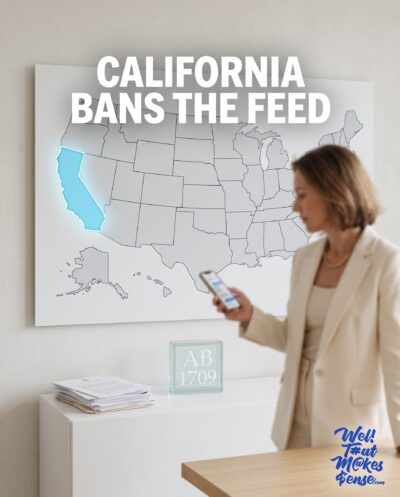
Meta, Google, and TikTok all filed separate federal lawsuits to block AB 1709, a California law set to take effect January 1, 2027. The law bans platforms from serving personalized recommendation feeds and autoplay to anyone under 16. The companies say it’s unconstitutional. Privacy groups say it could make things worse. And parents are caught in the middle, wondering what any of this actually means for their kids.
Here’s what’s happening, what each side is arguing, and why the outcome matters whether you’re in California or not.
What AB 1709 Actually Does
AB 1709 is California’s attempt to protect minors from what lawmakers call “psychologically exploitative” features. That means no personalized recommendation feeds — the algorithmic “For You” pages that serve content based on what you’ve watched, liked, or lingered on. It also means no autoplay, the feature that queues up the next video before you’ve decided to watch it.
The law applies to anyone under 16. Platforms that knowingly violate it face penalties up to $50,000 per affected child. If the violation is negligent rather than intentional, the penalty drops to $25,000 per child. The law takes effect at the start of 2027, giving platforms a little over a year to comply or to convince a court to block it.
California isn’t the first state to try this. Utah, Arkansas, and Ohio have all passed laws restricting how minors use social media, though enforcement and legal challenges vary. AB 1709 is notable because it targets specific features rather than imposing blanket age restrictions or parental-consent requirements. It’s also notable because California is home to most of the companies it regulates, and because the state’s size gives its laws outsize influence on how tech companies operate nationwide.
Why the Platforms Are Suing
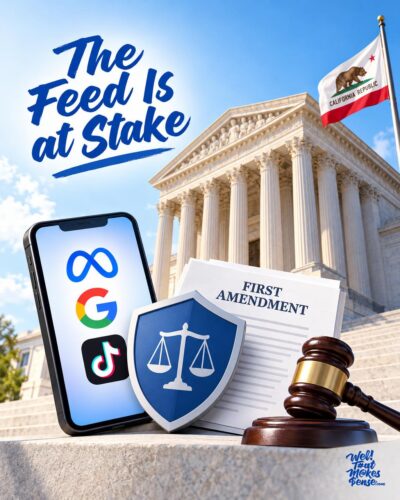
Meta, Google, and TikTok each filed separate lawsuits in federal court, but their arguments overlap. All three say AB 1709 violates the First Amendment by forcing them to change how they curate and display content. In their view, deciding which posts to show and in what order is an editorial judgment, and the government can’t compel or prohibit that kind of speech.
Meta’s complaint argues that California is trying to override its editorial decisions about how to present billions of posts to hundreds of millions of users. TikTok’s spokesperson called the law “a blatantly unconstitutional restriction on free expression.” Google framed the issue similarly, saying the law dictates how platforms must organize and deliver content, which is protected by the First Amendment.
The companies also argue that the law is too vague. Terms like “psychologically exploitative” and “personalized recommendation” lack clear definitions, making it hard to know what’s allowed and what isn’t. That vagueness, they say, chills speech because platforms might err on the side of removing more content than necessary to avoid penalties.
Finally, the platforms say the law is preempted by federal law, specifically Section 230 of the Communications Decency Act, which protects platforms from liability for how they moderate or organize third-party content. If California can dictate feed design, they argue, it undermines the federal framework that has governed online speech for decades.
Why California Passed the Law
California lawmakers say they’re responding to mounting evidence that algorithmic feeds and autoplay harm kids. Research has linked heavy social media use to higher rates of anxiety, depression, and sleep disruption in adolescents. The features AB 1709 targets are designed to keep users engaged, and they’re especially effective at keeping young users scrolling long past the point where they intended to stop.
Autoplay removes the friction of choosing what to watch next. Personalized feeds surface content that’s calibrated to hold your attention, often by amplifying emotionally charged or extreme material. For adults, that’s a design choice. For kids, lawmakers argue, it’s exploitation.
The law’s supporters also point to internal documents from Meta and other platforms showing that the companies knew their products were linked to mental health harms in teens but continued to prioritize engagement over safety. Those documents became public through lawsuits and whistleblower disclosures, and they’ve fueled calls for regulation at both the state and federal levels.
California’s approach is narrower than some other states’. It doesn’t require parental consent for accounts, and it doesn’t ban minors from using social media altogether. It targets specific features that research has identified as particularly addictive. The goal, proponents say, is to let kids use social media without being manipulated by algorithms designed to maximize their screen time.
The Privacy Problem No One Asked For
Here’s the twist: enforcing AB 1709 might require platforms to collect more data about their users, not less. To turn off personalized feeds and autoplay for everyone under 16, platforms need to know who’s under 16. That means age verification.
The Electronic Frontier Foundation, a digital rights group that usually fights against government overreach, has warned that AB 1709 could swap one safety problem for a privacy problem. Age verification typically requires users to submit a government ID, a credit card, or biometric data like a face scan. All of those methods create new risks: data breaches, misuse by the platform, or government access to sensitive information.
Some platforms already use age estimation tools that analyze selfies to guess a user’s age. Those tools are imperfect and raise their own privacy concerns. Even if a platform promises not to store the images, users have to trust that promise — and trust that the platform’s security is strong enough to keep the data safe.
There’s also the question of false positives. If a platform’s age-verification system incorrectly flags an adult as a minor, that adult loses access to features they’re legally entitled to use. If the system incorrectly flags a minor as an adult, the law’s protections don’t apply. Either way, the system creates friction and potential harm.
Privacy advocates argue that the better approach is to ban manipulative features for everyone, not just minors. That would eliminate the need for age verification and extend the law’s protections to adults who also struggle with compulsive social media use.
The First Amendment Question
The platforms’ lawsuits hinge on whether curating a feed is protected speech. Courts have generally held that editorial decisions — what to publish, how to organize it, what to emphasize — are covered by the First Amendment. A newspaper can’t be forced to run a story it doesn’t want to run, and it can’t be forced to bury a story on page six instead of page one.
Platforms argue that feed curation is the digital equivalent. When TikTok decides which videos to show you, or when Instagram decides what order to display your friends’ posts, those are editorial choices. The government can’t dictate those choices without violating the First Amendment.
California is likely to argue that AB 1709 regulates conduct, not speech. The law doesn’t tell platforms what content to allow or remove. It tells them how to display that content to a specific group of users. In the state’s view, that’s a reasonable regulation of business practices, not a restriction on speech.
The outcome will depend on how courts weigh the government’s interest in protecting minors against the platforms’ interest in controlling their own products. Courts have historically given the government more leeway to regulate content or conduct when minors are involved, but they’ve also been skeptical of laws that impose vague or sweeping restrictions on speech.
Legal experts are split on how this will play out. Some think the platforms have a strong First Amendment case. Others think California’s focus on minors and on specific harmful features gives the law a better chance of surviving a challenge.
What Meta Already Agreed To
Meta’s lawsuit is particularly notable because the company just settled a massive case over teen safety. In October 2024, Meta agreed to pay up to $18 billion and to implement new restrictions on how teens use Facebook and Instagram. The settlement resolved claims brought by 49 U.S. states and the District of Columbia, alleging that Meta knowingly designed addictive features and misled the public about the risks.
Under that settlement, Meta agreed to limit certain features for users under 16, including restricting who can send them messages and making it harder for them to discover harmful content. The company also agreed to more transparency about how its algorithms work and to fund independent research on social media’s effects on young people.
So why is Meta suing California over a law that seems to ask for similar restrictions? The difference is consent. Meta negotiated the terms of the settlement. AB 1709 is a mandate. The settlement applies nationwide. AB 1709 applies only in California, which could force Meta to build different versions of its products for different states. And the settlement focuses on disclosures and research, while AB 1709 bans specific features outright.
From Meta’s perspective, the settlement was a business decision. AB 1709 is government overreach. The company is willing to change its products, but only on its own terms.
The Google Lawsuit You Might Have Missed
The same week the platforms sued California, a family sued Google. The lawsuit, filed in federal court, alleges that the family’s 13-year-old used Google’s AI Mode to research methods of suicide and then attempted to take their own life. The family argues that Google knew its AI tools could generate harmful content but failed to implement adequate safeguards for minors.
The case is still in its early stages, and Google hasn’t filed a response yet. But it highlights a separate but related concern: as platforms add AI-powered features, the risks to young users may be evolving faster than the laws meant to protect them.
AI Mode, like other generative AI tools, can produce detailed, specific answers to almost any question. That includes questions about self-harm, violence, or illegal activity. Some platforms have built guardrails into their AI tools to refuse certain prompts or to provide crisis resources in response to others. But those guardrails aren’t perfect, and they’re not legally required.
The Google lawsuit argues that platforms have a duty to protect minors from foreseeable harm, especially when the platform knows that minors are using its tools. If the case moves forward, it could set a precedent for how courts think about AI safety and liability, particularly where young users are involved.
What Happens If California Wins
If the courts uphold AB 1709, platforms will have to disable personalized feeds and autoplay for California users under 16. That likely means building age-verification systems, which could range from requiring a birthday at signup to using third-party tools that scan IDs or faces.
It also means other states will likely follow. California’s size and influence make it a template for tech regulation. If AB 1709 survives a legal challenge, expect similar laws in New York, Illinois, Massachusetts, and other states with active legislatures and vocal advocacy groups.
Platforms would face a choice: comply state by state, building different versions of their products for different jurisdictions, or apply the restrictions nationwide to avoid the complexity and cost of managing multiple versions. The latter is what happened with California’s privacy law, the CCPA, which effectively became the national standard because it was easier for companies to extend its protections to all users than to build separate systems.
If AB 1709 becomes the norm, it could reshape how social media works for everyone, not just minors. Platforms might simplify their products, reduce reliance on algorithmic feeds, or shift toward chronological timelines and user-controlled recommendations. That could make social media less addictive, but it could also make it less useful or less profitable.
What Happens If the Platforms Win
If the courts block AB 1709, the fight moves back to the legislature. California could revise the law to address the courts’ concerns, narrowing its scope or clarifying its definitions. Or lawmakers could try a different approach, such as requiring disclosures about algorithmic amplification or funding independent audits of platforms’ effects on minors.
A loss for California would also slow momentum for similar laws in other states. Legislators would see that the First Amendment is a real barrier, and they’d either craft narrower laws or wait for federal action.
That federal action is unlikely in the near term. Congress has held hearings, introduced bills, and issued reports on social media and minors, but it hasn’t passed comprehensive legislation. The political will exists, but so does gridlock. In the absence of federal law, states have stepped in, and the result is a patchwork of regulations that platforms say is unworkable.
A platform victory in California could also embolden the companies to challenge other state laws. Utah’s social media restrictions, Arkansas’s age-verification requirements, and Ohio’s parental-consent rules are all vulnerable to First Amendment challenges. If the courts side with the platforms in California, those laws could fall too.
What This Means for Parents and Kids
If you’re a parent, the legal fight over AB 1709 probably feels abstract. Your kid is scrolling right now, and the lawsuit won’t change that anytime soon. But the outcome will shape what tools you have to manage their use.
If California wins, you’ll likely see more age-verification prompts and fewer algorithmic feeds for kids under 16. That could make social media less engaging, which might reduce screen time. It could also make it more annoying, leading kids to lie about their age or migrate to platforms that don’t verify.
If the platforms win, you’re back to relying on parental controls, conversations, and the platforms’ voluntary teen safety features. Some of those features are robust — Meta’s settlement includes new tools for parents to monitor and limit their teens’ use. But they’re optional, and they require parents to know they exist and to take the time to set them up.
Either way, the broader fight is about who gets to decide how kids interact with technology: parents, platforms, or the government. AB 1709 tips the balance toward the government. The lawsuits tip it back toward the platforms. And parents are left trying to make good decisions with incomplete information and limited control.
The Bottom Line
This isn’t just a California story. It’s a test case for how far governments can go in regulating the design of digital products, especially when minors are involved. The platforms say AB 1709 violates the First Amendment and creates a privacy problem worse than the one it’s trying to solve. California says it’s a reasonable response to evidence that algorithmic feeds harm kids.
Both sides have a point. The law does raise serious free-speech questions, and age verification does create new privacy risks. But the research on social media and adolescent mental health is hard to ignore, and voluntary industry efforts have been slow and incomplete.
The courts will decide whether AB 1709 survives, but the underlying tension won’t go away. Technology moves faster than legislation, and the tools that platforms build to keep users engaged often work too well. Whether the solution is regulation, litigation, or industry self-regulation, the question is the same: how do we let kids use these tools without letting the tools use them?
If you have questions about this or want to stay informed on issues that affect families and communities, reach out anytime or subscribe for more insights.
Let’s Connect
Have a question about how this affects you? I’d love to hear from you.
- Email: [goemailrod@gmail.com](mailto:goemailrod@gmail.com)
Subscribe for more plain-English breakdowns like this one: www.WellThatMakesSense.com