**WTMS Blog Today = What’s up in Mortgage Today (AM) – 07/06/2026**
Markets start the week modestly stronger after the holiday break, with the 10-year Treasury yield dropping 2.1 basis points to 4.465% and mortgage-backed securities gaining three ticks as bond buying sentiment carried over from the shortened trading week. The weak June jobs report, which showed only 57,000 payroll additions alongside significant downward revisions to prior months, offered some relief to the rate-sensitive sectors despite an unexpected dip in unemployment to 4.2%. The 10-year yield remains under pressure from expectations of slower labor force growth and persistent inflation concerns, but technicians remain cautious about following through below the 4.42% ceiling without more confirmed momentum.
Agency mortgage-backed securities issuance hit $118.5 billion in June, marking the fourth consecutive month exceeding $100 billion and the strongest June since 2022 as purchase originations increasingly drive supply. Conventional and Ginnie Mae production concentrated in 5.0% and 5.5% coupons kept the pipeline healthy, though refinancing activity has declined meaningfully since Q1 due to stable mortgage rates limiting refi opportunities. On the regulatory front, Fannie Mae quietly updated its Desktop Underwriter 12.1 Release Notes with material credit tightening, effective June 27, signaling that a moderate reduction in Approve/Eligible recommendations is coming as the GSE reviews risk assessment based on recent market performance.
The FHFA also proposed rescinding its existing Duty to Serve regulation in favor of a more innovation-focused framework designed to encourage high-impact lending initiatives rather than granular compliance-box checking, with the new rule targeted for January 1, 2028, and public comments due July 24. These GSE changes—combined with updates to MISMO mortgage insurance data standards supporting VantageScore 4.0 and FICO 10T, plus expanded Area Median Income limits in Desktop Underwriter reaching over 84% of census tracts—reflect a shifting compliance and credit landscape that loan originators need to track closely this week. National MI updated construction-to-permanent commitment periods to 18 months effective June 6 and modified manufactured housing guidelines, while Pennymac and other lenders are now accepting UAD 3.6 appraisal formats for GSE deliveries.
Housing supply remains a stubborn problem for the industry narrative: May new home sales fell to 580,000 units (seasonally adjusted), down 7% month-over-month and year-over-year, with completed home sales down three straight months and off over 30% since November despite a months supply now over 10 months—one of the worst readings in nearly 20 years. Median new home prices continue declining, yet federal housing policy remains a moving target with no firm affordability strategy yet implemented despite months of trial balloons around federal land sales, tri-merge elimination, extended amortizations, and assumable mortgages. The lack of policy clarity leaves originators without a clear roadmap for product strategy or pricing while affordability constraints continue pressuring purchase volumes and forcing the industry to rely more heavily on non-QM and specialty lending products to capture market share.
AI adoption across mortgage operations and credit decisioning is accelerating into mainstream conversation: LenderLogix’s new AI-POS evaluation guide helps lenders cut through hype and focus on compliance, transparency, borrower experience, and workflow fit, while Dark Matter’s LOS platform (Empower) now offers Ask Aiva, an AI assistant that answers loan-specific questions by pulling real data from your loan files rather than generic web results. Open banking and consumer-permissioned financial data modernization, powered by platforms like Plaid, is expanding cash flow and transaction-based credit decisioning, broadening credit access and shifting how lenders evaluate borrower sustainability—a shift that will reshape traditional credit models and credit bureau reliance. The broader technology ecosystem within mortgage is beginning to separate the infrastructure pioneers from traditional manual shops, with Figure’s latest analysis showing that 32% of national equity-backed lending growth over three years flowed through their tech platform partners, signaling where scale advantages increasingly cluster.
Chrisman Commentary and industry event calendars show a packed week ahead with webinars on open banking (July 6), STRATMOR’s Technology Insight Digital Innovations study (July 7), and discussions on Fannie Mae’s Desktop Underwriter updates and title insurance waiver initiatives (July 8). The Arizona Mortgage Expo kicks off July 16, followed by Western Secondary Conference (August 10), MBA of Mississippi Conference (August 20), and MISMO Fall Summit (August 24), offering networking opportunities as the industry recalibrates on AI, compliance changes, and market direction. Weekly podcast interviews feature Sei AI’s Pranay Shetty, American Pacific’s Jason Ponsonby, FICO’s Ethan Dornhelm, and FTI Consulting’s Creighton Oswald, surfacing emerging trends in automation, credit models, and servicing innovation.
The week ahead carries light economic data with only Final June S&P Global Services PMI and June ISM Non-Manufacturing Index scheduled today, followed by May Trade Balance, May Wholesale Inventories, June FOMC Minutes, May Consumer Credit, June Existing Home Sales, and the quarterly refunding announcement mid-week. Tech stocks are signaling strength on Monday with Nasdaq 100 futures up 1.1% after the holiday break as chipmakers Samsung and SK Hynix prepare earnings releases that will test investor conviction in the AI supercycle, while SpaceX’s Nasdaq 100 inclusion may trigger index rebalancing activity. Oil prices are softening (Brent at $71.67, down 0.6%) amid Strait of Hormuz flow concerns and OPEC+ supply signals, potentially offering some stability to broader rate markets, though central bank communication and energy newsflow remain the key variables for Treasury yields this week.
**Locking vs Floating**
Recent weakness in the June employment report provided some relief to rate shoppers in the bigger picture, but be cautious about reading too much into the afternoon reversal on the half-day before a three-day weekend. Risk-tolerant borrowers are hoping recent yield ceilings hold over the weekend and can be extended in coming weeks, yet caution remains warranted because follow-through below 4.42% on the 10-year has been lacking despite multiple recent attempts.
**Today’s Events**
Final June S&P Global U.S.
Services PMI and June ISM Non-Manufacturing Index.
**Bond Pricing**
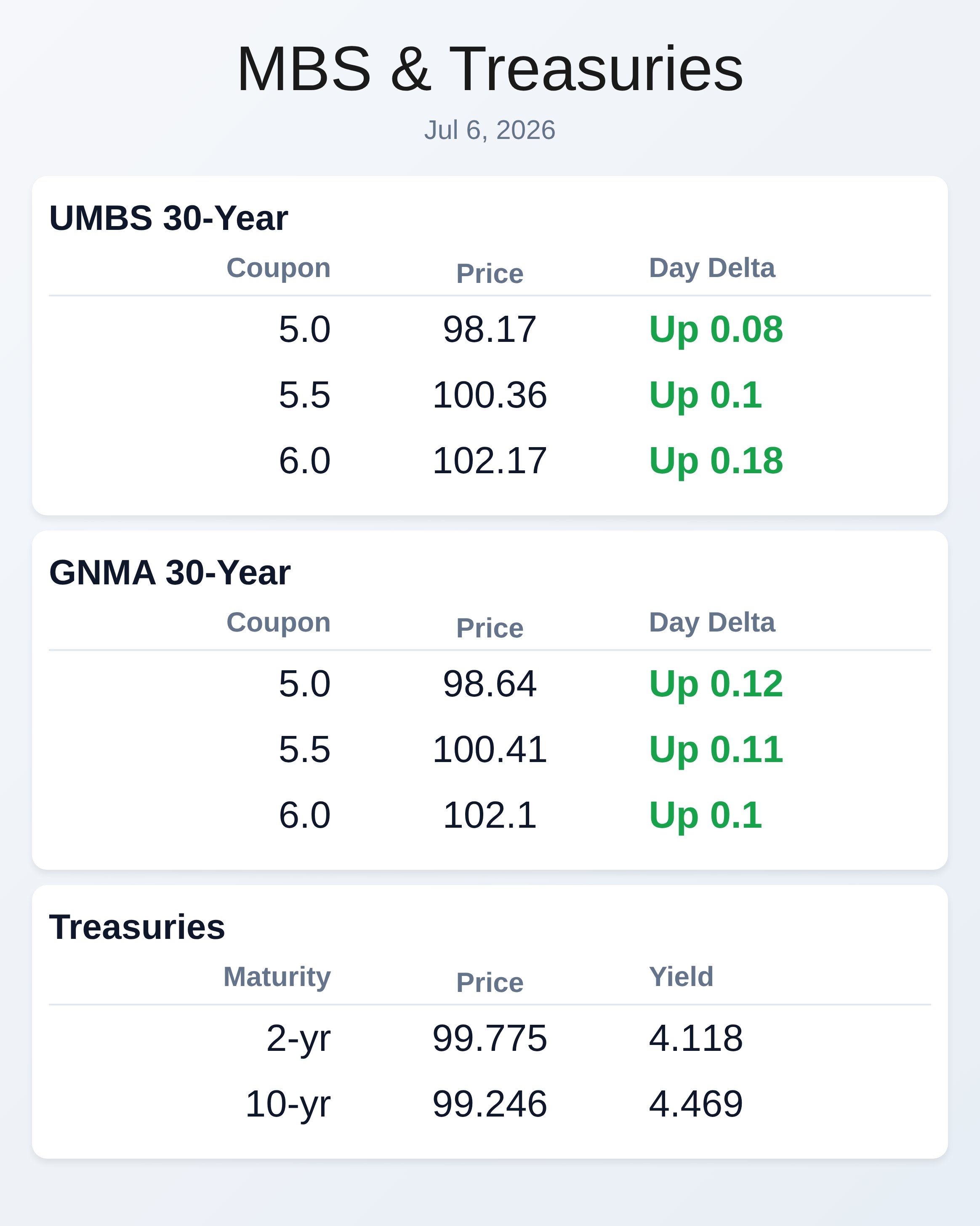
**UMBS 30 yr**
| Coupon | Price | Intra-Day Change |
| 5.0 | 98.17 | 0.08 |
| 5.5 | 100.36 | 0.1 |
| 6.0 | 102.17 | 0.18 |
**GNMA 30 yr**
| Coupon | Price | Intra-Day Change |
| 5.0 | 98.64 | 0.12 |
| 5.5 | 100.41 | 0.11 |
| 6.0 | 102.1 | 0.1 |
**Treasuries**
| Term | Yield | Price | Intra-Day Yield Change |
| 2yr | 4.118 | 99.775 | -0.019 |
| 3yr | 4.142 | 99.953 | -0.023 |
| 5yr | 4.206 | 99.638 | -0.026 |
| 7yr | 4.332 | 99.511 | -0.023 |
| 10yr | 4.469 | 99.246 | -0.016 |
| 30yr | 4.984 | 100.249 | 0.006 |