**WTMS Blog Today = What’s up in Mortgage Today (AM) – 09/22/2026**
Geopolitical headlines are moving bonds even when unconfirmed, as overnight markets rallied hard on reports—later denied by Iranian officials—that Tehran could reopen the Strait of Hormuz within seven days. Oil prices dropped instantly on the news, and Treasury yields followed lower across the curve. The market’s logic is sound: financial traders believe some Iranian official probably did say something to multiple news agencies that disagreed with the government’s official denials.
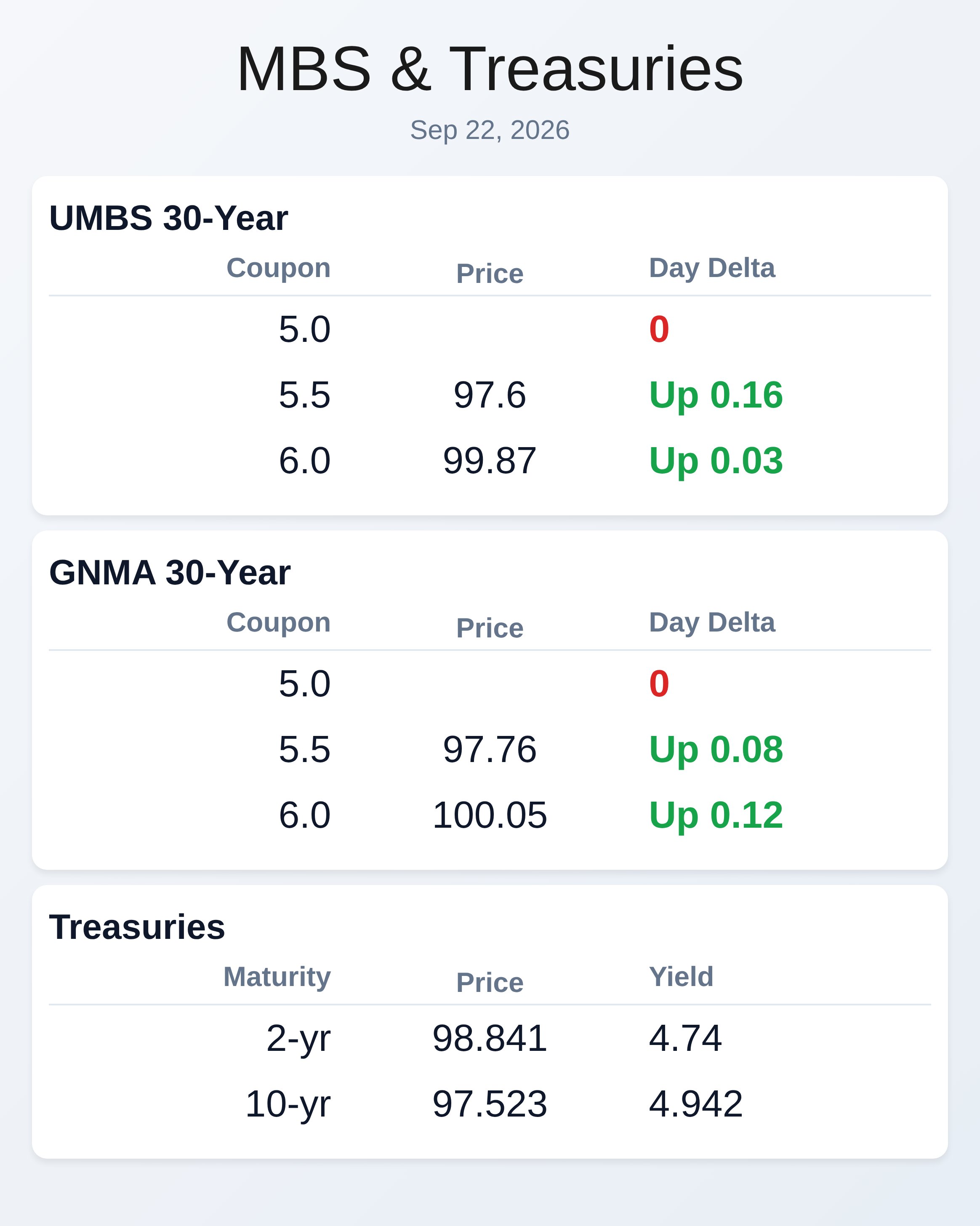
What matters most to mortgage professionals is that bond prices improved for the second consecutive day, benefiting both MBS coupons and rate-lock opportunities. UMBS 6.0 securities closed yesterday at 99.90 and have moved higher in overnight trading, while the broader 6.5 coupon remains around 102.12 despite sideways momentum. GNMA 6.0 securities gained ground overnight, now trading at 100.08 with intraday gains of 0.15 points.
Both agency MBS cohorts show modest strength in a risk-on environment driven by lower oil and geopolitical relief rather than fundamental economic improvements. Originators holding longer MBS positions may see modest cushion in their pipeline hedges, though the rally remains fragile without confirmed economic catalyst. The 10-year Treasury yield has declined 2.6 basis points from yesterday’s close, now trading near 4.93 percent as markets digest overnight strength.
Shorter maturities performed better, with the 2-year yield down 4 basis points to near 4.73 percent, while the 30-year fell 1.2 basis points to 5.27 percent. The two-to-ten spread narrowed to approximately 21 basis points yesterday, reflecting curve flattening amid Fed hawkish rhetoric. Today’s $69 billion two-year note auction will test institutional demand in a market still bracing for potential October rate increases.
Manufacturing cost claims across the mortgage industry range wildly from $125 to $12,500 per loan, creating confusion when lenders use these figures to recruit loan officers and compete for borrowers. The MBA reported Q2 2026 production expenses of $10,936 per loan for independent mortgage banks and $11,754 for retail-only lenders, establishing a standard that industry practitioners should reference when evaluating employer efficiency claims. Most cost variance stems from inconsistent definitions of what constitutes “manufacturing”—whether sales compensation, technology, fulfillment, or overhead are included—making peer comparisons nearly impossible.
Loan officers deserve the same standardized clarity that consumers receive through the Loan Estimate when evaluating job opportunities and compensation promises. Without agreed-upon definitions, lenders risk making decisions based on incomplete or misleading data. Multiple Fed officials are scheduled to speak today, including Presidents Williams, Jefferson, and Barkin, though markets will remain cautious pending confirmation that underlying inflation is actually moving toward the 2.0 percent target rapidly.
The Federal Reserve’s recent hawkish pivot has restored some market confidence in its inflation-fighting independence, but the bar for tighter policy remains low and financial conditions are not yet restrictive enough to signal a policy shift. An October interest rate hike remains likely unless incoming economic data demonstrates sharp disinflation, putting pressure on mortgage originators to remain defensive on rate locks until clearer evidence emerges. Fed Chair Warsh’s emphasis on controlling money and credit growth may eventually conflict with the central bank’s continued balance sheet expansion, creating tactical opportunities for investors who fade near-term fed funds rallies.
Builders continue using capital to temporarily buy down rates or permanently offer 30-year fixed mortgages at 1 percent below prevailing market rates rather than cut prices and devalue existing subdivisions. This builder-driven rate subsidy strategy reflects housing affordability pressure but masks the underlying demand weakness as residential volume continues declining across the industry. Credit unions are aggressively pursuing market share in this environment, leveraging their position in consumer financial relationships and willingness to undercut traditional originators on pricing.
Mortgage professionals should expect continued competitive pressure on loan-level pricing and widening gain-on-sale margins as builders and credit unions fight for shrinking production volume. Today’s bond market strength provides brief relief, but the structural headwind of declining volume remains the dominant issue facing originators.
**Locking vs Floating**
Technical resistance levels remain critical guides for mortgage professionals evaluating lock-versus-float decisions without guaranteed predictive power.
The 4.94 percent level on 10-year yields represents important intermediate resistance, while 5.00 percent marks the ceiling many technical traders monitor closely. Friday’s trading tested 5.00 percent repeatedly, but today’s session approached 4.94 percent from below, suggesting potential momentum shifting. The conservative stance held since early July remains appropriate—lock aggressively until a definitive shift below 4.94 percent confirms sustained bond market rally momentum, as intraday MBS price movements alone provide insufficient confirmation of broader trend change.
**Today’s Events**
10:05 AM ET – Fed President Williams Speech
10:20 AM ET – Fed President Jefferson Speech
1:00 PM ET – Two-Year Note Auction ($69 billion)
1:00 PM ET – Fed President Barkin Speech
**Bond Pricing**
**UMBS 30 yr**
| Coupon | Price | Intra-Day Change |
**GNMA 30 yr**
| Coupon | Price | Intra-Day Change |
**Treasuries**
| Term | Yield | Price | Intra-Day Yield Change |