**WTMS Blog Today = What’s up in Mortgage Today (AM) – 10/06/2026**
Treasury yields sold off sharply to start the week as 10-year and 30-year yields hit their highest levels since 2022, keeping 30-year mortgage rates locked in the mid-seven percent range. The broader bond market weakness stems from a mix of concerns: escalating global fiscal pressures (particularly French sovereign debt turmoil), elevated U.S. Treasury issuance driven by budget deficits, and competition for investor capital from booming artificial intelligence investment and rising corporate debt.
Brent crude has dipped below $98 per barrel, which provided some modest relief to the bond curve, but the underlying structural headwinds pushing rates higher remain intact. Services sector pricing data continues to reinforce inflation fears among investors, signaling potential consumer price pass-through that keeps longer-term yields under pressure. The market is bracing for meaningful concessions required at tomorrow’s 10-year and Thursday’s 30-year Treasury auctions, where investor demand faces headwinds from already-elevated yields and fiscal uncertainty.
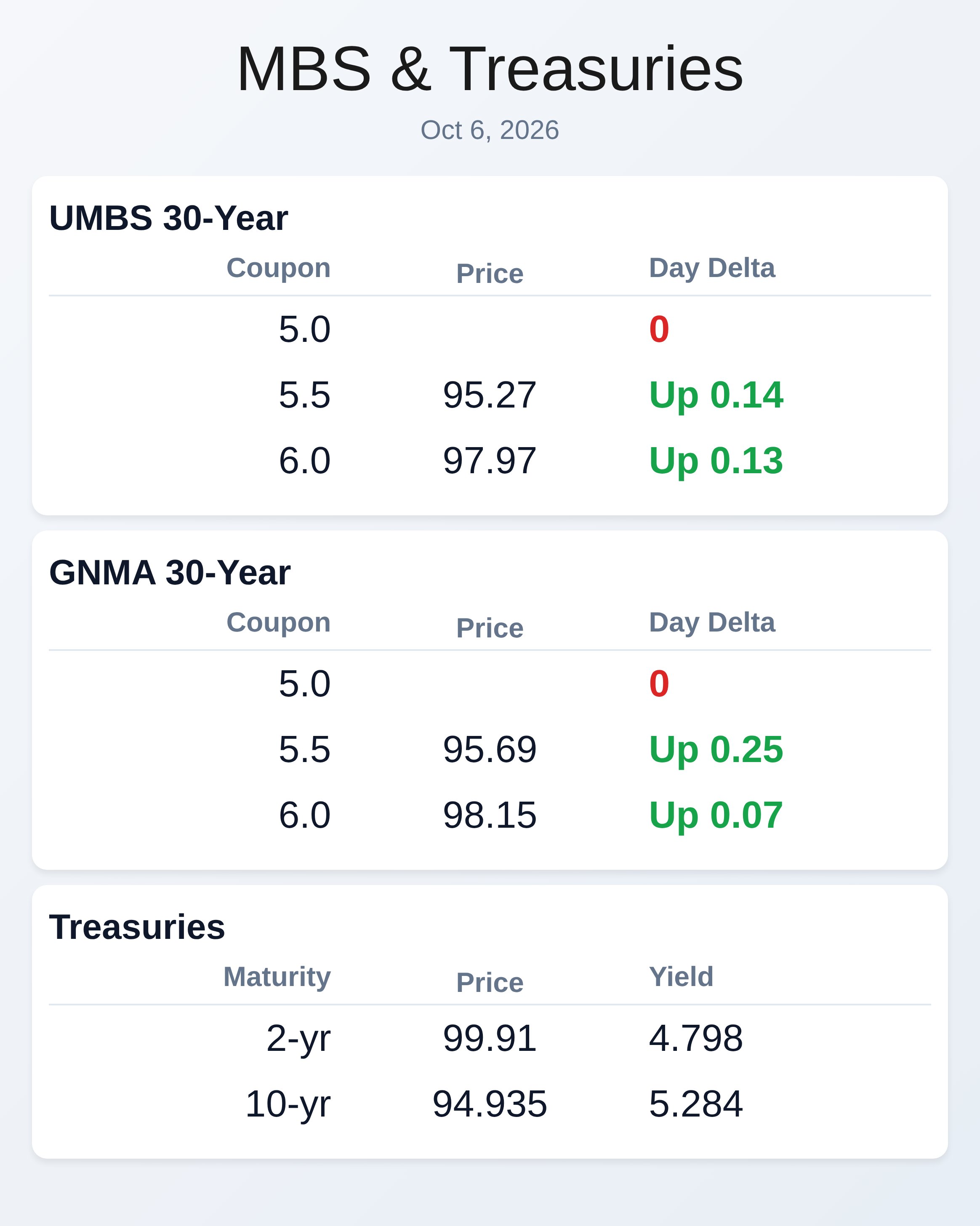
UMBS and GNMA securities showed mixed but modest intraday gains this morning, with UMBS 6.5 coupon pricing at 100.55 (up 0.16) and GNMA 6.5 at 100.48 (up 0.15). The resilience in agency MBS reflects some technical support from overnight trading and a stronger 10-year JGB auction in Japan, though the overall rally lacked conviction given the magnitude of the week’s bond selloff. Mortgage originators remain cautious about locking significant volumes given the relentless upward rate pressure since late August and the lack of a sustained correction to provide confidence.
Without a meaningful two-day rally averaging at least six basis points per day in yields, defensive positioning remains the prudent strategy for most lenders. The spread between current mortgage rates and Treasury yields suggests limited cushion for originators betting on further rate compression. Weaker-than-expected September payroll data has knocked down Fed rate-hike expectations to just 20 percent probability for October, shifting market focus to whether softer labor momentum can justify holding policy rates steady.
The modest unemployment tick and continued job growth keep labor conditions broadly stable, which may still warrant concern among policymakers focused on inflation dynamics. However, the trade deficit widened more than expected to $105.6 billion in August (versus the $102.1 billion estimate), signaling robust domestic demand and adding another layer to the Fed’s inflation calculus. These competing signals—softer jobs but stickier goods demand—leave policymakers in a holding pattern as they weigh whether inflation remains too persistent to pause.
The market now prices in lower odds of aggressive Fed action, though terminal rates remain elevated at levels that constrain mortgage demand. High U.S. Treasury issuance, war-related oil price pressures, tariff-driven import costs, and weakening foreign demand for American bonds collectively explain why rates have climbed relentlessly since late August.
The Federal Reserve remains committed to using the Fed Funds Rate to fight inflation, though it is an imperfect tool that creates spillover effects across the entire yield curve and mortgage market. Elevated corporate bond issuance and resilient equity markets (S&P 500 futures up 0.4% and approaching record highs) continue to draw investor demand away from bonds, compressing valuations. Mortgage originators should prepare for an extended period of elevated mortgage rates unless one or more of these structural headwinds reverses substantially.
The near-term technical setup does not yet suggest a meaningful correction is imminent. Loan officers exploring mortgage hedging strategies face a critical decision point: whether to position defensively for further rate increases or size hedges to protect against the one-in-five chance of an October Fed hold combined with a stabilization in the long end. Capital markets teams are watching upcoming Treasury auctions and speeches from Federal Reserve speakers (Governor Bowman, Boston President Logan, and New York President Williams scheduled for today) for signals of policy resolve.
The August trade surplus widening despite the elevated dollar suggests pent-up foreign demand for U.S. goods could normalize, potentially easing some inflation pressures if geopolitical risks diminish. For now, the risk-reward of aggressive long positioning remains unfavorable compared to maintaining smaller pipeline positions and locking only rate-sensitive borrowers.
Secondary market managers should stress-test both hedge ratios and dealer concentration given the binary nature of current rate risks. Mortgage companies navigating this volatile landscape should lean on data-driven credit scoring models (like the new VantageScore 4.0 now live across all production channels) and fiduciary-grade lending data to manage costs and workflows amid pricing uncertainty. Treasury Secretary Scott Bessent’s recent assurance that the government’s debt load can be tamed offers limited comfort to bond markets already pricing in elevated term premiums and fiscal risk.
The week ahead brings the 3-year Treasury auction (today at 1 p.m. ET), 10-year auction (tomorrow), and 30-year auction (Thursday), with results likely to set the tone for mortgage rates through early next week. Originators should communicate clearly with borrowers about rate lock windows and leverage updated pricing tools to stay competitive in a 7.5 percent mortgage rate environment.
Market recovery will require either demonstrated Fed commitment to cooling inflation or clear signs that geopolitical risks and fiscal pressures are easing.
**Locking vs Floating**
Rising rate momentum since late August has been relentless, making a defensive stance prudent until the market demonstrates a sustained correction. A successful reversal would require yields to fall at least six basis points daily for two consecutive days, which has yet to materialize.
War-related inflation, Treasury issuance pressures, corporate bond competition, equity resilience, weaker foreign demand, solid economic data, and an inflation-fighting Federal Reserve all contribute to the current upward bias. MBS prices offer intraday risk guidance, but monitoring 10-year Treasury yield ceilings and floors provides better visibility into broader bond market momentum and directional shifts.
**Today’s Events**
The economic calendar includes the August Trade Balance (already released, showing a wider-than-expected deficit of $105.6 billion), Redbook same-store sales, Federal Reserve remarks from Governor Bowman, Boston Federal Reserve President Logan, and New York Federal Reserve President Williams, plus a $58 billion auction of 3-year Treasury notes at 1 p.m.
ET.
**Bond Pricing**
**UMBS 30 yr**
| Coupon | Price | Intra-Day Change |
| 5.5 | 95.27 | 0.14 |
| 6.0 | 97.97 | 0.13 |
| 5.5 | 95.69 | 0.25 |
**GNMA 30 yr**
| Coupon | Price | Intra-Day Change |
**Treasuries**
| Term | Yield | Price | Intra-Day Yield Change |
| 2 yr | 4.798 | 99.91 | -0.016 |
| 3 yr | 4.926 | 98.482 | -0.028 |
| 5 yr | 5.034 | 99.852 | -0.02 |
| 7 yr | 5.155 | 99.101 | -0.028 |
| 10 yr | 5.284 | 94.935 | -0.024 |
| 30 yr | 5.658 | 92.345 | -0.005 |