**WTMS Blog Today = What’s up in Mortgage Today (PM) – 11/23/2026**
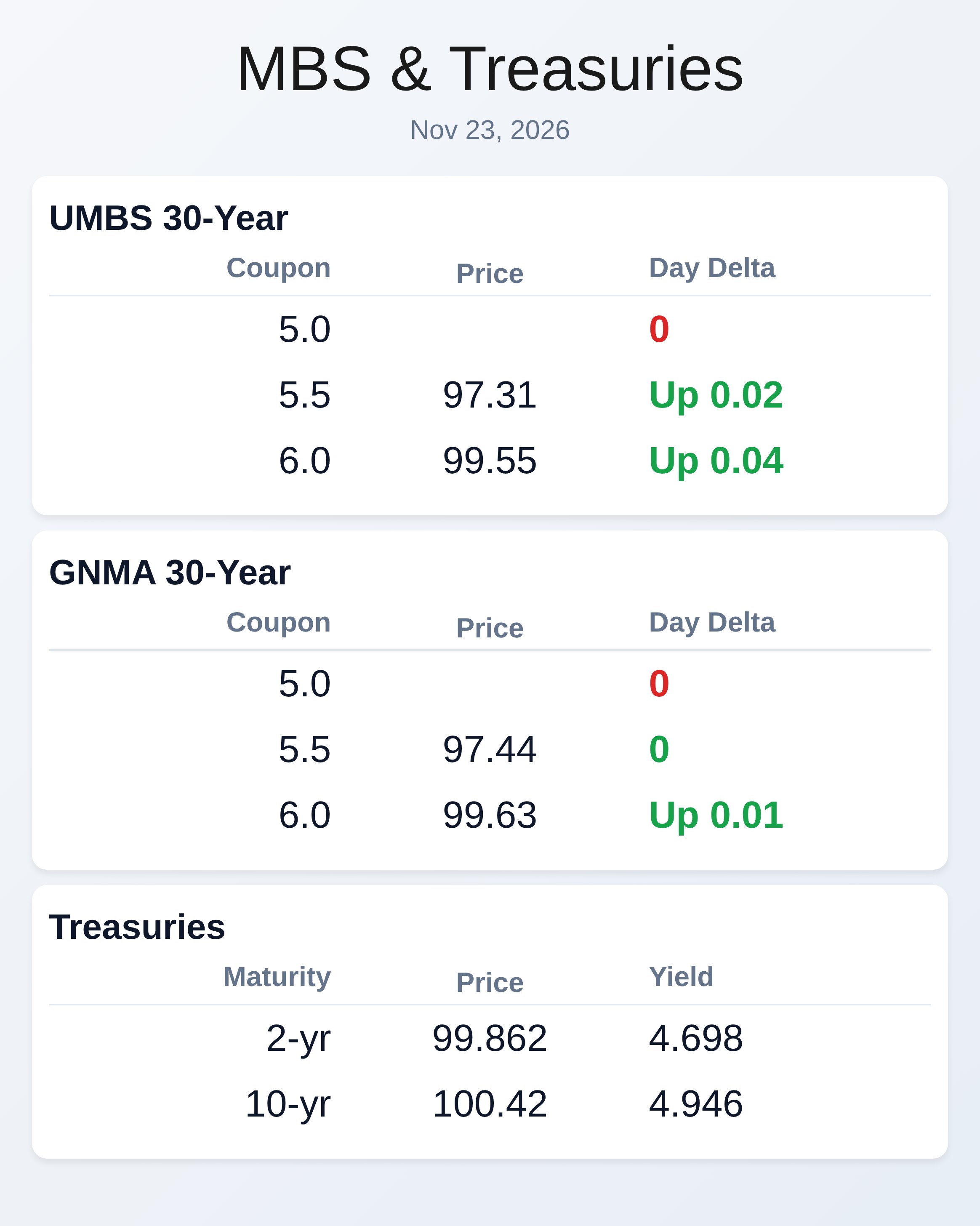
Bonds showed surprising resilience on Monday despite a massive stock rally sparked by Jensen Huang’s reinstatement as NVIDIA CEO, signaling that the mortgage market remains cautious even as equities surge. The long end of the yield curve bounced back into positive territory by day’s end, with UMBS 6.0 posting a modest gain of 0.07 at 99.59, suggesting that mortgage investors are not automatically capitulating to risk-on sentiment. The NASDAQ remains barely above early November lows despite today’s rally, which kept fixed-income traders from panic-selling and provided psychological cover for duration positions.
Thanksgiving week volatility remains a wildcard, and traders are accordingly hedging their bets rather than committing aggressively to either direction. The day’s performance underscores how disconnected mortgage markets have become from pure equity enthusiasm in this risk-off environment. New-home mortgage applications collapsed 13.6% year-over-year in October, marking the fourth consecutive month of annual declines and raising red flags for builders and originators alike.
Applications also dropped 7% month-over-month as mortgage rates climbed to 7.5%, up roughly 60 basis points in just two months and pricing many potential homebuyers out of the market. The seasonally adjusted annualized sales pace of 592,000 units masks an unadjusted reality—only 44,000 homes sold in October compared to 47,000 in September, the weakest two-month average since July 2022. Average loan sizes declined to $368,934, reflecting either lower-priced homes or borrowers pulling back on ambition given elevated rate levels.
This data suggests that rate-sensitive purchase demand remains severely impaired and could continue weighing on origination volume into year-end. Pennymac is aggressively expanding its second-lien program by lowering minimum FICO scores from 720 to 700 on primary residences and introducing a 10-year interest-only payment option effective immediately. The move targets self-sufficient borrowers seeking home equity access without refinancing their first mortgages, particularly attractive in a rising-rate environment where refi economics have disappeared.
The expansion also covers second homes and investment properties with loan limits up to $250,000, demonstrating confidence in non-owner-occupied demand. These product enhancements suggest that lenders are hunting for revenue in pockets where purchase activity has dried up, specifically in the equity-access and cash-out segments. The strategic push into second liens reflects a broader industry pivot toward alternative origination channels as traditional purchase lending deteriorates.
Non-QM originations are surging—jumping 31.6% in dollar volume and 25% in units from 2024 to 2025—and now represent approximately 10% of the overall mortgage market, with no signs of deceleration. Optimal Blue data shows non-QM locks at 12% of September 2026 activity, up five points year-over-year, with investor and DSCR loans comprising 33% of non-QM locks and bank-statement loans at 30%. Major players like Pennymac and Rocket Pro are launching new non-QM products, though the actual number of active originators remains largely flat despite explosive volume growth, suggesting consolidation and concentration among fewer competitors.
The key operational question is whether non-QM represents genuine demand from self-employed and investor borrowers or simply volume-chasing behavior by lenders facing purchase-market headwinds. Infrastructure, compliance, capital markets hedging, and staff training create meaningful setup and ongoing operating costs that many lenders may not have adequately modeled. The 1099 independent contractor classification debate is intensifying as lawsuits mount against West Capital Lending, regulators tighten scrutiny, and retail lenders cry foul about unfair competition in recruiting.
West Cap faces multiple class actions alleging loan officers were misclassified as independent contractors while working fixed hours, reporting to management, and receiving recurring compensation—with one former LO claiming $357 monthly in unreimbursed technology and credit fees. The U.S. Department of Labor finalized a new contractor-friendly classification rule emphasizing employer control and worker profit-or-loss opportunity, but this federal framework does not override state law, leaving jurisdictions like California operating under different standards and creating a fragmented patchwork.
Retail lenders argue the ambiguity creates a recruiting nightmare and competitive disadvantage, while brokers counter that retail companies are “bloated” with overhead and overpaid executives that crimp their margins regardless of compensation model. Until regulatory clarity emerges, the classification question will continue fueling industry conflict and potentially exposing non-compliant lenders to significant litigation risk. The mortgage industry faces a tightening credit report cost squeeze as FICO’s 2027 pricing remains undisclosed heading into the final quarter, leaving lenders unable to forecast expense structures for the coming year.
Industry confusion persists around FICO’s rumored subscription model and other product changes, with FICO’s Preferred Program announcement regarding Xactus and Informative Research providing only marginal clarity. Some brokers are openly criticizing FICO’s silence as the year winds down, noting that lenders need visibility to budget and plan staffing effectively for the new year. FICO’s delayed pricing announcement reflects broader industry coordination and pricing power concerns that mortgage originators raised with regulators months ago.
Without pricing transparency, lenders are essentially flying blind into 2027 budget cycles, amplifying cost uncertainty at a time when margins are already under pressure from rising rates and declining purchase volumes.
**Locking vs Floating**
Mixed signals dominate the week as Huang’s reinstatement temporarily stabilized equity sentiment, but the NASDAQ remains only slightly above early November lows, suggesting that one announcement has not restored conviction in the AI trade or broader risk appetite. If you believe today’s news puts a floor under equity losses and stabilizes risk sentiment, favoring locking is the prudent posture; if you view it as temporary relief before deeper corrections unfold, maintaining lock flexibility makes sense given elevated probability of further volatility.
Thanksgiving week introduces random noise unrelated to fundamentals, so position sizing and discipline matter more than directional conviction this week. Watch the 10-year yield anchor around 4.93%—breaks below 4.88% trigger another leg lower, while failure to hold above 5.00% suggests consolidation rather than a bullish breakout.
**Bond Pricing**
**UMBS 30 yr**
| Coupon | Price | Intra-Day Change |
**GNMA 30 yr**
| Coupon | Price | Intra-Day Change |
**Treasuries**
| Term | Yield | Price | Intra-Day Yield Change |