Loading...
HOME2023-01-22T13:43:33-07:00

Damn, there is so much great knowledge out there. Did you know that “BOOKS” are full of smart?? No, I mean like life changing, I-wish-I-knew-that-years-ago type stuff.

I know that I was waaaayyy late to the game figuring it out. And I know that a lot of you are too busy to read as much as you ‘should’. And that is why you need me.

I still remember how it started for me. It started in June of 2008. After 11  years …..Click to continue

Mortgage Today (AM) - 05/14/26 {{catlist}}
May 14, 2026
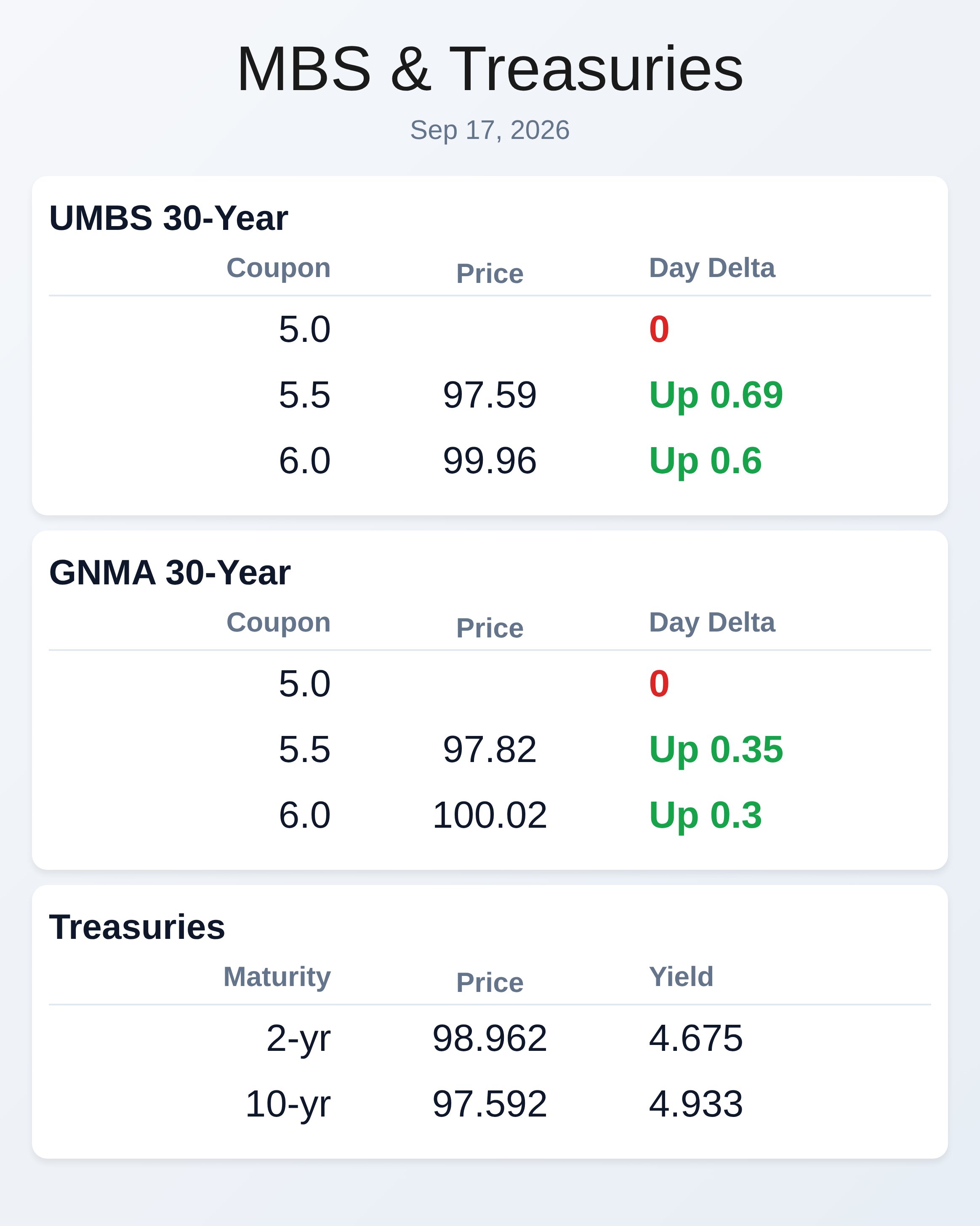
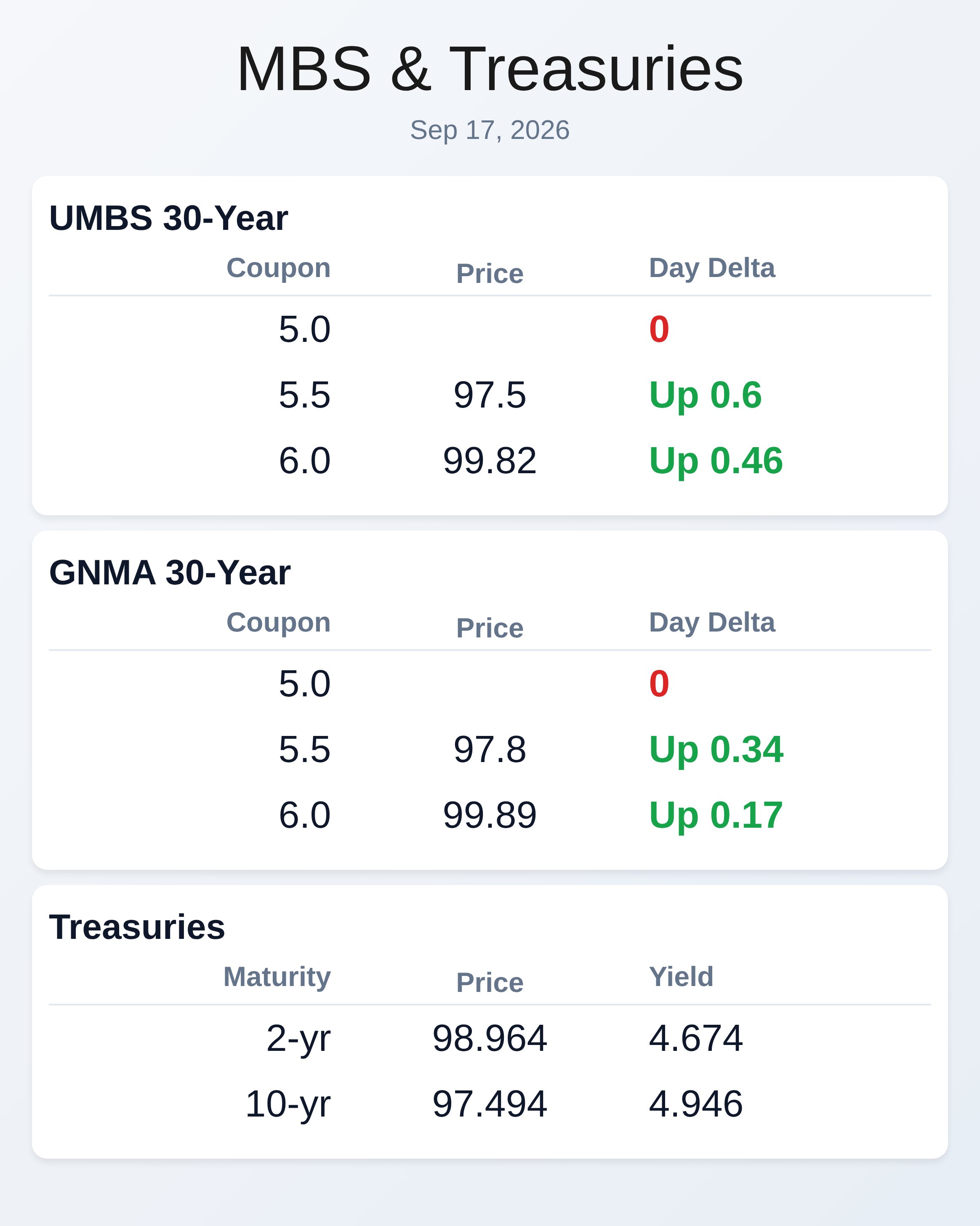
READ MORE **WTMS Blog Today = What's up in Mortgage Today (AM) - 05/14/2026** MBS rallied strongly overnight after initially selling off when producer prices crushed forecasts, with the 30-year UMBS 5.0 coupon gaining 22 basis points to 98.44 while the 10-year Treasury fell 30 basis points to 4.443%. Retail sales came in exactly on target at 0.5%, and jobless claims at 211K were only marginally higher than the 205K estimate, providing no fresh volatility. April import prices surged 1.9% month-over-month, nearly double the 1.0% forecast, with a 6.0% year-over-year producer price increase signaling broad-based inflation pressures tied to energy and industrial goods. Oil's recent pullback and growing optimism around the Trump-Xi meeting helped bonds stabilize after Tuesday's PPI shock. GNMA securities mirrored the UMBS strength, with the 5.5 coupon at 100.72, up 14 basis points, though longer-dated spreads remain under pressure from geopolitical uncertainty. The mortgage origination industry is absorbing significant technology shifts as AI platforms now execute trades on live mortgage pipelines for the first time, marking a watershed moment in capital markets automation. MCT's Atlas delivered the industry's first AI-powered trade execution on UMBS TBAs this week after recommending hedge trades at MBA Secondary 2025, demonstrating that artificial intelligence can operate within defined risk parameters to complete electronic auctions autonomously. Meanwhile, eNote adoption continues accelerating with over 90 investors now accepting digital notes through the MERS eRegistry, eliminating investor acceptance as a barrier to implementation. Lenders pursuing asset-based lending strategies are seeing record funding volumes, with one platform closing $103 million across 111 loans in April alone, a 91% year-over-year increase. Bankruptcy servicing workflows remain a critical operational challenge as rising volume exposes gaps in coordination, proof-of-claim accuracy, and Rule 3002.1 compliance across servicers managing portfolios under federal stay protections. The 10-year Treasury yield moved lower despite inflation pressures, closing at 4.44% as investors rotated toward fixed income ahead of potential Fed policy shifts and a full rate hike already priced in for early 2027. Kevin Warsh's Senate confirmation as Federal Reserve Chair by the narrowest margin in history (54-45) signals contentious rate-setting deliberations ahead, especially as market participants debate whether inflation will spike for only three to four months or persist through the end of the year. The 30-year Treasury auction yesterday drew decent demand with a 2.30x bid-to-cover ratio, though non-dealer takedown at 88% and a "tail" of 0.5 basis points suggest investors still wanted higher yields to own long-duration government paper. Supply-and-demand dynamics for 30-year mortgages shifted meaningfully as institutional buyers found 5.0% yields attractive for the first time since 2007, pulling demand toward long-dated instruments. War headlines and Middle East escalation, including reports of vessel seizures near the Strait of Hormuz, continue to cloud the outlook and prevent any meaningful lock-float strategy based on short-term geopolitical developments. Mortgage bankers should remain defensive and focus on capital preservation rather than aggressive risk-taking as volatility persists above the longer-term average despite recent stabilization. Current coupon spreads trade near the middle of recent ranges, indicating neither compelling value nor significant overhang in MBS valuation overall. Higher-coupon specified pools offer better relative value than current coupons, particularly for loans with strong FICO scores or investor properties that command tighter pay-ups in secondary market trading. The 5.0% UMBS coupon's resilience at 98.44 reflects investor appetite for discounted paper despite rate uncertainty, while GNMA securities continue to track UMBS with slight premium pricing reflecting investor preferences for government-backed securities. Traders should anticipate continued monitoring of oil prices and Middle East developments as leading indicators for bond market direction, since energy costs remain the primary driver of inflation expectations until geopolitical headlines stabilize. **Locking vs Floating** War-driven volatility in bonds makes tactical lock-float strategies unreliable on an intraday basis since geopolitical headlines do not follow predictable schedules and potential price swings are elevated. Peace negotiations or a formal deal would likely benefit mortgage rates versus current levels over the longer term. Instead of reacting to daily war news, originators should track 10-year Treasury ceilings and floors to identify bigger-picture bond market momentum, which reveals whether the mortgage market is entering a new trading range. **Today's Events** April Import Prices Month-over-Month: 1.9% vs 1.0% forecast May Jobless Claims: 211,000 vs 205,000 forecast April Retail Sales Month-over-Month: 0.5% vs 0.5% forecast (in-line) April Retail Sales Control Group: 0.5% vs 0.4% forecast **Bond Pricing** **UMBS 30 yr** | Coupon | Price | Intra-Day Change | **GNMA 30 yr** | Coupon | Price | Intra-Day Change | **Treasuries** | Term | Yield | Price | Intra-Day Yield Change | | 2 yr | 3.965 | 99.805 | -0.006 | | 3 yr | 4.012 | 98.565 | -0.006 | | 5 yr | 4.096 | 98.969 | -0.011 | | 7 yr | 4.269 | 99.887 | -0.021 | | 10 yr | 4.443 | 97.422 | -0.018 | | 30 yr | 5.003 | 96.091 | -0.033 | Market Data
Mortgage Today (PM) - 05/13/26 {{catlist}}
May 13, 2026
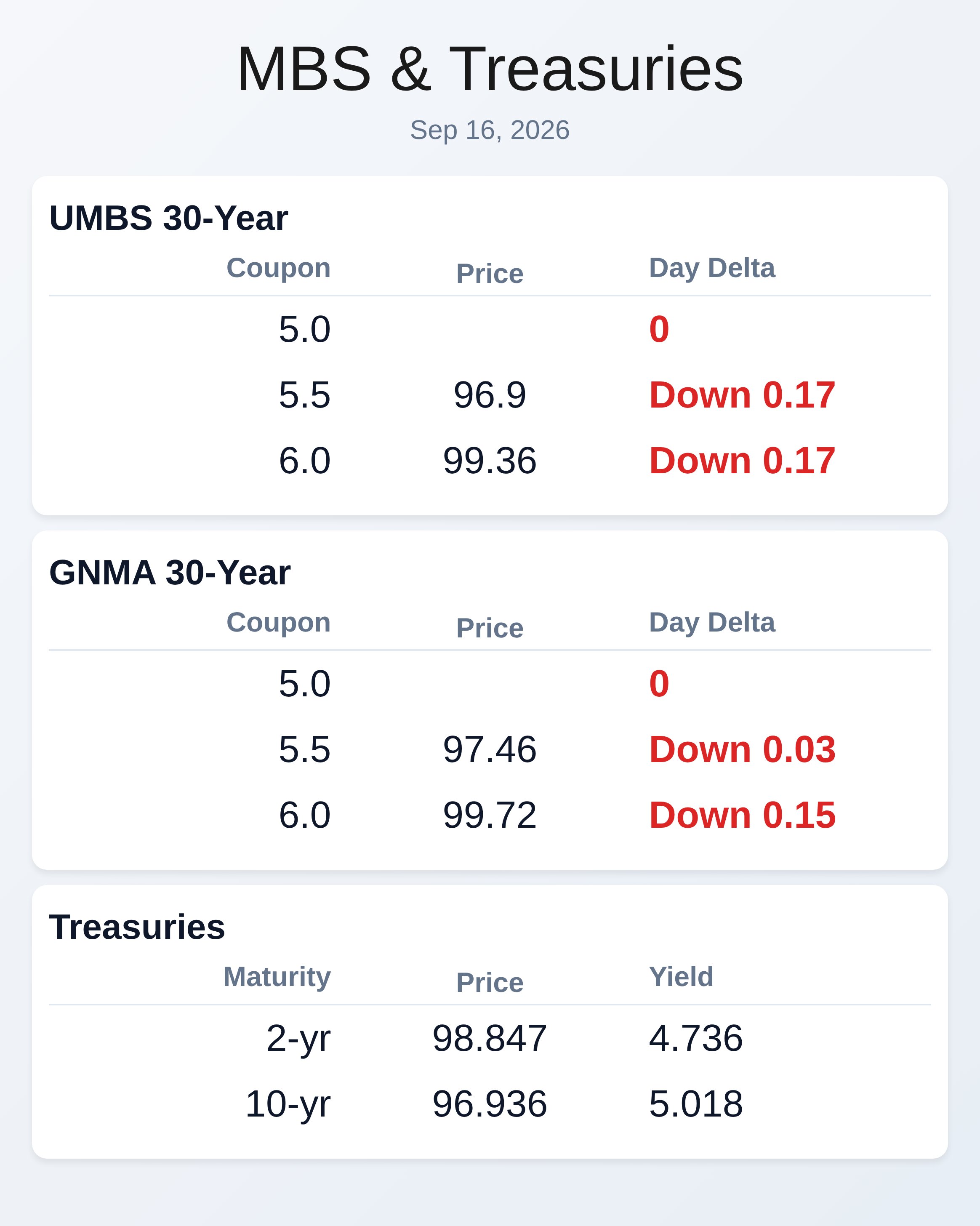
READ MORE **WTMS Blog Today = What's up in Mortgage Today (PM) - 05/13/2026** Mortgage-backed securities staged a stunning intraday recovery after hotter-than-expected inflation data briefly sent markets reeling this morning. The April PPI report shocked traders with core wholesale prices jumping 1.0% month-over-month versus a 0.3% forecast, signaling persistent cost pressures that had bonds selling hard at the open. Despite MBS falling nearly three ticks and 10-year yields spiking 4.3 basis points within minutes, the bond market found its footing and MBS ultimately finished the day trading positive territory. By 2:16 p.m., UMBS 5.0 printed at 98.22, up nearly one tick on the day, as traders reassessed the inflation shock. The persistent inflation picture means rates could stay elevated for longer than many borrowers hope. Year-over-year PPI came in at 6.0% against a 4.9% forecast, with core PPI at 5.2% versus 4.3% expected, underscoring that cost pressures have not cooled as the Fed would like. This data represents the kind of behind-the-scenes pressure that keeps mortgage rates sticky higher and limits the rate relief cycles that were once possible. For mortgage sellers managing pipeline risk, this environment demands discipline on locking decisions and rate sheet positioning because volatility remains the dominant theme. Geopolitical uncertainty continues complicating any lock-and-float strategy traders might attempt to employ. War-related headlines are driving wild swings in bond markets with no predictable schedule, making it nearly impossible to set fixed rules for risk management in the near term. Volatility spikes can happen at any moment independent of economic data, which means lenders should focus on protecting margins rather than timing perfect locks. A peace deal would likely offer some benefit to rates from current levels, but until that occurs, brokers and originators must treat each day as a fresh test of client tolerance for uncertainty. Servicers are bracing for a wave of FHA delinquencies and foreclosures as the federal safety net fully unwinds and modification caps tighten significantly. April data showed FHA foreclosures surging 28% year-over-year in the first quarter as borrowers exhausted loss-mitigation options and balloon payments from deferred CARES Act balances came due simultaneously. Property taxes, insurance costs, and returning student loan payments are colliding with weak equity positions for recent buyers, creating a squeeze that will disproportionately hit borrowers who received down payment assistance programs. Independent mortgage banks holding servicing portfolios face real financial risk if delinquencies accelerate, as they remain obligated to advance principal and interest to bondholders even as collections decline. The M&A battle between Two Harbors and UWM took another sharp turn as Two Harbors rejected UWM's revised offer as "illusory, predatory, and unactionable." With a $12-per-share all-cash deal from CrossCountry Mortgage on the table and a shareholder vote scheduled for May 19, the competitive tension is defining how mortgage companies are being valued in a challenging environment. For originators watching this fight, the messaging about capital markets execution, balance sheet strategy, and servicing value provides a real-time case study in what Wall Street believes matters most. This deal drama will likely reshape consolidation expectations across the entire industry by signaling which acquisition partners offer credibility and financial stability. VantageScore 4.0 early comparisons are producing shocking spreads against traditional FICO scores, forcing loan officers to rethink credit box definitions and pricing strategy. Mortgage Scoop reporting indicates some VantageScore-to-FICO variations are so extreme that they are causing double-takes among originators unaccustomed to managing that much credit score volatility. While widespread VantageScore 4.0 adoption is still months away, the early signals suggest the transition will be more disruptive than initially expected. Now is the time for lenders to stress-test their pricing, approval workflows, and client communication strategies for a credit score environment that behaves differently than anything experienced in the past decade. **Locking vs Floating** War headlines remain the primary driver of bond market volatility and make traditional lock-and-float strategies ineffective for near-term decision-making. Because geopolitical events do not follow an economic calendar and carry unpredictable timing, originators cannot build mechanical triggers or rules into their risk frameworks. A peace deal announcement would likely deliver meaningful rate benefit from current levels, but attempting to predict when that occurs is impossible. Lenders should focus instead on protecting pipeline profitability and client communication clarity rather than trying to optimize timing around external political shocks. **Today's Events** Core PPI m/m (Apr): 1.0% vs 0.3% forecast, 0.1% previous Core PPI y/y (Apr): 5.2% vs 4.3% forecast, 3.8% previous PPI m/m (Apr): 1.4% vs 0.5% forecast, 0.5% previous PPI y/y (Apr): 6.0% vs 4.9% forecast, 4% previous **Bond Pricing** **UMBS 30 yr** | Coupon | Price | Intra-Day Change | **GNMA 30 yr** | Coupon | Price | Intra-Day Change | **Treasuries** | Term | Yield | Price | Intra-Day Yield Change | Market Data
Mortgage Today (AM) - 05/13/26 {{catlist}}
May 13, 2026
READ MORE **WTMS Blog Today = What's up in Mortgage Today (AM) - 05/13/2026** War headlines and auction concessions have pushed 10-year Treasury yields to their highest level in 10 months, signaling stronger headwinds for mortgage originators. The 10-year Treasury yield jumped 1.4 basis points to 4.467 percent, while UMBS 30-year coupons showed minimal intraday movement across all coupon levels. GNMA 30-year securities similarly held steady, with the 6.0 coupon unchanged and lower coupons barely budging. Market volatility remains elevated due to geopolitical uncertainty, making it harder to establish reliable lock and float strategies in the near term. This selloff reflects broader bond market pressure rather than mortgage-specific weakness. Core inflation data beat expectations on the month, with headline CPI also running hotter than forecast, creating additional upward pressure on longer-dated yields. Core CPI rose 0.4 percent versus 0.3 percent expected and 0.2 percent prior, while year-over-year core inflation accelerated to 2.8 percent from 2.6 percent. Headline inflation on a monthly basis matched the 0.6 percent forecast but year-over-year readings climbed to 3.8 percent from 3.3 percent. The broader inflation story remains sticky despite some moderation from prior year comparisons. Originators should expect elevated rate volatility to persist through the upcoming week. The two-year Treasury dipped 1 basis point to 3.989 percent, suggesting some flattening across the shorter end of the curve despite the 10-year's sharp move higher. Mid-curve yields like the five-year and seven-year also moved modestly lower, with the five-year down 1 basis point to 4.124 percent. The 30-year Treasury remained flat at 5.026 percent, maintaining a wide spread versus the 10-year that reflects market uncertainty about long-term inflation and growth. Current pricing suggests bond traders are hedging against recession risks even as inflation data disappoint. The yield curve continues to signal mixed economic signals. **Locking vs Floating** Geopolitical tensions are creating unpredictable market swings that defy traditional rate forecast models. Short-term lock and float decisions should not be based on war headlines because volatility could move in either direction without warning or schedule. A peace agreement would likely provide some relief to rates compared to current levels, but timing such a resolution is impossible. Originators may want to consider the longer-term probability of de-escalation rather than making tactical decisions on daily newsflow. Hedging current pipeline positions is more prudent than betting on near-term direction during this period of elevated uncertainty. **Today's Events** Core CPI (April): 0.4% monthly vs. 0.3% forecast, 2.8% year-over-year vs. 2.7% forecast Headline CPI (April): 0.6% monthly vs. 0.6% forecast, 3.8% year-over-year vs. 3.7% forecast **Bond Pricing** **UMBS 30 yr** | Coupon | Price | Intra-Day Change | | 5.0 | 98.17 | 0.03 | | 5.5 | 100.24 | 0.02 | | 6.0 | 101.94 | 0 | **GNMA 30 yr** | Coupon | Price | Intra-Day Change | | 5.0 | 98.96 | 0.01 | | 5.5 | 100.52 | 0 | | 6.0 | 101.75 | 0.01 | **Treasuries** | Term | Yield | Price | Intra-Day Yield Change | | 2 yr | 3.989 | 99.784 | -0.001 | | 3 yr | 4.023 | 98.536 | -0.003 | | 5 yr | 4.124 | 98.886 | -0.001 | | 7 yr | 4.291 | 99.754 | -0.003 | | 10 yr | 4.467 | 97.267 | 0.014 | | 30 yr | 5.026 | 95.75 | 0 | Market Data
LATEST ARTICLES

RECENT ARTICLES

What’s up in Mortgage Today (09/30/2025)

September 30th, 2025|Week In Review|

WTMS Blog Today = What's up in Mortgage Today (09/30/2025) Mortgage-backed securities (MBS), particularly the Uniform Mortgage-Backed Securities (UMBS) market, saw mixed activity today. UMBS prices showed a slight decline, reflecting a cautious investor sentiment [...]

Article Archive

Subscribe

Send me some brain food

Go to Top