Loading...
HOME2023-01-22T13:43:33-07:00

“Damn, there is so much great knowledge out there. Did you know that “BOOKS” are full of smart?? No, I mean like life changing, I-wish-I-knew-that-years-ago type stuff.

I know that I was waaaayyy late to the game figuring it out. And I know that a lot of you are too busy to read as much as you ‘should’. And that is why you need me.

I still remember how it started for me. It started in June of 2008. After 11  years …..Click to continue

Mortgage Today (PM) - 10/29/26 {{catlist}}
October 29, 2026
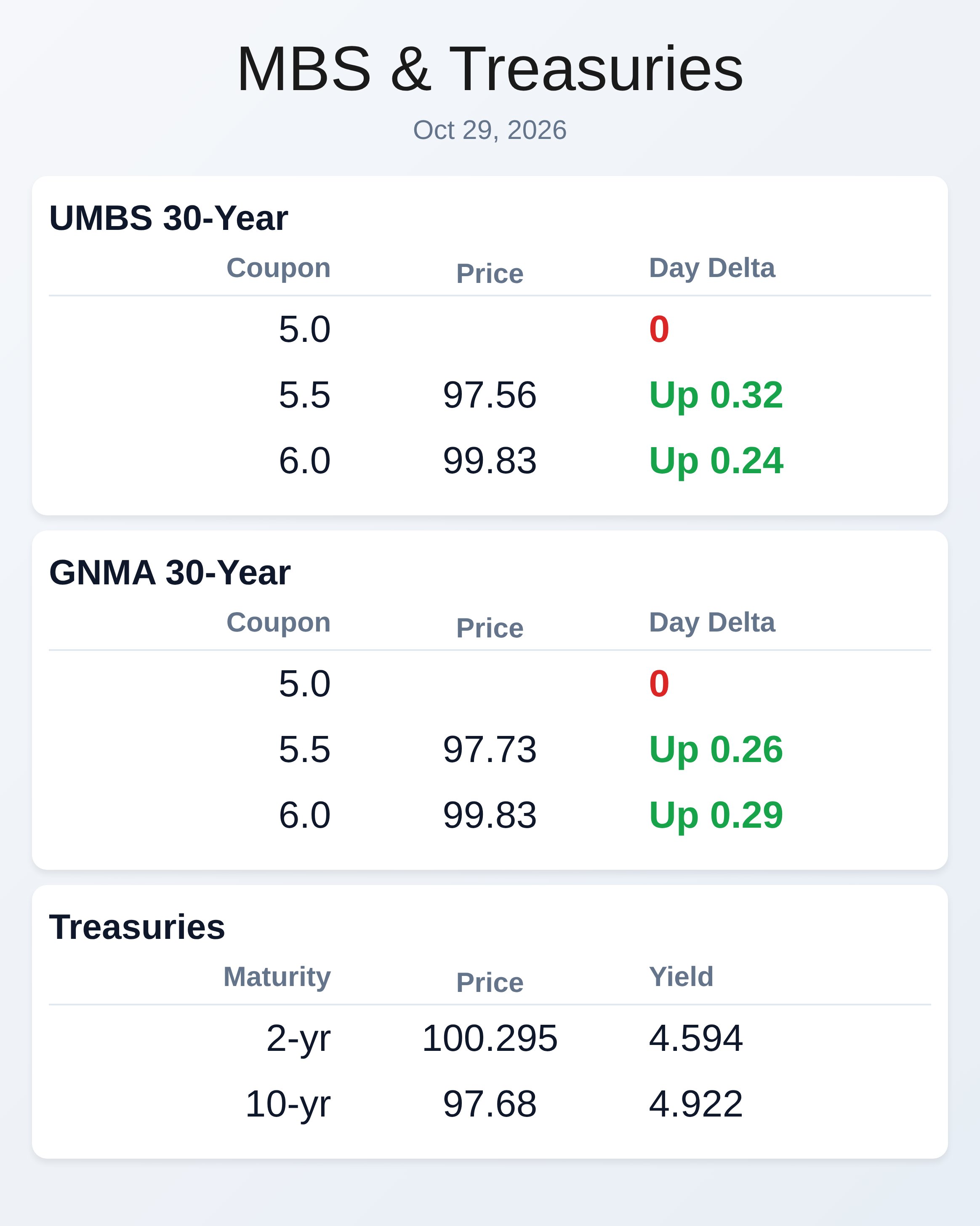
READ MORE **WTMS Blog Today = What's up in Mortgage Today (PM) - 10/29/2026** Tech stocks are cratering again, and it's lifting Treasury yields off their lows—a sign that fear of artificial intelligence losses is temporarily overwhelming hawkish Fed rhetoric. The 10-year yield pulled back from 4.92% as Amazon and Google reported disappointing results Thursday morning, triggering another flight to safety in bonds. Agency MBS gained 25 basis points on the week as persistent concerns about tech sector leverage keep investors buying Treasuries over equities. Mortgage applications climbed 3.4% week-over-week after two consecutive weeks of rate declines, though purchase and refi volume remain sharply below year-ago levels. The ARM share of new applications hit 11.3%—the highest in over a year—as borrowers desperate for savings gravitate toward adjustable-rate mortgages. The Federal Reserve held rates steady Wednesday at 3.75% to 4%, offering little relief but also no new hikes despite two officials voting to tighten. Fed Chair Kevin Warsh's comments suggested patience rather than urgency for future moves, and markets reduced rate-hike bets to single digits through year-end. Third-quarter GDP came in hot at 3.4%, beating expectations and reinforcing the economy's underlying resilience despite higher borrowing costs. Core PCE inflation matched forecasts at 0.3% month-over-month, suggesting price pressures may be leveling off, though year-over-year core inflation remains elevated at 3.1%. The mixed signals leave mortgage lenders caught between persistent inflation concerns and growing anxiety about a potential economic slowdown from tech sector weakness. Mortgage originators face brutal economics as volumes decline and pricing pressure mounts. United Wholesale Mortgage is selling $70 billion to $80 billion in mortgage servicing rights to reduce debt, shrinking its $270 billion servicing portfolio and signaling stress across the industry. Enterprise Bank & Trust exited mortgage origination entirely this week, citing lack of scale—another casualty of higher rates and razor-thin margins. Smaller players are consolidating or disappearing entirely as cost structures become unsustainable without sufficient loan volume. The gap between top-performing loan officers and bottom performers has widened dramatically, with education and relationships now separating winners from those leaving the business. CrossCountry Mortgage reported that borrowers using VantageScore 4.0 saw average loan-level pricing adjustments drop 62 basis points, translating to roughly $2,500 in savings over the first 60 days of implementation. The lender removed its 80% loan-to-value cap for conventional loans using the alternative score, expanding eligibility and giving borrowers more options to improve pricing. The shift toward VantageScore continues as Fannie Mae and Freddie Mac diverge on artificial intelligence governance standards, complicating compliance for lenders selling to both enterprises. Fannie's new Section 4 tightens AI model governance, while Freddie focuses on audits and executive approvals—forcing lenders to double down on policy updates and vendor agreements. The credit scoring battlefield is heating up as competition between FICO and VantageScore intensifies, with real financial consequences for borrowers hunting better rates. Home equity lending is emerging as a survival strategy for originators as cash-out refinancing remains dead despite $11.6 trillion in rate-locked equity. With roughly half of mortgages carrying sub-4% rates, the refi incentive has evaporated, leaving HELOCs and home equity lines as the only path to tap equity. Buyers are absorbing higher rates by shifting to adjustable-rate mortgages and pushing sellers for concessions rather than price cuts—evidence of the market's desperation to transact in an affordability crisis. Zillow is packaging down payment assistance aggressively through its lending operation, leveraging its real estate platform to capture purchase loans and deepen customer relationships. New home sales fell 0.6% in September as the median price dropped 3.9% year-over-year, yet inventory remains tight and affordability gaps persist despite modest price relief. Mortgage rates are holding near 7.3% following the Fed's pause, but near-term direction hinges entirely on whether tech sector weakness deepens or stabilizes. A sustained sell-off in growth stocks could push Treasury yields lower and provide temporary relief to originators facing margin compression. Conversely, if market sentiment stabilizes and inflation concerns resurface, the 10-year yield could break back above 5.0%—devastating news for purchase pipelines. Loan officers must prepare clients for volatility and lock in rates aggressively when the opportunity presents itself. The next 30 days will determine whether the tech-driven bond rally is act one of a broader correction or a brief intermission before yields resume climbing. **Locking vs Floating** Tech jitters remain the primary driver of near-term rate direction rather than economic data or Fed policy. Bond markets are responding to fears of artificial intelligence investment losses compressing future corporate earnings, creating temporary safe-haven demand. Lenders should treat this rally opportunistically—it could reverse quickly if tech stocks stabilize or if inflation data reignites hawkish Fed expectations. Lock decisions should account for the possibility that this is a tactical bounce, not the start of a sustained trend lower. **Today's Events** Q3 GDP (release completed): 3.4% vs 3.2% forecast October 24 Jobless Claims (release completed): 194K vs 199K forecast September Core PCE m/m (release completed): 0.3% vs 0.3% forecast September Core PCE y/y (release completed): 3.1% vs 3.1% forecast 7-Year Note Auction (release completed): 5.085% **Bond Pricing** **UMBS 30 yr** | Coupon | Price | Intra-Day Change | **GNMA 30 yr** | Coupon | Price | Intra-Day Change | **Treasuries** | Term | Yield | Price | Intra-Day Yield Change |

Market Data
Mortgage Today (AM) - 10/29/26 {{catlist}}
October 29, 2026
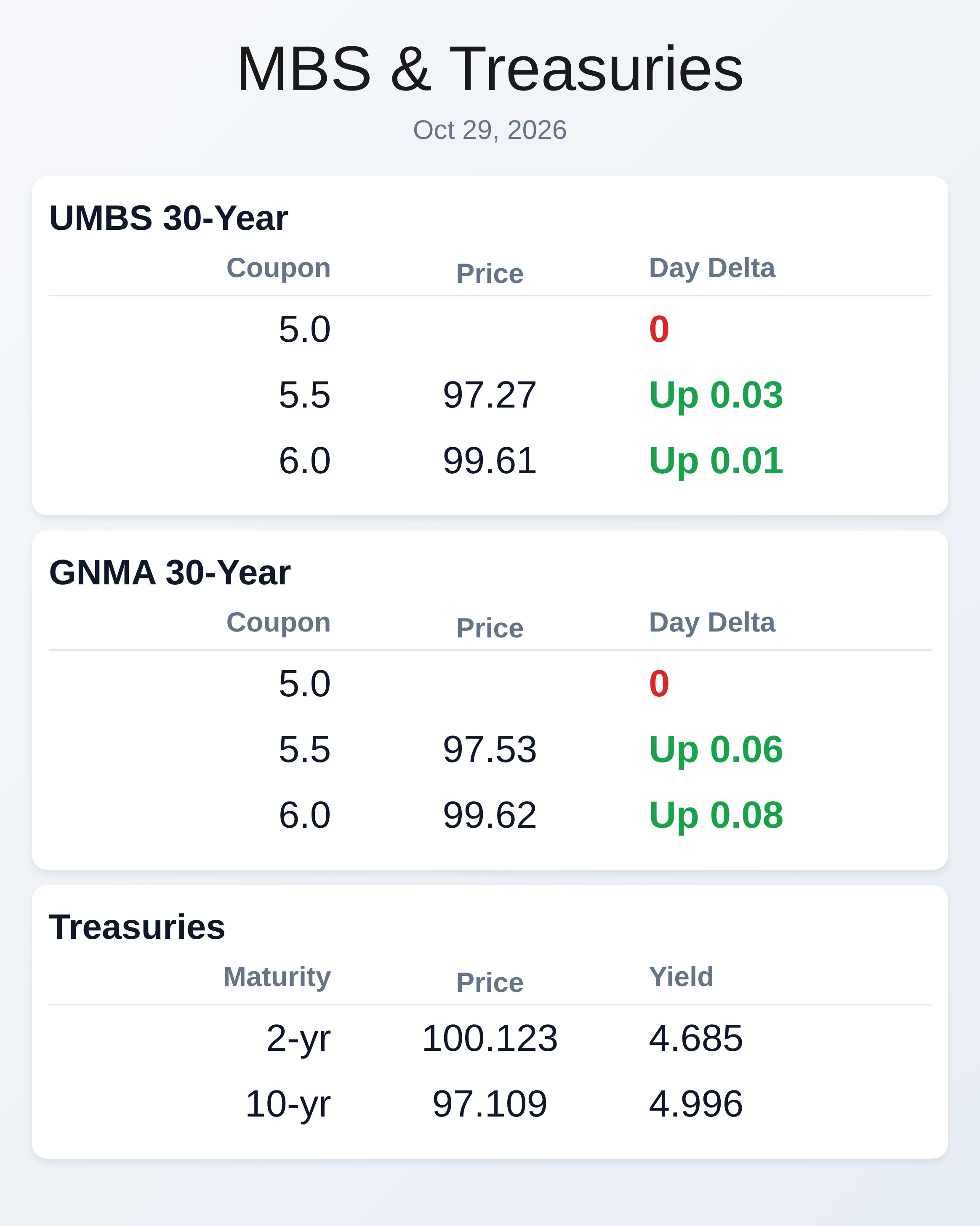
READ MORE **WTMS Blog Today = What's up in Mortgage Today (AM) - 10/29/2026** Mortgage applications rose for the second straight week as rates edged lower, yet purchase demand remains 18 percent below year-ago levels and refinancing is down 61 percent, revealing persistent affordability headwinds in a market where half of borrowers already hold sub-4 percent first mortgages. The Federal Reserve held rates steady this week at 3.75–4.00 percent as expected, but Chair Warsh's noncommittal messaging and dismissal of forward guidance sparked volatile repricing in 2-year yields as traders scrambled to cover short positions and reassess December rate expectations. UMBS 6.0 securities weakened from mid-week highs after the Fed announcement, ending the week around 99.60 as 10-year Treasuries ranged from just under 5.00 percent to above 5.04 percent, with safe-haven flows from technology selloffs occasionally offsetting inflation worries tied to crude oil near $100–$115 per barrel. Non-QM production continues to grow despite elevated rates, with lenders expanding product suites across bank statements, DSCR, and expanded credit-box offerings as conventional conforming pricing loses share in a market where buyers increasingly hunt for product flexibility to qualify. The Fannie Mae–Freddie Mac complex reported strong third-quarter earnings—Fannie Mae earned $4.2 billion and Freddie Mac earned $3.2 billion—while both entities announced pilots and guide updates including streamlined income calculations, property data standardization, and occupancy verification enhancements that will reshape origination workflows. Homebuilder confidence fell to its lowest level since June 2012, with new home sales sliding 0.6 percent to an annualized 676,000 units as elevated mortgage rates, high construction costs, and labor shortages continue to compress builder margins and incentivize price cuts and concessions rather than traditional financing inducements. Lenders are reporting compressed margins and tightening competition across jumbo and home-equity channels, with some independent mortgage banks capping loan officer compensation on jumbo loans to compete with credit unions and banks operating under different cost structures. Mortgage apps remain challenged despite slight weekly gains, with purchase volume flat year-over-year and refinancing down double digits as homeowners lack refinancing incentives and household purchasing power erodes from inflation that outpaced wage growth for the sixth consecutive month. UAD 3.6 appraisal standards, effective November 2, are raising AMC fees from historical $525 to $625–$700 per report, imposing new costs that add friction to already-strained closing processes and prompt lenders to invest in AI-assisted appraisal review tools to minimize manual underwriting delays. Employment pressure is mounting as the MBA forecasts 2027 production will fall 5 percent below $2 trillion, prompting lenders to evaluate loan officer retention strategies, shift staff to part-time status, and invest in technology to handle reduced headcount without sacrificing throughput. ARM products are gaining share as borrowers seek rate relief, with 5/1 ARM rates near 6.41 percent and ARM share reaching 11.3 percent, the highest in more than a year, signaling renewed buyer appetite for product flexibility over fixed-rate certainty. Geopolitical tensions, elevated oil prices, AI funding concerns, and midterm election uncertainty are keeping Treasury yields volatile and mortgage spreads unpredictable, while persistent delinquency risks among lower-FICO borrowers and those with high debt-to-income ratios continue to weigh on credit expectations and MSR valuations in a market where traditional safe-haven demand no longer reliably support bond prices. **Locking vs Floating** Pressure has built on lock positions as buyers remain cautious and rate movements introduce reprice risk for aggressive pricers. Short-covering and safe-haven flows have produced tactical rallies, but sustainability depends on whether tech-sector stabilization or new inflation signals dominate. Loan officers should balance competitive pricing against hedge losses and borrower fallout, particularly with an election week ahead and PCE data likely to rattle positioning. **Today's Events** October 29, 2026: Advance Q3 GDP, September Personal Income, Personal Spending, PCE Prices, Core PCE Prices, Initial Claims, Continuing Claims, 7-year Treasury note auction, ECB monetary policy decision. **Bond Pricing** **UMBS 30 yr** | Coupon | Price | Intra-Day Change | **GNMA 30 yr** | Coupon | Price | Intra-Day Change | **Treasuries** | Term | Yield | Price | Intra-Day Yield Change |

Market Data
{{title}} {{catlist}}
{{date}}
READ MORE {{content}}
LATEST ARTICLES

RECENT ARTICLES

Mortgage Today (PM) – 01/15/26

January 15th, 2026|Week In Review|

WTMS Blog Today = What's up in Mortgage Today (PM) - 01/15/2026 Markets stumbled today as jobless claims fell to 198,000, significantly below expectations and suggesting a tighter labor market than anticipated. UMBS prices dropped [...]

Mortgage Today (AM) – 01/15/26

January 15th, 2026|Week In Review|

WTMS Blog Today = What's up in Mortgage Today (AM) - 01/15/2026 Jobless claims fell to 198,000 last week, well below the 215,000 forecast and marking the lowest level since November. This surprisingly strong employment [...]

Article Archive

The Emptiness of Fear

November 17th, 2023|0 Comments

Today's lesson is from "The Fear Book" by Cheri Huber Some things we may not think of as fear - anger, sadness, irritation, urgency, depression, control issues - are pointing to an underlying fear.  [...]

The Slight Edge IV

November 16th, 2023|0 Comments

Reading Notes For:  Mortgage Peeps – Follow us on Facebook (below or #DuaneKayeWTMS) or Twitter (@MakesYouSmarter) for daily rate lock updates.

The Slight Edge V

November 14th, 2023|0 Comments

Reading Notes For:  Mortgage Peeps – Follow us on Facebook (below or #DuaneKayeWTMS) or Twitter (@MakesYouSmarter) for daily rate lock updates.

Behind the Fear Door

November 10th, 2023|0 Comments

Herbert Gray studied success for 11 years and found the common denominator was that successful people make the habit of doing the things that unsuccessful people don’t like to do. Whatever you do repeatedly [...]

Subscribe

Send me some brain food

Go to Top