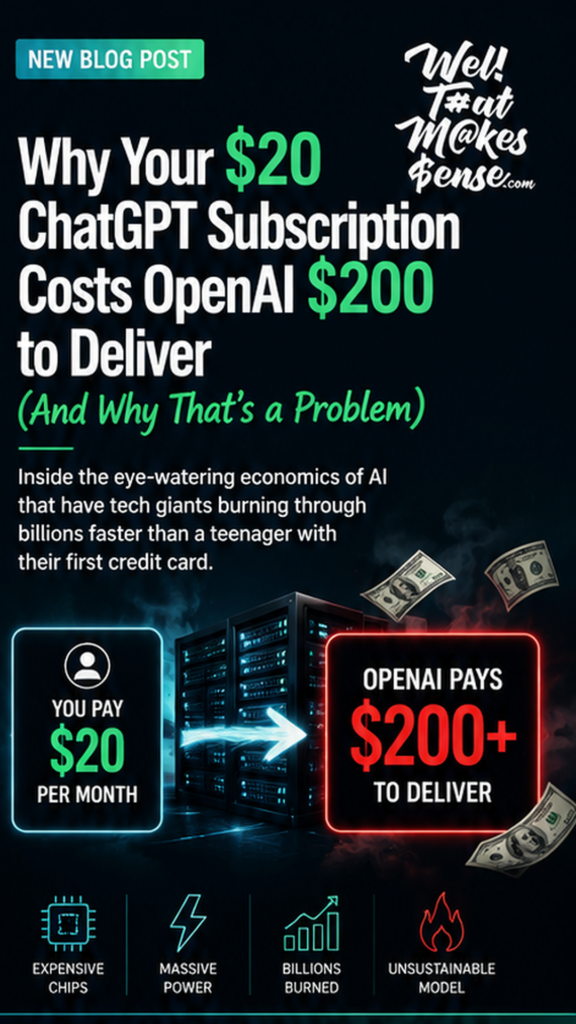
Why Your $20 ChatGPT Subscription Costs OpenAI $200 to Deliver (And Why That’s a Problem)
Inside the eye-watering economics of AI that have tech giants burning through billions faster than a teenager with their first credit card
Imagine running a lemonade stand where every cup you sell for a dollar costs you ten dollars to make. You’d be out of business faster than you can say “bankruptcy court.” Yet that’s essentially the business model Silicon Valley’s AI darlings are running right now, and somehow, investors keep writing checks with more zeros than a phone number.
According to recent industry analysis, companies like OpenAI and Anthropic might be spending more than $1,000 in computational costs for every $100 their customers pay them. Let that sink in for a moment. For every Benjamin Franklin customers hand over, these companies are burning through ten of them just to keep the digital hamster wheel spinning. It’s like discovering your Uber driver is paying $50 in gas for your $5 ride—except instead of one confused driver, it’s an entire industry worth hundreds of billions of dollars.
The Math That Would Make Your Accountant Cry
Here’s what’s happening behind the curtain: When you ask ChatGPT to write your wedding toast or help debug your Python code, you’re not just tapping into some magical cloud fairy dust. You’re activating massive data centers filled with specialized computer chips that consume electricity like a small city and cost more than most people’s houses. These aren’t your grandma’s desktop computers—we’re talking about cutting-edge AI processors that cost tens of thousands of dollars each and run hotter than a Phoenix parking lot in August.
Every query you submit gets processed by these expensive machines, which need to crunch through billions of calculations to generate responses. The bigger and smarter the AI model, the more computational power it requires, and the more it costs to run. It’s the technological equivalent of using a Formula One race car for your grocery store runs—incredibly impressive, absurdly expensive, and probably not sustainable long-term.
OpenAI charges most consumers around $20 per month for ChatGPT Plus. Enterprise customers pay more, but even those premium prices don’t come close to covering the actual computational costs for heavy users. When someone is having lengthy conversations, generating images, or running complex analyses, the company could be spending $200 or more per month in infrastructure costs to serve that single $20 subscriber. The economics are, to put it mildly, challenging.
The Venture Capital Treadmill Keeps Spinning
So how do these companies stay afloat while hemorrhaging money on every transaction? The same way many tech startups have survived for decades: they raise absolutely enormous amounts of venture capital. OpenAI has raised billions from investors like Microsoft. Anthropic has pulled in billions from Google, Amazon, and others. These companies are essentially running on a financial treadmill, constantly needing to raise more capital to fund their operations while they figure out how to make the economics work.
The pitch to investors goes something like this: “Yes, we’re losing money on every customer right now, but we’re building the future of technology! Eventually, we’ll make the models more efficient, the chips will get cheaper, and we’ll figure out pricing that works. Trust us, and keep those checks coming.” It’s a bet that the technology will improve faster than the cash burns out—a gamble that’s worked for companies like Amazon and Tesla, but has also spectacularly failed for countless others whose names you’ve forgotten.
This creates a fascinating dependency cycle. OpenAI needs Microsoft’s billions to keep the lights on. Anthropic needs Google and Amazon’s cash infusions to compete. The AI race has become less about who has the best technology and more about who has the deepest-pocketed backers willing to fund years of losses. It’s like a high-stakes game of financial chicken, where everyone’s betting that they won’t be the first to blink—or run out of runway.
What This Means for the Future of AI
Here’s where things get interesting for those of us not sitting on venture capital boards. This unsustainable economic model has to resolve somehow, and there are really only a few ways it can play out. First, the technology could get dramatically more efficient. Companies are working furiously on this, developing smaller models that can run on less expensive hardware, optimizing their code, and finding clever shortcuts that maintain quality while reducing costs. Some progress is being made, but it’s a race against mounting losses.
Second, prices could go way up. That $20 monthly subscription might become $50, $100, or more as companies try to close the gap between revenue and costs. We’re already seeing this with enterprise pricing, where companies pay thousands per month for API access. The free tier that many people enjoy? That’s probably living on borrowed time. Nothing says “we need to make money” quite like watching your burn rate exceed your revenue by a factor of ten.
Third, we could see massive consolidation. Smaller AI companies without access to big tech’s infinite money fountain will simply run out of cash and shut down or get acquired. We might end up with just a handful of AI providers—essentially the ones backed by Microsoft, Google, Amazon, and maybe a couple others with sufficiently deep pockets. Competition would decrease, innovation might slow, and consumers would have fewer choices. It’s the natural endpoint when an industry requires billions in capital just to play the game.
Fourth, there’s the possibility that the whole thing is a bubble that eventually pops. If investors lose faith that AI companies can ever achieve profitable unit economics, the funding spigot could turn off. Companies would be forced to dramatically scale back operations, lay off staff, and potentially shut down entirely. It’s happened before in tech—remember when everyone thought 3D TVs and Google Glass were the future? Yeah, investors do too, and they’re not eager to repeat those expensive lessons.
The Trillion-Dollar Question Nobody Wants to Ask
The elephant in the server room is whether current AI technology is actually worth the astronomical costs being poured into it. ChatGPT is undeniably useful and impressive, but is it “lose billions of dollars per year” useful? That’s a question that keeps CFOs up at night, even if the true believers in AI’s transformative potential prefer not to dwell on it too much.
For consumers and businesses currently enjoying AI services at prices that don’t reflect their true costs, the message is clear: enjoy it while it lasts. You’re essentially being subsidized by venture capitalists who are betting that AI will eventually justify its price tag. Whether you’re using AI to write emails, generate marketing copy, or automate customer service, you’re getting a sweetheart deal that economics suggests can’t last forever.
The next few years will be crucial. Either AI companies will crack the code on making their services profitable, or they’ll need to radically change their approach. Maybe that means better technology, higher prices, new business models, or some combination we haven’t imagined yet. What’s certain is that the current situation—where companies burn through ten dollars to earn one—isn’t a long-term strategy, no matter how much venture capital you have backing you.
For the mortgage and real estate industries increasingly relying on AI tools for everything from property valuations to customer service chatbots, this matters more than you might think. If AI pricing suddenly doubles or triples to reflect actual costs, or if smaller AI providers start disappearing, it could disrupt workflows and force companies to rethink their technology strategies. The smart money is on having backup plans and not putting all your eggs in the AI basket—at least not until the economics make more sense than a lemonade stand selling dollar cups that cost ten bucks to make.
Want to stay ahead of the curve on how technology, economics, and occasionally questionable business models are shaping the future of real estate and mortgages? Subscribe to our newsletter at WellThatMakesSense.com where we translate the chaos of the financial and tech worlds into insights you can actually use—no MBA or venture capital required. We promise to keep making sense of things that, well, should make sense but somehow don’t until we explain them