**WTMS Blog Today = What’s up in Mortgage Today (PM) – 11/16/2026**
The mortgage industry’s consolidation wave is accelerating as STRATMOR Group expects 46 M&A transactions by year-end, with sellers facing a stark choice: exit or intensify spending on technology and talent. Weak profitability, the relentless pace of artificial intelligence adoption, and competition from vertically integrated giants are pushing more independent operators toward the exits, according to industry analysts. Some lenders are simply exhausted by the technology arms race and have concluded the cost of competing independently outweighs potential gains.
The calculus for sellers is straightforward—if you are not profitable today and the next three years look bleak, why continue fighting? This M&A environment rewards both larger independent mortgage banks acquiring smaller competitors and smaller regional banks re-entering the mortgage space with fresh capital and appetite for growth. Smaller banks with under $5 billion in assets are showing renewed interest in mortgage M&A, seeing opportunities to leverage existing customer relationships, expand home equity origination, and potentially benefit from looser capital requirements.
These regional players can offer meaningful advantages to sellers: access to larger deposit bases, reduced compliance complexity, and the ability to retain lending teams under a stable corporate parent. Meanwhile, warehouse lenders are losing patience with unprofitable independent mortgage banks that cannot achieve scale or profitability within reasonable timeframes. The firms determined to remain independent face tough decisions about staffing levels, technology spending, and operating expenses that cannot be deferred indefinitely without risking market share loss.
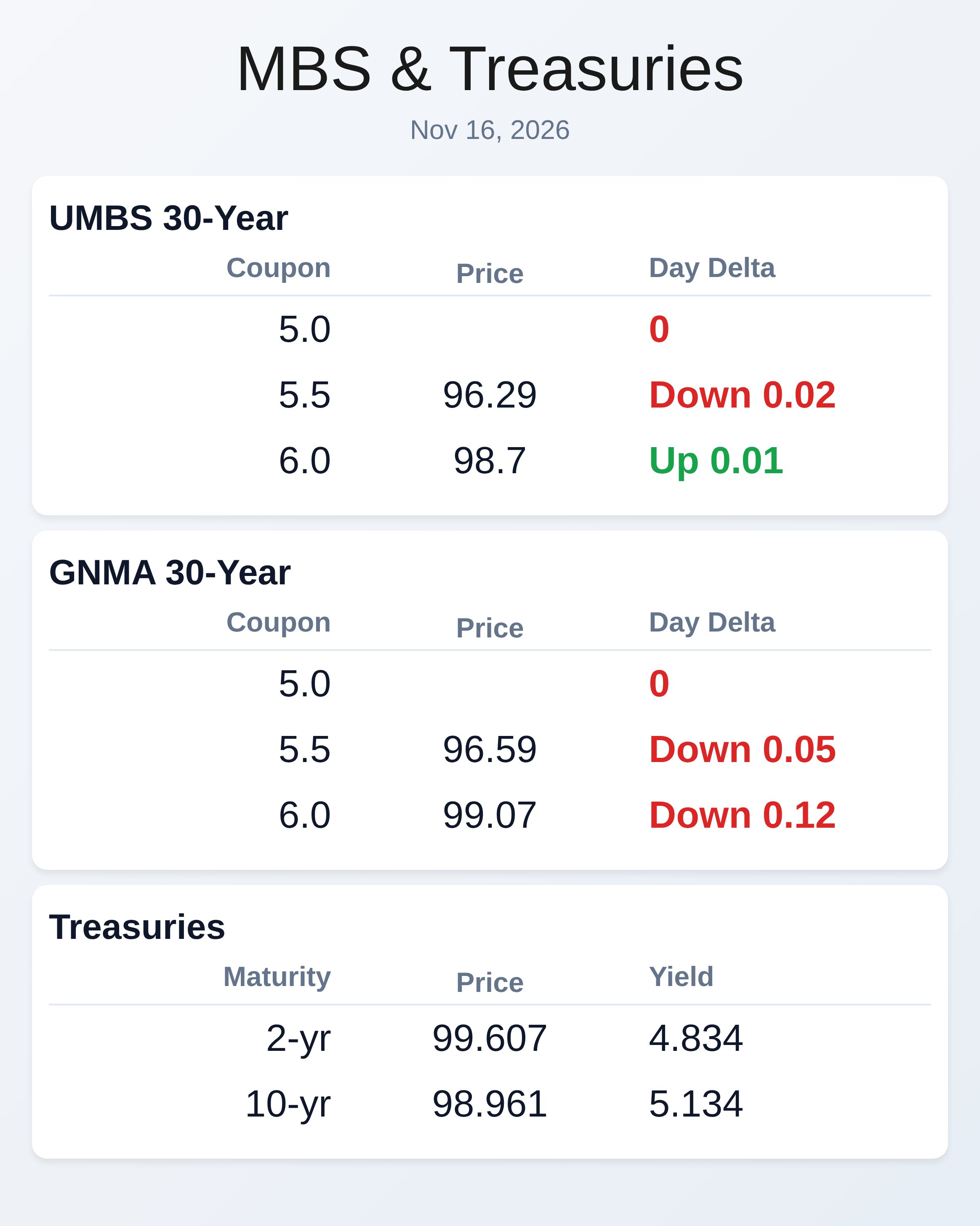
UMBS 6.0 securities finished the week at 98.69, down 0.08 from the prior session, as moderate bond weakness reflected light liquidity and no compelling new catalysts for yield movement. MBS underperformed relative to Treasury yields on Friday, with 6.0 UMBS declining roughly five ticks while the 10-year moved modestly higher by just 1.3 basis points. The divergence between MBS and Treasury weakness suggests curve trading activity in a thin-volume environment rather than broad-based systemic selling.
Early estimates suggest some lenders may be contemplating negative reprices as MBS prices fell further below recent morning highs. This pricing pressure created uncertainty for loan officers managing pipeline risk heading into the weekend. GNMA 6.0 securities moved slightly lower at 99.19, down just one basis point, as Ginnie Mae instruments showed more resilience than UMBS during Friday’s moderate sell-off.
The relative steadiness in GNMA pricing reflects the structural support these securities receive from their government guarantee and their appeal as collateral for balance sheet repositioning. Despite the broader bond weakness, GNMA’s performance suggests some underlying institutional demand remains intact, particularly among risk-averse investors seeking government-backed exposure. Mortgage originators holding GNMA inventory faced fewer repricing pressures compared to peers managing UMBS exposure.
The 10-year Treasury yield climbed to 5.141% by Friday’s close, up 1.3 basis points, as the bond market exited October’s bullish trend and established a more defensive posture heading into the final six weeks of the year. No single economic datapoint or headline dominated the session; rather, weakness reflected a combination of lighter trading volumes and uncertainty about whether recent equity market volatility would persist. PPI data arrived in line with consensus forecasts and showed no signs of broad-based inflation acceleration, yet failed to inspire meaningful bond buying in a market already focused on higher-for-longer rate expectations.
The 10-year’s proximity to the 5.14% support level and 5.27% resistance ceiling suggests technicians will watch these technical points closely for signals about whether yields can extend further higher. Mortgage servicers retain just 27% of refinancing borrowers industry-wide, according to ICE data for the third quarter, indicating that billions spent on servicing portfolios and customer retention technology have delivered disappointing recapture results. Even among borrowers who locked in mortgages during the low-rate environment and would benefit from refinancing, servicers lose nearly 73% of these customers to competitors and alternative products.
Cash-out refinancing borrowers show even weaker retention at just 26%, as these customers often shop rates aggressively and are less loyal to their original servicer when accessing equity. The challenge reflects a fundamental shift in borrower behavior: homeowners sitting on $17.5 trillion in home equity increasingly view refinancing as a shopping opportunity rather than a routine transaction with their existing lender. Mortgage Solutions Financial is shifting its origination team to Fairway effective November 30, while its parent company concentrates on mortgage servicing operations, allowing the lending platform to retain its brand identity while gaining access to Fairway’s larger origination infrastructure.
This move marks another example of independent operators deciding that the mortgage origination business no longer justifies standalone operations and that partnership or subordination to a larger platform offers better economics. Fannie Mae’s revised rental income documentation standards take effect December 1, tightening eligibility for investor loans and limiting how some borrowers can qualify using rental income, which will narrow the pool of investment property purchasers who can qualify through agency channels. The CFPB has submitted a revised mortgage servicing rule to the White House for review, with potential changes to foreclosure protections and loss mitigation procedures that could reshape how servicers manage delinquent accounts under a new administration.
**Locking vs Floating**
Remain in a defensive “wait and see” posture as bonds have clearly exited October’s rally trend. Bond bullishness depends on the return of technology-sector volatility—a risk factor that has been substantially defused over the past five trading days. Lock triggers should focus on the 10-year technical ceiling at 5.27% if sellers want meaningful rate protection, while floaters can monitor the 5.00% support level as a potential floor for rates over the near term.
**Today’s Events**
No major economic data is scheduled. Market focus remains on anticipation of Fed minutes and central bank commentary that could signal December rate-hike probability.
**Bond Pricing**
**UMBS 30 yr**
| Coupon | Price | Intra-Day Change |
**GNMA 30 yr**
| Coupon | Price | Intra-Day Change |
**Treasuries**
| Term | Yield | Price | Intra-Day Yield Change |