**WTMS Blog Today = What’s up in Mortgage Today (AM) – 08/07/2026**
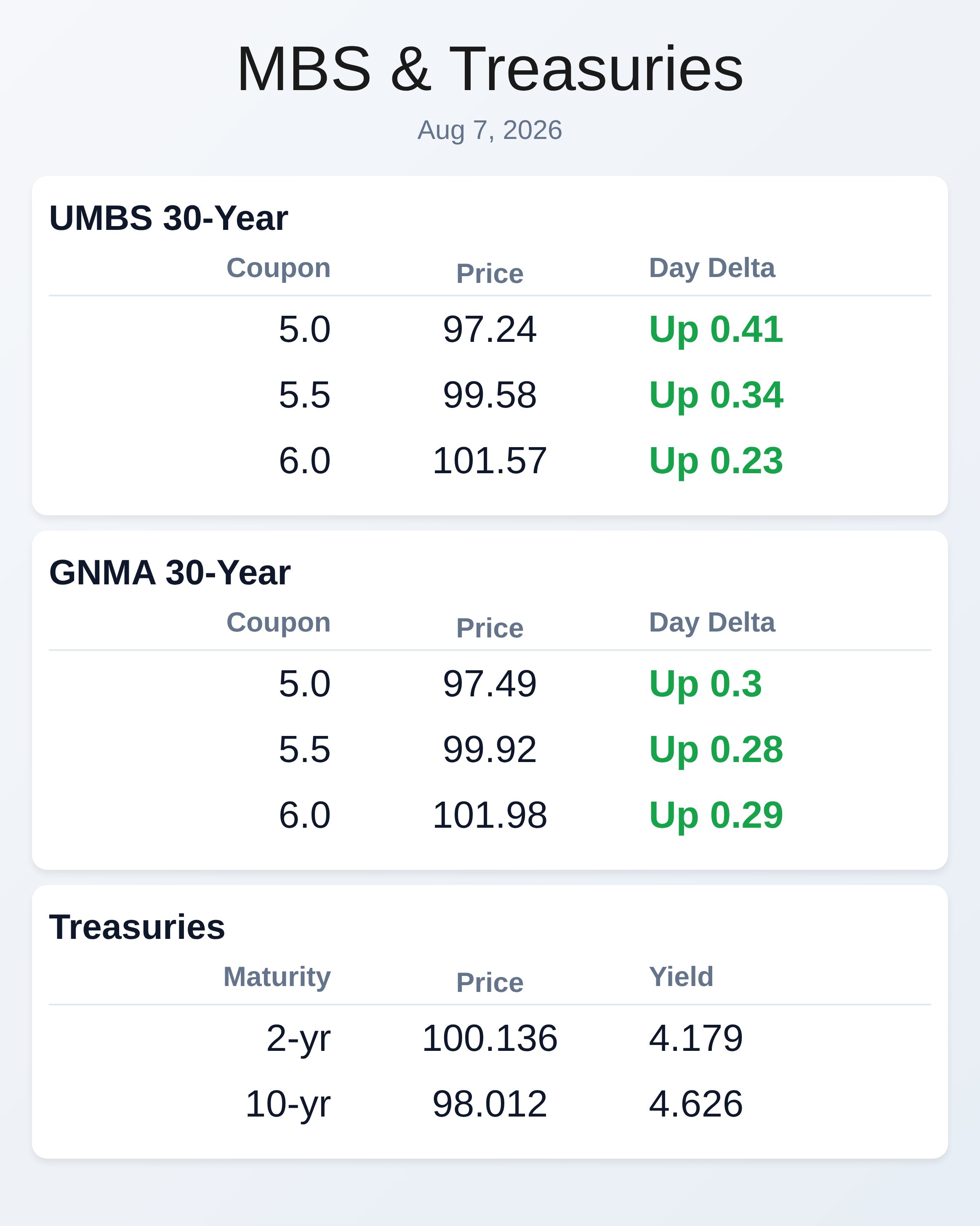
Nonfarm payrolls unexpectedly fell 23,000 in July versus an 80,000 forecast, sending bonds and mortgage-backed securities sharply higher in early trading. The negative jobs print signaled labor market weakness that could reduce the likelihood of a September Federal Reserve rate hike, providing relief to mortgage originators and MBS investors watching for rate direction signals. UMBS 5.5 coupon bonds gained 0.32 points to 99.56, while the 10-year Treasury yield dropped 5.3 basis points to 4.625 percent by mid-morning.
Previous months saw significant downward revisions totaling -103,000 jobs net, underscoring a softer employment picture than headlines suggested earlier this year. Labor force participation also declined, indicating tightening supply-side pressures that offset unemployment’s 4.1 percent reading. The Treasury rally remains the day’s primary driver after weeks of anxiety about Fed policy tightening.
Six basis points of yield compression across the 10-year (closing at 4.62 percent after opening at 4.67 percent) reflected immediate repricing as traders reduced bets on higher rates ahead. Dollar weakness and equity futures strength accompanied the move, signaling classic risk-on sentiment despite geopolitical tensions around the Iran-Oman Strait of Hormuz negotiations still looming. Mortgage originators who locked loans before Thursday’s close or early Friday morning captured immediate secondary market gains, though market analysts caution against assuming this rally sticks permanently given shifting trading patterns post-employment data over the past year.
Refinance activity should accelerate modestly from this week’s levels as rate-sensitive borrowers reassess loan opportunities. With only 3.7 percent of conventional borrowers currently holding a refinance incentive—the lowest share in a year—any sustained yield decline could unlock pent-up demand and boost Agency mortgage supply. However, the broader purchase market remains the origination engine as start-home affordability pressures persist despite easing economic data.
Luxury home sales rose 6.2 percent while starter home sales fell 5.4 percent, creating a K-shaped housing recovery that leaves most originators still focused on jumbo and non-QM products to maintain volume. Average hourly earnings came in at +0.1 percent month-over-month versus the 0.3 percent forecast, with year-over-year growth at 3.2 percent against 3.5 percent expectations. This wage disinflation narrative gives the Fed additional cover to pause or delay rate hikes, removing a key hawkish argument from recent policy discussions.
Participation rate softened to 61.4 percent from 61.5 percent, suggesting workers leaving the labor force rather than new hires entering it. The combination paints a picture of a labor market losing momentum, which historically foreshadows either Fed rate cuts or extended rate holds—both beneficial for mortgage pricing and originator pipelines. Secondary market execution improved substantially through late morning as bid-ask spreads tightened and volume picked up.
Lenders with best-execution capabilities saw three-basis-point moves on certain UMBS coupons, rewarding those with diversified investor relationships and automated pricing. The 2-year Treasury dropped eight basis points to 4.16 percent, flattening the yield curve further and signaling lower refinance-rate floors heading into next week. GNMA 30-year bonds moved similarly, gaining 0.28-0.30 points, with the 5.5 coupon at 99.92 reflecting comparable strength to UMBS counterparts.
Originators should prepare for potential pipeline momentum shifts as rate locks become more attractive and brokers shop larger loan batches for afternoon closures. Geopolitical risks remain—war-related volatility in Treasuries could resurface by Friday’s close or carry into next week—so rate-sensitive borrowers may accelerate lock decisions to capture today’s gains. Watch Monday’s follow-through carefully, as bond markets historically struggle to maintain sharp rallies post-employment data if subsequent headlines turn hawkish.
Lock this setup if margins remain adequate; float only if your pipeline can absorb Friday or next-week volatility without flinching.
**Locking vs Floating**
Job market weakness typically signals easier Fed policy, yet past year trading patterns show bond-rally reversals post-jobs data remain a real risk. Lenders who repriced too aggressively yesterday missed today’s opportunity, while those holding rates benefited from secondary gains.
War-related volatility could resurface Friday, and the employment report itself always carries execution risk. Lock for clients wanting certainty; float only if pipeline depth supports weekend or early-week downside exposure.
**Today’s Events**
July Non Farm Payrolls: -23K (forecast: 80K; prior: 57K)
July Unemployment Rate: 4.1% (forecast: 4.2%; prior: 4.2%)
July Average Earnings (month-over-month): 0.1% (forecast: 0.3%; prior: 0.3%)
July Participation Rate: 61.4% (prior: 61.5%)
Later today: June Consumer Credit and Richmond Fed President Barkin remarks
**Bond Pricing**
**UMBS 30 yr**
| Coupon | Price | Intra-Day Change |
| 5.0 | 97.24 | 0.41 |
| 5.5 | 99.58 | 0.34 |
| 6.0 | 101.57 | 0.23 |
**GNMA 30 yr**
| Coupon | Price | Intra-Day Change |
| 5.0 | 97.49 | 0.30 |
| 5.5 | 99.92 | 0.28 |
| 6.0 | 101.98 | 0.29 |
**Treasuries**
| Term | Yield | Price | Intra-Day Yield Change |
| 2 yr | 4.179 | 100.136 | -0.071 |
| 3 yr | 4.236 | 99.691 | -0.068 |
| 5 yr | 4.327 | 100.213 | -0.069 |
| 7 yr | 4.467 | 99.453 | -0.067 |
| 10 yr | 4.626 | 98.012 | -0.052 |
| 30 yr | 5.188 | 97.154 | -0.032 |