**WTMS Blog Today = What’s up in Mortgage Today (AM) – 09/29/2026**
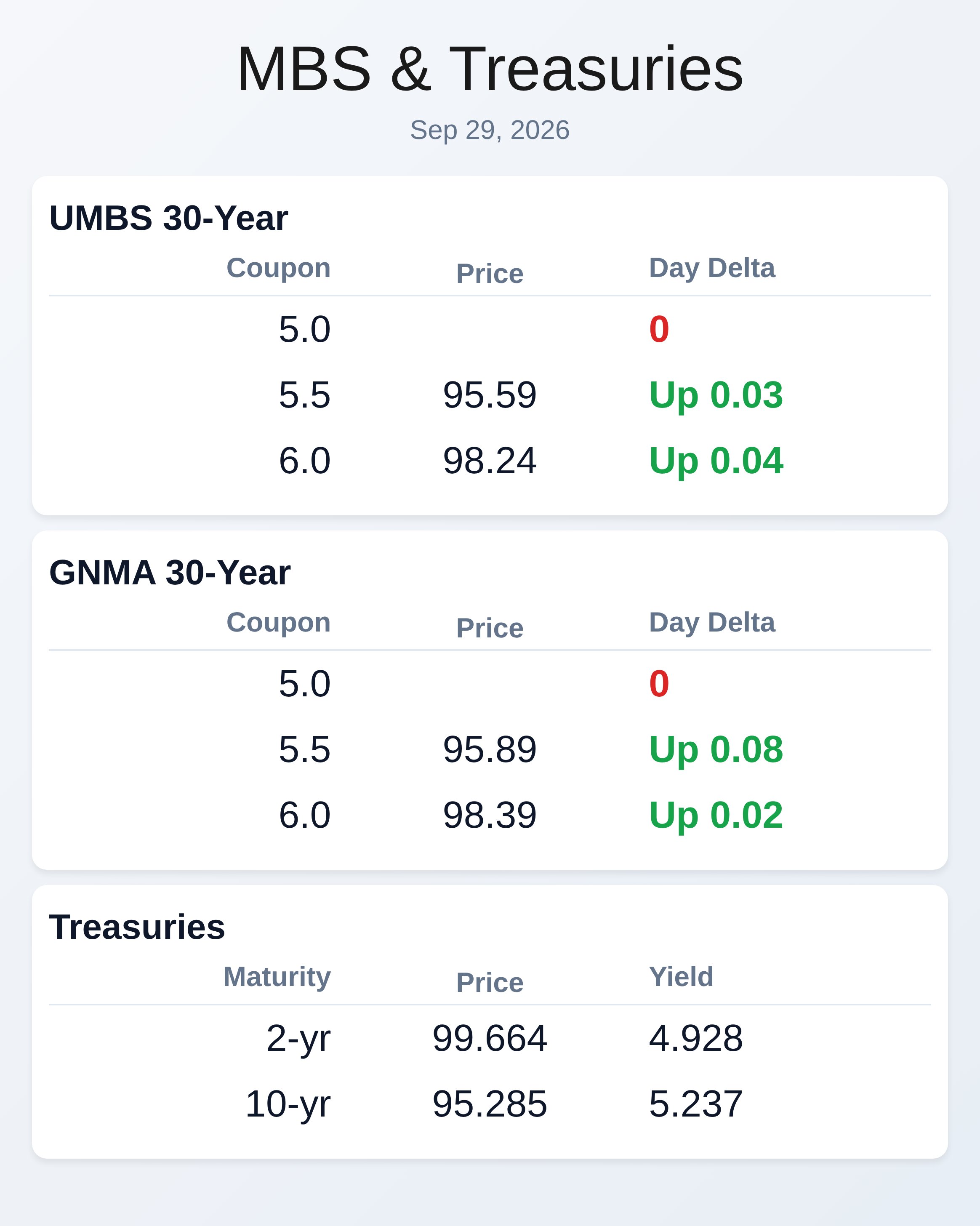
Oil prices are easing and Treasury yields are retreating slightly, giving mortgage professionals a moment of relief after a brutal week of selling pressure. The 10-year yield dropped to 5.213 percent this morning, down 2.2 basis points from yesterday’s close of 5.237 percent, as Saudi Arabia resumed flows through a critical pipeline. UMBS securities are holding steady with modest gains, while the broader bond market awaits critical economic data later today.
Energy-driven inflation remains the primary headwind, but weakening oil suggests markets may finally be catching a breather. This intraday relief could matter for lock-and-float decisions, but the bigger question is whether this bounce has legs or fizzles out by Friday’s jobs report. UMBS 30-year coupons posted minimal overnight movement, with the 6.0 coupon at 98.24, up just 0.04 points from yesterday.
The 5.5 coupon printed at 95.59, up 0.03, while the 6.5 coupon remained nearly flat at 100.68 with only a 0.02 point increase. GNMA securities performed slightly better, particularly in the 5.5 coupon, which gained 0.08 points to 95.89 compared to UMBS weakness. These modest gains reflect cautious positioning ahead of a data-heavy Tuesday that includes the FHFA Housing Price Index, Case-Shiller Home Prices, and Consumer Confidence at 10 a.m.
The market is essentially holding its breath, waiting to see if economic momentum confirms the case for higher-for-longer rates or if cracks finally appear in consumer spending. The credit score battle intensified when Rocket Mortgage announced it will default to VantageScore 4.0 for all GSE-eligible loans starting in the fourth quarter of 2026. After testing 1.4 million credit reports over four months, Rocket found that VantageScore helped more clients qualify and saved borrowers an average of $1,600 at closing.
However, this move raises serious operational questions for the broader industry: verification infrastructure must be ready before investor infrastructure can catch up, and smaller lenders dependent on correspondent aggregators may lack the direct GSE delivery capabilities of Rocket or UWM. The concern isn’t just competition—it’s equity across lender channels. Without widespread correspondent investor participation, VantageScore expansion could widen the competitive moat for large direct lenders rather than democratizing access as regulators intended.
The Iran conflict remains a central driver of bond market movement, with geopolitical tensions keeping energy inflation at the forefront of Fed policy discussions. Investors increasingly view elevated oil and diesel prices as sustained inflation risks rather than temporary volatility, knowing that transportation costs will eventually filter into food and core goods. The Treasury selloff reflects a market convinced the U.S.
economy remains resilient: 10-year break-even inflation sits at 2.35 percent, suggesting confidence in the Fed’s inflation-fighting ability. Yet the paradox is sharp—stronger economic data means higher rates, while weaker data could trigger a sharp rally if markets begin pricing in demand destruction from elevated borrowing costs. For mortgage professionals, this catch-22 makes floating riskier but waiting potentially costlier.
Employment transitions across the mortgage sector continue, with Informative Research announcing that Tim Cox has returned as executive vice president of business process automation. Cox brings over two decades of mortgage technology and operational strategy experience from previous roles at IR and most recently at Xactus, where he led AI enablement and operational scalability initiatives. Meanwhile, the HELOC market remains volatile and demand-sensitive: home equity nationwide sits at $34.9 trillion with HELOC balances up for 17 straight quarters, yet pipeline activity swings sharply with every rate move.
Lenders responding to this volatility are shifting toward fully automated fulfillment where possible, expert-managed where necessary, and flexible capacity that adapts to rate environment changes. The trend signals that mortgage professionals who can operationalize rapid scaling will win regardless of whether rates spike or stabilize. A crowded Tuesday economic calendar will test market resolve as the day unfolds with FHFA Housing Price Index, Case-Shiller data, Consumer Confidence, August JOLTS, and remarks from Fed Governors Bowman, Barr, and Waller all hitting between 9 a.m.
and afternoon sessions. This concentration of data and Fed speak creates genuine risk for intraday whipsaws, making tactical decisions harder than strategic ones. Month-end passive rebalancing flows will overlap with data reactions, potentially exaggerating moves in either direction.
The November Presidential election year backdrop adds policy uncertainty to every economic release, particularly around inflation and employment data. Professional mortgage originators should expect volatility and avoid anchoring decisions to this morning’s brief Treasury relief.
**Locking vs Floating**
Wait for confirmation of a genuine bond market rally before adjusting lock-and-float positioning.
Market participants continue recommending caution until economic data or Fed guidance provides clearer directional conviction. A strong economic report would likely add to rate pressure, while weak employment data could unlock a substantial mortgage rate rally if combined with bond market recovery. The issue remains asymmetric: data could accelerate either direction, making early positioning bets risky.
**Today’s Events**
FHFA Housing Price Index (July)
S&P Case-Shiller Home Price Index (July)
Conference Board Consumer Confidence (September)
August JOLTS Job Openings
Federal Reserve speakers: Governor Michelle Bowman, Governor Austan Barr, Governor Christopher Waller
**Bond Pricing**
**UMBS 30 yr**
| Coupon | Price | Intra-Day Change |
| 5.5 | 95.59 | 0.03 |
| 6.0 | 98.24 | 0.04 |
| 5.5 | 95.89 | 0.08 |
**GNMA 30 yr**
| Coupon | Price | Intra-Day Change |
**Treasuries**
| Term | Yield | Price | Intra-Day Yield Change |