**WTMS Blog Today = What’s up in Mortgage Today (AM) – 10/09/2026**
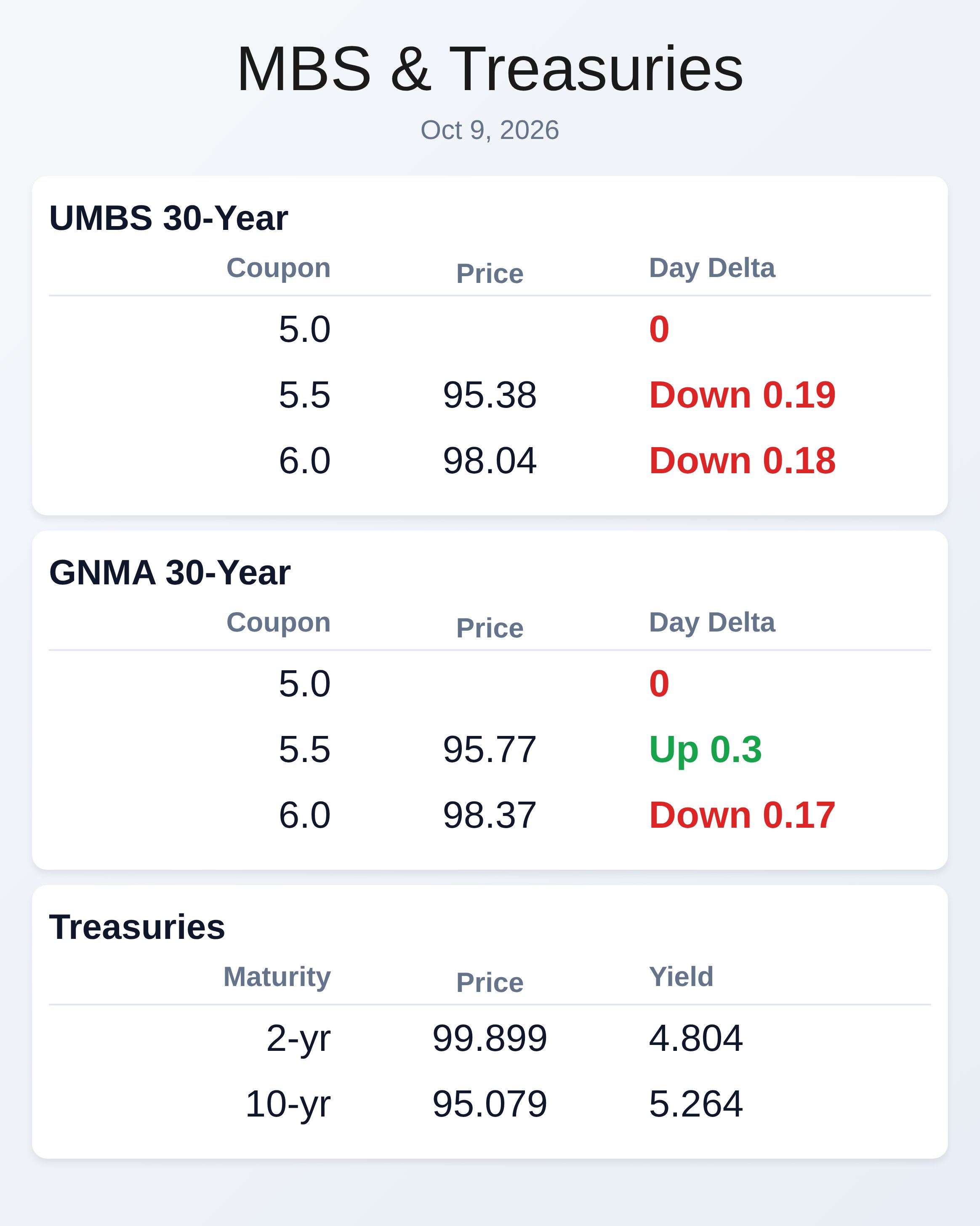
Bonds staged a modest rally Thursday after Fed official Chris Waller’s hawkish comments spooked markets in early trading, but Treasury yields retreated from multidecade highs as oil prices fell and geopolitical tensions eased around Iran. The 10-year yield closed near 5.23%, down from earlier peaks around 5.34%, signaling that investors remain torn between inflation concerns and hopes for relief. UMBS 6.0 coupons finished Thursday around 97.78, holding most of their recent losses.
Initial jobless claims fell to 197,000 for the week ending October 3, reinforcing that labor markets remain resilient despite some softening in continued claims data. The calendar ahead is extremely light, with only preliminary University of Michigan Consumer Sentiment and Boston Fed President Collins’s remarks on tap. Thursday’s Treasury auction cycle showed solid demand at the longer end of the curve, with the 30-year sale generating a 2.54x bid-to-cover ratio and nearly 94% of awards going to non-dealers—well above historical averages.
This strong indirect bidding suggests institutional investors still see value despite the elevated yield environment. The Treasury’s $6 billion long-end buyback program also provided price support. However, the follow-through after the auction was mixed, as bonds cheapened once the real buying pressure subsided.
Mortgage originators should note that while Thursday’s rally felt encouraging, it represents a technical bounce rather than a fundamental break in the relentless uptrend that has dominated since late August. Servicer-level prepayment speeds reveal meaningful differences in borrower behavior across originator platforms. Rocket/Quicken continues to lead as the fastest payer on both 30-year and 15-year UMBS loans, while Freedom Mortgage and Fifth Third rank among the quickest on longer-dated securities.
Conversely, Bank of America, loanDepot, and Provident frequently trail as the slowest servicers on 30-year pools, with Lakeview, JPMorgan Chase, and Provident lagging on 15-year mortgages. These servicer-specific patterns have persisted for months, suggesting structural differences in loan origination, customer demographics, or operational practices. September mortgage prepayments continued their sharp deceleration, with Fannie Mae speeds falling to 6.7 CPR—the slowest pace since April 2025—as rates climbed from 5.98% in February to 7.28% by early October.
Equity markets bounced Friday as oil prices slipped below $103 per barrel and investors digested OpenAI’s guidance that it will hit $70 billion in annualized revenue by year-end. The S&P 500 futures rose 0.4% and Nasdaq 100 contracts climbed 0.9%, buoyed by relief that the artificial-intelligence investment boom remains on track despite rising borrowing costs. President Trump’s statement that the U.S.
will not attack Iran before the midterm elections eased geopolitical risk, removing a major inflation catalyst that had pushed crude prices higher. European markets rallied as well, with the Stoxx 600 rising 1.2% and French bonds outperforming as political uncertainty began to fade. The narrowing of the French yield premium over German debt—from 160 basis points to under 130—signals that global bond-market stress, while still elevated, is moderating.
September mortgage fundings declined 15% year-over-year and 10% month-over-month, according to Curinos proprietary data drawn directly from lenders. The average 30-year conforming retail funded rate in September stood at 6.58%, up 8 basis points from August and 10 basis points from last year. Refinance rates climbed 15 basis points month-over-month and 20 basis points year-over-year, while purchase rates rose a more modest 7 basis points month-over-month.
Mortgage volume weakness reflects both the higher-rate environment and the dwindling pool of economically viable refinance candidates—currently estimated at only 0.5% of outstanding mortgages. Lenders should prepare for continued volume headwinds through year-end unless rates reverse meaningfully. Capital markets execution remains a core focus for originators looking to capture margin that best-efforts delivery leaves on the table.
Polly announced a partnership with newly launched F9 Advisors, a capital markets execution firm led by former Compass Analytics leaders including Brandon Story and Virgil Caselli Jr. F9 will run pipeline hedging, lock desk operations, and loan sales inside the Polly operating system, ensuring that data, pricing, and positions remain entirely within the lender’s platform and visible to leadership. This model allows lenders to scale capital markets expertise without building expensive internal teams or switching technology stacks.
Rob Kessel, founder of Compass Analytics and Panoramic Capital Academy, serves in an advisory capacity to the partnership.
**Locking vs Floating**
Rates have climbed relentlessly since late August, with the 10-year yield hitting multidecade highs near 5.34% this week before modest recovery Thursday. Originators should remain defensive until the market proves it can sustain a correction—roughly 6 basis points of decline per day for at least two consecutive days.
Multiple structural headwinds persist: geopolitical inflation from Middle East conflict, elevated Treasury issuance fueled by fiscal deficits, strong corporate bond issuance competing for investor money, resilient stocks and AI investment drawing capital away from bonds, gradual decline in foreign demand partly driven by tariffs, and a Federal Reserve willing to use rate hikes as its inflation-fighting tool. A meaningful rally would require a sustained break below the 5.20% level, though true risk-reward does not improve materially until yields reach the 5.00% range in late November.
**Bond Pricing**
**UMBS 30 yr**
| Coupon | Price | Intra-Day Change |
| 5.5 | 95.38 | -0.19 |
| 6.0 | 98.04 | -0.18 |
| 5.5 | 95.77 | 0.30 |
**GNMA 30 yr**
| Coupon | Price | Intra-Day Change |
**Treasuries**
| Term | Yield | Price | Intra-Day Yield Change |