**WTMS Blog Today = What’s up in Mortgage Today (AM) – 11/25/2026**
Mortgage rates fell to two-week lows this week as Treasury yields plummeted on safe-haven demand amid a collapsing artificial intelligence sector and recession fears among equity investors. The 10-year Treasury yield dropped roughly 73 basis points across the week from Friday’s opening, with the latest PCE inflation reading matching expectations and providing modest relief even though core inflation remains sticky at 3.3% year-over-year. The average 30-year fixed-rate mortgage trickled down from last week’s 7.28% to approximately 7.25%, reversing the previous week’s uptick and marking a retreat toward levels not seen since early November.
The Federal Housing Finance Agency announced the 2027 conforming loan limit at $855,400 for one-unit properties, representing a $22,650 increase from 2026 and reflecting a 2.72% rise in home prices from Q3 2025 to Q3 2026. This baseline increase will expand opportunities in the high-balance mortgage space, though lenders who had already set their own limits during the fall—ranging from $845,000 to $850,000—will need to adjust their lending parameters and marketing accordingly. High-cost area limits climb to $1,283,100, with Alaska, Hawaii, Guam, and the Virgin Islands reaching $1,924,650, creating meaningful corridor opportunities for originators in those markets.
Mortgage application volume surged 6.1% week-over-week as purchase applications jumped 10.2%, marking the strongest weekly gain since September and signaling renewed buyer engagement despite lingering rate uncertainty. Refinance applications barely budged with only a 0.5% increase, confirming that the refinance window remains largely closed for borrowers with existing mortgages. Loan officers are also noticing borrower behavior shifts, with adjustable-rate mortgage adoption climbing to 11.5%—the highest share in more than a year—as price-conscious buyers seek lower teaser rates to manage monthly payment shocks in a 7%-plus environment.
Rocket Mortgage and Mr. Cooper (formerly Nationstar) will jointly pay $6.75 million to settle cybersecurity violations with New York’s Department of Financial Services, underscoring mounting regulatory pressure on mortgage servicers and originators to fortify data protection controls. Rocket failed to report seven cybersecurity incidents within the mandated 72-hour window between December 2019 and August 2021, with examiners discovering incidents the company had concealed for over a year.
Mr. Cooper’s 2023 breach exposed substantially all current and former customer data after attackers impersonated employees on the help desk, exposing critical gaps in multifactor authentication that persisted despite the breach occurring years earlier. Consumer confidence rebounded sharply in November, rising from 91.9 in October to 103.3 according to the Conference Board, exceeding analyst expectations and marking the highest level since January 2025.
The surge was led by improved perceptions of labor market conditions and strengthening business sentiment, with economists partially attributing the jump to reduced political uncertainty following the midterm elections. This confidence rebound may provide tailwinds for purchase demand heading into year-end, particularly if mortgage rates stabilize near current levels and jobless claims remain anchored around historical averages. The mortgage industry’s profitability crisis deepened as MBA data revealed that independent mortgage banks and their subsidiaries recorded an average pretax loss of $30 per loan in Q3 2026, a dramatic reversal from the $973 profit-per-loan average in Q2.
Servicing portfolios have become critical offsets for lenders bleeding on origination margins, while industry consolidation accelerates as smaller players seek strategic partnerships or acquire licensed entities with established tax registrations and agency approvals rather than building state-by-state from scratch.
**Locking vs Floating**
Treasury yields have fallen dramatically amid equity-market turmoil and safe-haven demand, potentially rewarding borrowers who float locks through early next week if volatility stabilizes. However, with the Fed still signaling a December rate hike and PCE inflation remaining elevated, the downside may be limited—lock-conscious borrowers who have faced elevated rates for months should consider securing rates before year-end volatility resurfaces.
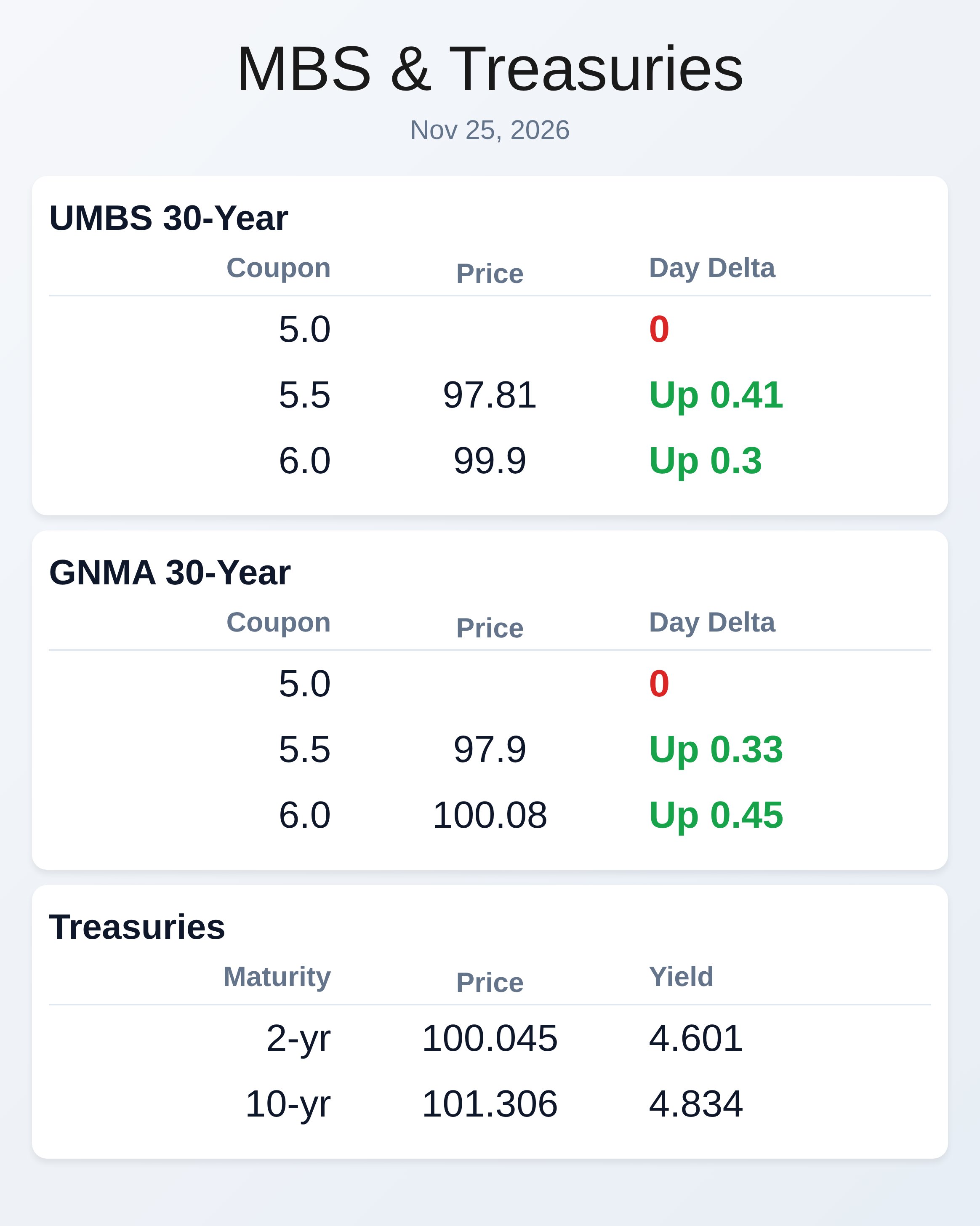
**Bond Pricing**
**UMBS 30 yr**
| Coupon | Price | Intra-Day Change |
**GNMA 30 yr**
| Coupon | Price | Intra-Day Change |
**Treasuries**
| Term | Yield | Price | Intra-Day Yield Change |