**WTMS Blog Today = What’s up in Mortgage Today (PM) – 09/23/2026**
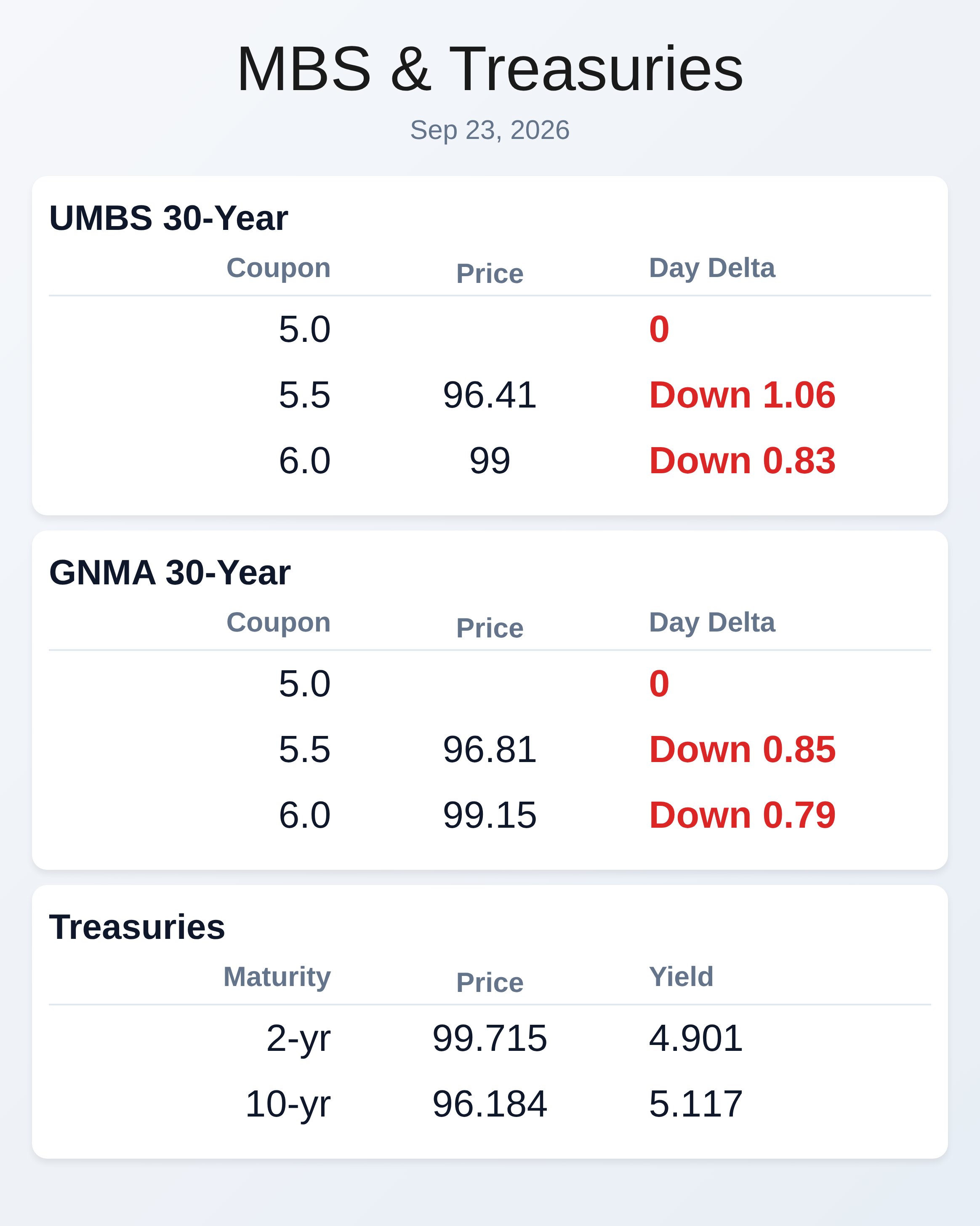
UMBS securities tanked more than half a point today as surprisingly strong economic data pushed Treasury yields to their highest levels since 2007, signaling the Fed has room for additional rate hikes. The S&P Global PMI data hit multi-year highs across both manufacturing and services, triggering immediate bond selling and forcing lenders to reprice rate sheets downward. Ten-year Treasury yields jumped from 5.0% to over 5.04%, with market pricing showing over 50% odds for a second rate hike at the next Federal Reserve meeting.
MBS are down approximately 56 basis points on the day, leaving many lenders scrambling with negative reprices before borrowers see updated rates. This kind of volatility creates urgency for borrowers sitting on the fence to lock rather than float. The mortgage origination business faces a structural problem that has little to do with whether rates are 7% or 6%.
According to analysis from The Mortgage Scoop, the industry is producing roughly half as many loans today compared to the late 1990s when rates were similarly elevated, yet average loan balances have grown 53% since 2015 while production expenses exploded. Loan officer compensation has remained indexed to loan balance at roughly 100 basis points, meaning a $400,000 mortgage pays twice what a $250,000 mortgage does, even though the work required is nearly identical. When production revenue per loan dropped from 434 basis points in 2020 to 333 basis points in Q2 2026, that same $4,000 LO commission suddenly represented 30% of lender revenue instead of 23%.
Originators now need roughly 1,515 loans annually to generate the same $1.19 million in production profit that 1,000 loans produced in 2015. The compensation model created after the 2008 crisis to eliminate conflicts of interest has ironically become a new pressure point as markets tighten. When loan amount became the index for LO pay, it worked because rates were falling and home values were surging, so bigger loan balances correlated with bigger lender revenues.
Today’s environment inverts that equation—lenders must chase more volume with shrinking margins while loan officers still expect their balance-based commissions. This mismatch explains why even “historical” rate levels feel desperate to the industry; the business model supporting those rates depends on either massive volume or massive margins, and borrowers are not materializing regardless of messaging about historically normal rates. Freddie Mac’s mortgage-backed securities buying could help compress spreads by another 10 to 12 basis points, according to the Community Home Lenders of America, though that relief depends on Treasury yields cooperating.
The FHFA disclosed last week that Fannie and Freddie were ramping up large-quantity MBS purchases after three consecutive months of declining holdings. Even 12 basis points of spread compression would matter to originators grinding through lower profitability, but Treasury yields can easily move in the opposite direction and erase any gains from secondary market support. The real question for mortgage sellers is whether policy support translates to rate sheet improvement or simply prevents spreads from blowing wider.
Loan officers may be underestimating borrower demand for digital closing technology, according to new ServiceLink research highlighting a disconnect between originator assumptions and consumer expectations. Many borrowers want streamlined digital experiences, yet lenders continue deploying traditional paper-based processes or half-measures that frustrate both parties. UWM’s new Underwriting+ platform combines underwriting, processing, and borrower communication into a single workflow, with pilot loans averaging just 8.3 days from submission to clear-to-close.
This kind of technology adoption becomes even more critical when originators must close more volume with fewer staff and tighter economics. Mutual of Omaha’s mortgage division auction caught even internal stakeholders by surprise, signaling potential consolidation in a market already under pressure from rate volatility and volume constraints. The broader mortgage industry faces a test of resilience as borrower demand remains soft at 4.5% to 4.6% rate levels, production margins compress further, and compensation models designed for a different era strain lender profitability.
Companies that cannot adapt their cost structures or technology infrastructure risk becoming acquisition targets or casualties.
**Locking vs Floating**
With the 10-year Treasury at 5.06% and strong economic data supporting further Fed rate hikes, borrowers with closings approaching should strongly favor locking rates. Treasury yields are at their highest since 2007, and market pricing suggests additional rate increases are likely, making floating a high-risk bet for near-term closings.
**Today’s Events**
September 23, 2026: MBA Mortgage Market Index (230.8 forecast), MBA Purchase Index (156.2 forecast), S&P Global Composite PMI (56 forecast), S&P Global Manufacturing PMI (53.6 forecast), S&P Global Services PMI (56 forecast), 5-Year Note Auction.
**Bond Pricing**
**UMBS 30 yr**
| Coupon | Price | Intra-Day Change |
**GNMA 30 yr**
| Coupon | Price | Intra-Day Change |
**Treasuries**
| Term | Yield | Price | Intra-Day Yield Change |