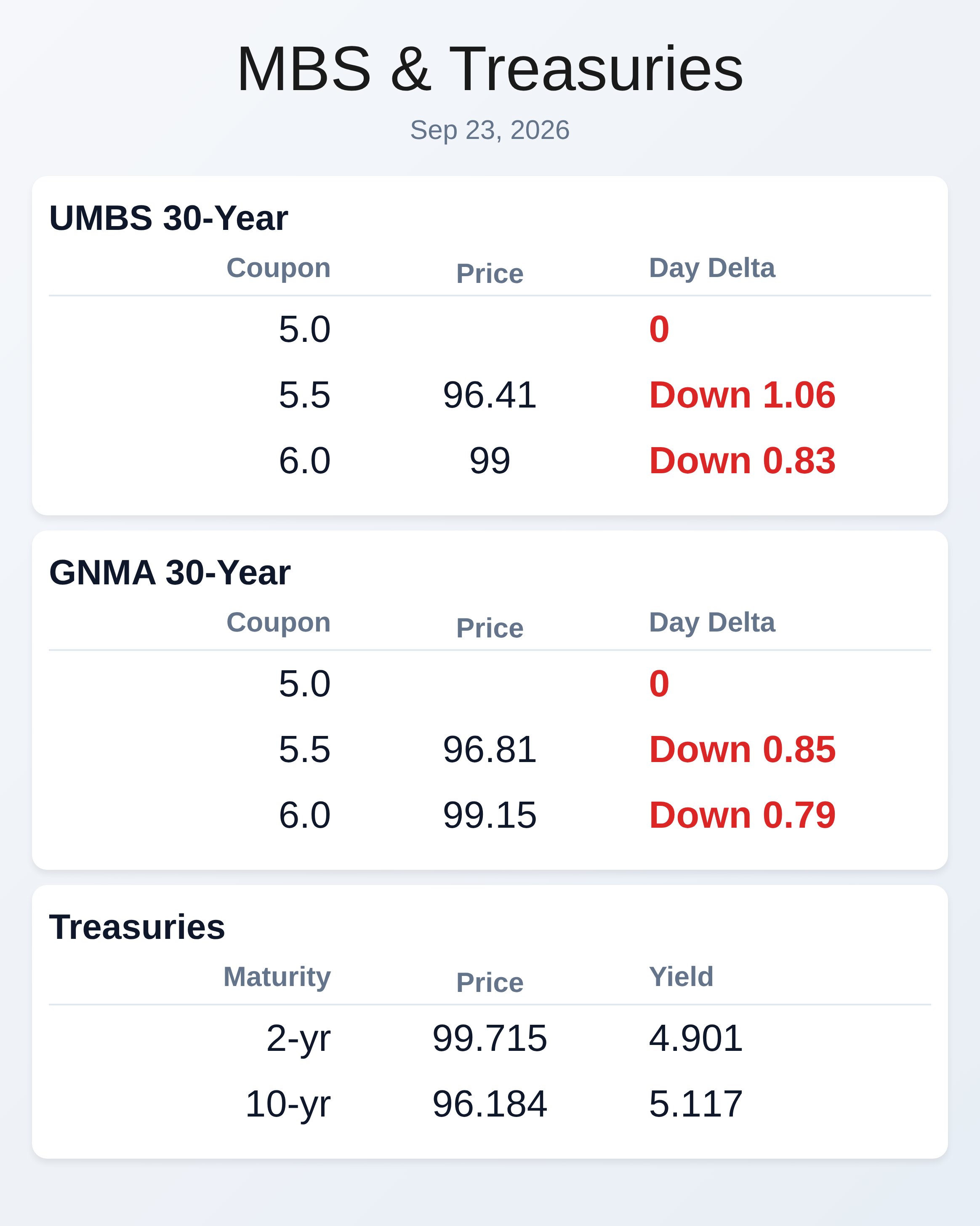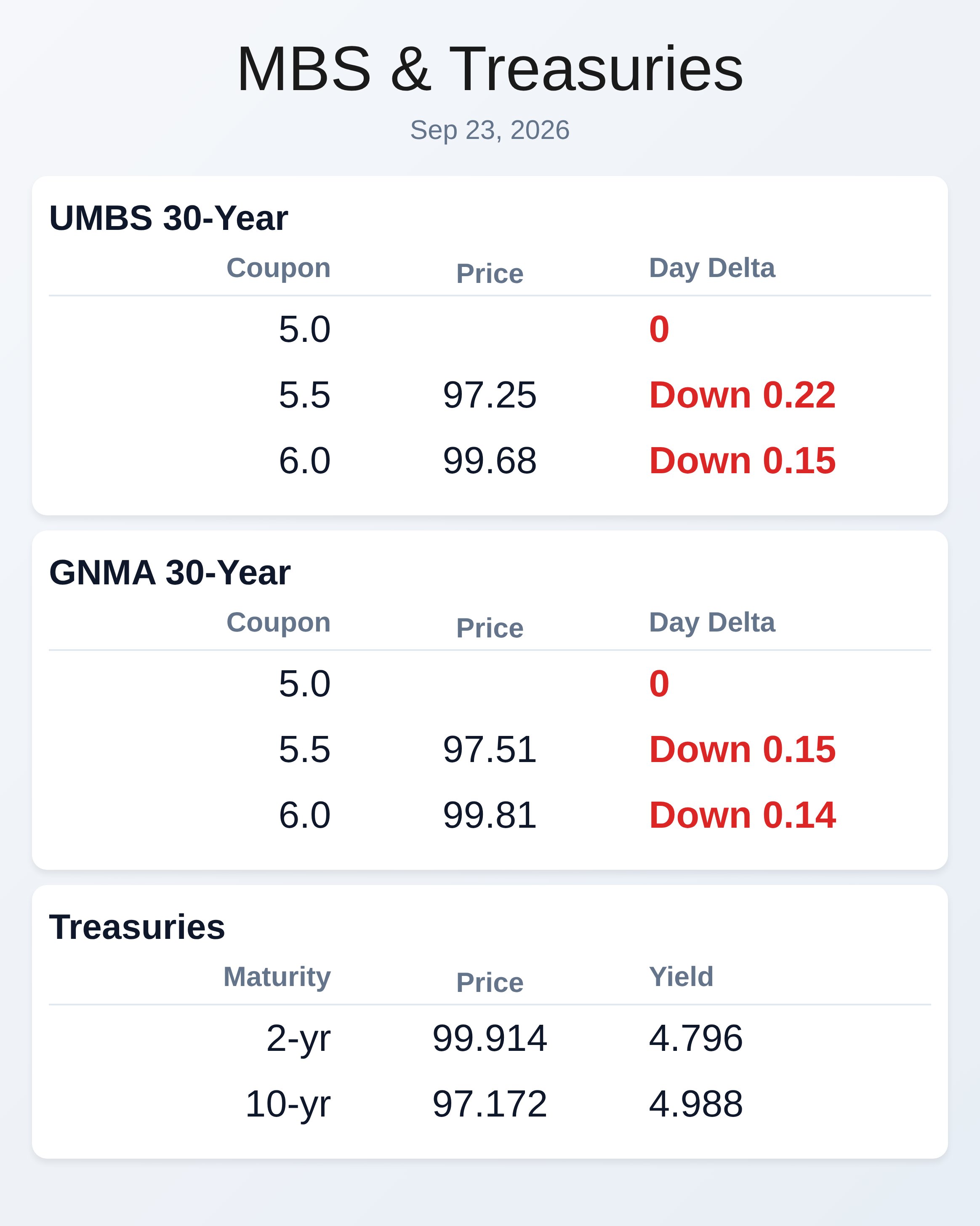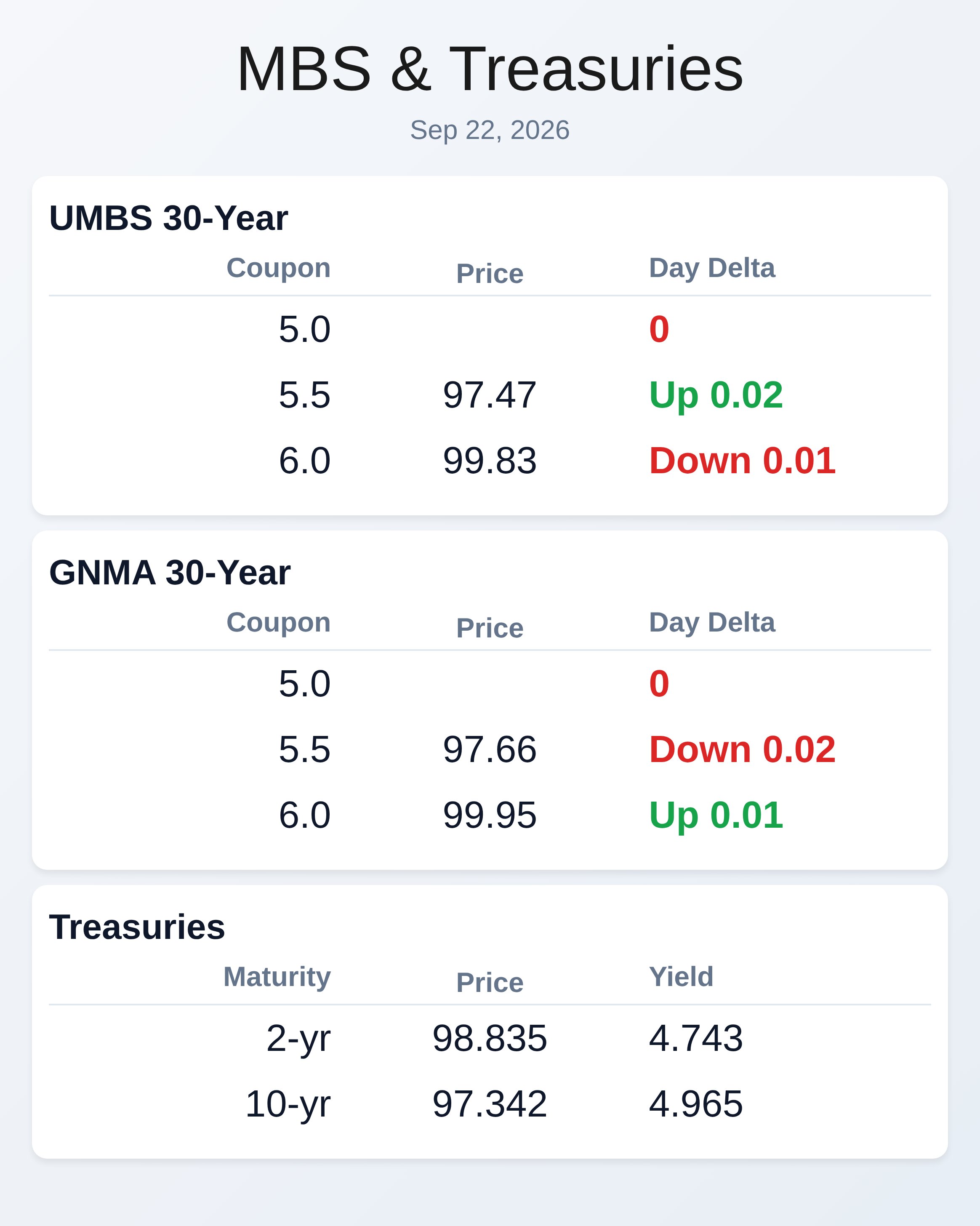
Loading...
HOME2023-01-22T13:43:33-07:00

Damn, there is so much great knowledge out there. Did you know that “BOOKS” are full of smart?? No, I mean like life changing, I-wish-I-knew-that-years-ago type stuff.

I know that I was waaaayyy late to the game figuring it out. And I know that a lot of you are too busy to read as much as you ‘should’. And that is why you need me.

I still remember how it started for me. It started in June of 2008. After 11  years …..Click to continue

Mortgage Today (PM) - 06/26/26 {{catlist}}
June 26, 2026
READ MORE **WTMS Blog Today = What's up in Mortgage Today (PM) - 06/26/2026** Friday delivered a textbook case of diminishing returns as mortgage bonds started the day strong, rallied into noon, and then gave back gains in an ultra-quiet afternoon. The 10-year Treasury held in a razor-thin range below 4.38%, while UMBS 5.0 coupons ended just barely positive at 98.63, up only 3 basis points on the day. MBS underperformed relative to Treasuries despite the broader bond market holding firm, signaling mixed sentiment heading into the weekend. The culprit remains quarter-end volatility uncertainty—a reminder that positioning ahead of month-end typically creates choppy, range-bound trading. Technicians note the critical support level at 4.19% in the 10-year, with resistance overhead at 4.43%, 4.51%, and 4.59%. What makes today's action matter for loan officers is the relative weakness in MBS spreads even on an up day. When Treasuries rally harder than mortgage-backed securities, it means mortgage originators face tighter pricing on new locks and funded loans. The technical picture suggests we're bottoming around current levels, but geopolitical headlines—war-related volatility remains a wildcard—could disrupt this fragile equilibrium. Bond market participants are clearly waiting for next week's employment data to set a firmer direction. Until then, expect Friday's pattern to repeat: early strength fading into a drift sideways. Positive Treasury momentum came from the 2-year yield dropping 3.4 basis points to 4.089%, the 3-year falling 3.3 basis points to 4.090%, and the 5-year sliding 3.5 basis points to 4.128%. The 10-year closed 1.6 basis points lower at 4.375%, while the long-end 30-year barely budged, up 0.6 basis points to 4.868%. This curve flattening is typical during risk-off trading, but the move lacked conviction. GNMA 5.5 coupons held at 100.70 (up 0.07), slightly lagging their UMBS equivalents at 100.61 (up 0.06). Spread compression between government-insured and agency pools suggests tight liquidity—not necessarily bullish for mortgage volumes. **Locking vs Floating** Originators should take the calm end to the week as tactical reassurance, not a signal to relax guard. Quarter-end volatility remains a genuine threat, capable of moving 10-year yields 20+ basis points in either direction by Wednesday. War-related headlines, while not yet moving markets significantly, provide a tail risk that bond traders cannot ignore—especially heading into a three-and-a-half-day week due to Independence Day. Next week's job report on Thursday will be the dominant event; stronger-than-expected payrolls could trigger immediate 10yr yield spikes. Current support sits at 4.19% (buy signal) and resistance at 4.43%, 4.51%, and 4.59% (sell triggers). **Bond Pricing** **UMBS 30 yr** | Coupon | Price | Intra-Day Change | **GNMA 30 yr** | Coupon | Price | Intra-Day Change | **Treasuries** | Term | Yield | Price | Intra-Day Yield Change | Market Data
Mortgage Today (AM) - 06/26/26 {{catlist}}
June 26, 2026
READ MORE **WTMS Blog Today = What's up in Mortgage Today (AM) - 06/26/2026** New home sales collapsed 7.3% in May, marking the lowest pace since January as affordability crises overwhelm buyers and builders alike. The annualized sales rate fell to 580,000 units, well below the 640,000 expected, while inventories spiked to 10.3 months of supply—the highest level since 2009. The West saw the steepest decline at 26.9%, while the South dropped to a seven-year low despite being the nation's largest homebuilding region. Median prices edged up to $424,900 even as developers slashed prices and offered mortgage rate buydowns. This inventory glut is forcing builders to pull back on new construction to clear the backlog. Mortgage payments hit a one-year high in May at $2,198 on new purchase loans, up 2.1% from April and rising for three consecutive months. Affordability collapsed in 33 states as rising rates combined with elevated home prices to push monthly obligations skyward across all loan types. Conventional loan payments jumped to $2,211 while FHA payments surged 2.4% to $1,873. Although current payments remain below last May's $2,211 peak, the recent three-month trend signals sustained pressure on borrowers and originators facing tighter pipelines. Rate hold at current levels would continue dampening origination volumes through the summer. Agency MBS prices started Friday sideways with minimal momentum as the economic calendar remains quiet ahead of weekend quarter-end positioning flows. The 10-year Treasury moved down 1.7 basis points overnight but bounced back near yesterday's close, creating technical uncertainty around the 4.42% resistance level tested this week. UMBS 5.0 coupons sat at 98.62 with intraday gains modest at +0.02, while GNMA 5.0s traded slightly better at 98.94. The broader market awaits the final University of Michigan Consumer Sentiment reading, expected to be revised higher on lower gasoline prices and strong stock-market gains. Quarter-end rebalancing among portfolio managers could trigger random volatility spikes through next Wednesday. Buydown mortgages have become a critical tool for survival, now representing $41.7 billion or 1.6% of the Ginnie Mae universe as affordability pressures persist. Concentrated in FHA and VA lending, these loans temporarily reduce borrower rates for one to three years while requiring qualification at the fully indexed payment. Investors value buydowns for prepayment protection during the subsidy period since borrowers have less incentive to refinance, though activity typically accelerates once the buydown expires. This product segment is likely to remain significant as originators battle higher rate environments and buyer resistance. For lenders, buydowns represent both a competitive necessity and a source of longer-duration cash flow. Fifteen-year UMBS pools continue outperforming their 30-year counterparts despite representing a much smaller market share due to declining refinance activity. The 30-year UMBS universe has exploded 141% since 2019 to $5.3 trillion, while 15-year issuance contracted sharply after rates rose in 2022. Faster prepayment speeds on 15-year pools reflect borrower quality and curtailment behavior that appeals to investors seeking principal return and duration control. The shrinking supply of 15-year pools combined with favorable borrower profiles creates a diversified investment case that compares favorably in higher-rate environments where cash-in-hand carries premium value. Forward issuance trends suggest this relative scarcity will persist, supporting relative value. Global markets are struggling to find footing as technology stock weakness spreads across equities while bond markets gain traction. Nasdaq 100 futures fell 1.3% Friday morning following a New York Times report that OpenAI may delay its public offering until 2027. Investors pulled money from U.S. equities for the first time in three months with record withdrawals from tech, signaling potential rotation away from crowded trades. Oil prices resumed their decline to below $71 per barrel, supporting bond rallies as inflation fears ease. The dollar held onto year-to-date gains as Federal Reserve Chairman Kevin Warsh signaled commitment to price stability, potentially supporting continued accommodative market sentiment. **Locking vs Floating** Rates confirmed a break below the 4.42% technical level Thursday with modest strength, marking the best showing in recent weeks. However, the fragile nature of the breakdown means quarter-end volatility could easily erase gains or push rates higher into next week. MBS price movements remain the most reliable intraday hedging tool, while longer-term momentum direction tracks the 10-year Treasury yield ceiling-floor band that signals bigger market picture trends. **Bond Pricing** **UMBS 30 yr** | Coupon | Price | Intra-Day Change | | 5.0 | 98.66 | 0.07 | | 5.5 | 100.61 | 0.06 | | 6.0 | 102.23 | -0.01 | **GNMA 30 yr** | Coupon | Price | Intra-Day Change | | 5.0 | 98.95 | 0.02 | | 5.5 | 100.67 | 0.04 | | 6.0 | 102.12 | 0.06 | **Treasuries** | Term | Yield | Price | Intra-Day Yield Change | | 2yr | 4.084 | 99.84 | -0.038 | | 10yr | 4.383 | 99.933 | -0.008 | | 30yr | 4.875 | 101.963 | 0.012 | Market Data
Mortgage Today (AM) - 06/25/26 {{catlist}}
June 25, 2026
READ MORE **WTMS Blog Today = What's up in Mortgage Today (AM) - 06/25/2026** Bonds rallied moderately today after the Personal Consumption Expenditures price index arrived exactly as expected, calming inflation concerns that have dominated recent trading. The 10-year Treasury fell 1.2 basis points to 4.375 percent while MBS prices climbed 6 ticks following the benign PCE print, which showed core inflation at 3.4 percent annually and monthly at 0.3 percent. These aligned forecasts suggest the Federal Reserve's inflation trajectory remains steady despite persistent pressure from energy-related costs and broader price pressures. Mortgage originators found modest tailwinds this morning as lender pricing had not fully caught up to yesterday's bond rally, creating a small cushion for rate locks. The market remains cautious, however, waiting for a second close below the key 4.42 percent technical level in 10-year yields before declaring a decisive trend shift. Economic data released Thursday morning delivered a mixed picture of labor demand and consumer resilience that will shape mortgage strategy through the remainder of the quarter. Initial jobless claims fell to 215,000 from 226,000 in the prior week, beating expectations of 225,000 and signaling tighter labor markets heading into summer. Personal income surged 0.7 percent month-over-month, outpacing the 0.4 percent forecast, while personal spending accelerated 0.7 percent against expectations of just 0.3 percent. Durable goods orders declined 4.5 percent as expected, suggesting manufacturing caution, though the broader economy expanded at an annualized 2.1 percent in Q1, beating prior estimates of 1.6 percent. Origination teams should note that strong consumer spending paired with moderate inflation keeps rate expectations anchored near current levels rather than forcing sudden repricing. New home sales tumbled 7.3 percent month-over-month in May to an annualized rate of 580,000 units, falling well below expectations of 627,000 and marking the second-lowest sales pace in the past twelve months. Affordability constraints linked to persistent mortgage rates drove the decline, with the West region experiencing the most acute pullback as higher-priced markets face buyer resistance. Even the South—traditionally the nation's most resilient homebuilding region—showed meaningful weakness, suggesting pricing sensitivity is spreading beyond coastal markets. Year-over-year sales fell 6.8 percent, underscoring the cumulative headwind from elevated rates and limited inventory. For mortgage lenders, this data reinforces that rate-conscious borrowers are delaying or postponing purchases, likely transferring demand to refinance and home equity products. The Federal Reserve's latest stress test validated the resilience of the banking system, with all 32 large banks maintaining capital above regulatory minimums even under an extreme recession scenario featuring 10 percent unemployment, 30 percent home price declines, and 39 percent commercial real estate losses. Banks would absorb over $708 billion in losses across credit cards and commercial real estate yet retain aggregate capital ratios declining only 1.6 percentage points. This structural strength means correspondent lenders and major portfolio managers remain well-positioned to fund mortgage originations without external capital constraints. The findings provide some assurance that mortgage funding will remain available through any economic stress, though competitive conditions may tighten. Originators can reference this stability when reassuring borrowers and investors about market liquidity. A Treasury auction of $70 billion in 5-year notes received lukewarm reception Wednesday, with investors demanding slightly higher yields than the market expected, forcing dealers to absorb an outsized share. Although the sale "tailed," the broader Treasury market barely reacted, suggesting dealers viewed the outcome as disappointing but not alarming for the long-term outlook. Shorter-dated Treasuries remain near 2025 highs due to lingering energy-inflation sensitivity, while longer-term bonds extended their rally as oil prices fell and demand for duration strengthened. A $44 billion auction of 7-year notes is scheduled for later today, and market observers will watch closely for any signs of persistent auction weakness. The key takeaway for origination: secondary market demand for government debt remains adequate, stabilizing funding costs for GSE mortgages. Borrower retention strategies are increasingly shifting from broad recapture percentages toward targeted, analytics-driven outreach that identifies homeowners most likely to benefit from a new product or rate reset. Many lenders report impressive headline recapture figures without standardizing definitions—some count only rate-and-term refinances while others include streamlined government products—rendering industry comparisons nearly meaningless. Servicers now leverage richer borrower data, updated tax and insurance information, and behavioral analytics to distinguish between borrowers worth pursuing versus those better left alone. This evolving sophistication means retention success no longer tracks with call volume but instead reflects the quality of pre-outreach decision-making. Originators seeking competitive advantage should audit whether their recapture efforts emphasize contact quantity or borrower fit, as the latter increasingly determines market share gains. **Locking vs Floating** Lenders face a measured backdrop for lock-versus-float decisions given modest tailwinds from pricing that hasn't caught up to yesterday's bond rally coupled with a potential technical breakdown if 10-year yields close below 4.42 percent. The risk-on environment that allowed intraday bond gains reflects rebalancing between stocks and bonds rather than a fundamental shift in Fed policy expectations. Building a small cushion for rate locks makes sense until the market confirms the technical level breaks on a second consecutive close. **Today's Events** Jobless Claims (Jun 20): 215,000 versus 225,000 forecast Personal Income (May, m/m): 0.7% versus 0.4% forecast Personal Spending (May, m/m): 0.7% versus 0.3% forecast Core PCE (May, m/m): 0.3% versus 0.3% forecast (in line) Core PCE (May, y/y): 3.4% versus 3.4% forecast (in line) PCE (May, y/y): 4.1% versus 4.1% forecast (in line) Durable Goods (May): -4.5% versus -4.5% forecast (in line) GDP Q1: 2.1% versus 1.6% forecast Treasury Auction (7-year, $44 billion): Scheduled for 1:00 PM ET **Bond Pricing** **UMBS 30 yr** | Coupon | Price | Intra-Day Change | | 5.0 | 98.62 | 0.1 | | 5.5 | 100.58 | 0.11 | | 6.0 | 102.24 | 0.08 | **GNMA 30 yr** | Coupon | Price | Intra-Day Change | | 5.0 | 98.94 | 0.1 | | 5.5 | 100.67 | 0.13 | | 6.0 | 102.1 | 0 | **Treasuries** | Term | Yield | Price | Intra-Day Yield Change | | 2 yr | 4.114 | 99.784 | -0.034 | | 3 yr | 4.116 | 100.025 | -0.03 | | 5 yr | 4.157 | 99.857 | -0.022 | | 7 yr | 4.256 | 99.963 | -0.02 | | 10 yr | 4.383 | 99.937 | -0.004 | | 30 yr | 4.84 | 102.525 | -0.008 | Market Data
LATEST ARTICLES

RECENT ARTICLES

Article Archive

Subscribe

Send me some brain food

Go to Top