Loading...
HOME2023-01-22T13:43:33-07:00

“Damn, there is so much great knowledge out there. Did you know that “BOOKS” are full of smart?? No, I mean like life changing, I-wish-I-knew-that-years-ago type stuff.

I know that I was waaaayyy late to the game figuring it out. And I know that a lot of you are too busy to read as much as you ‘should’. And that is why you need me.

I still remember how it started for me. It started in June of 2008. After 11  years …..Click to continue

Mortgage Today (AM) - 10/08/26 {{catlist}}
October 8, 2026
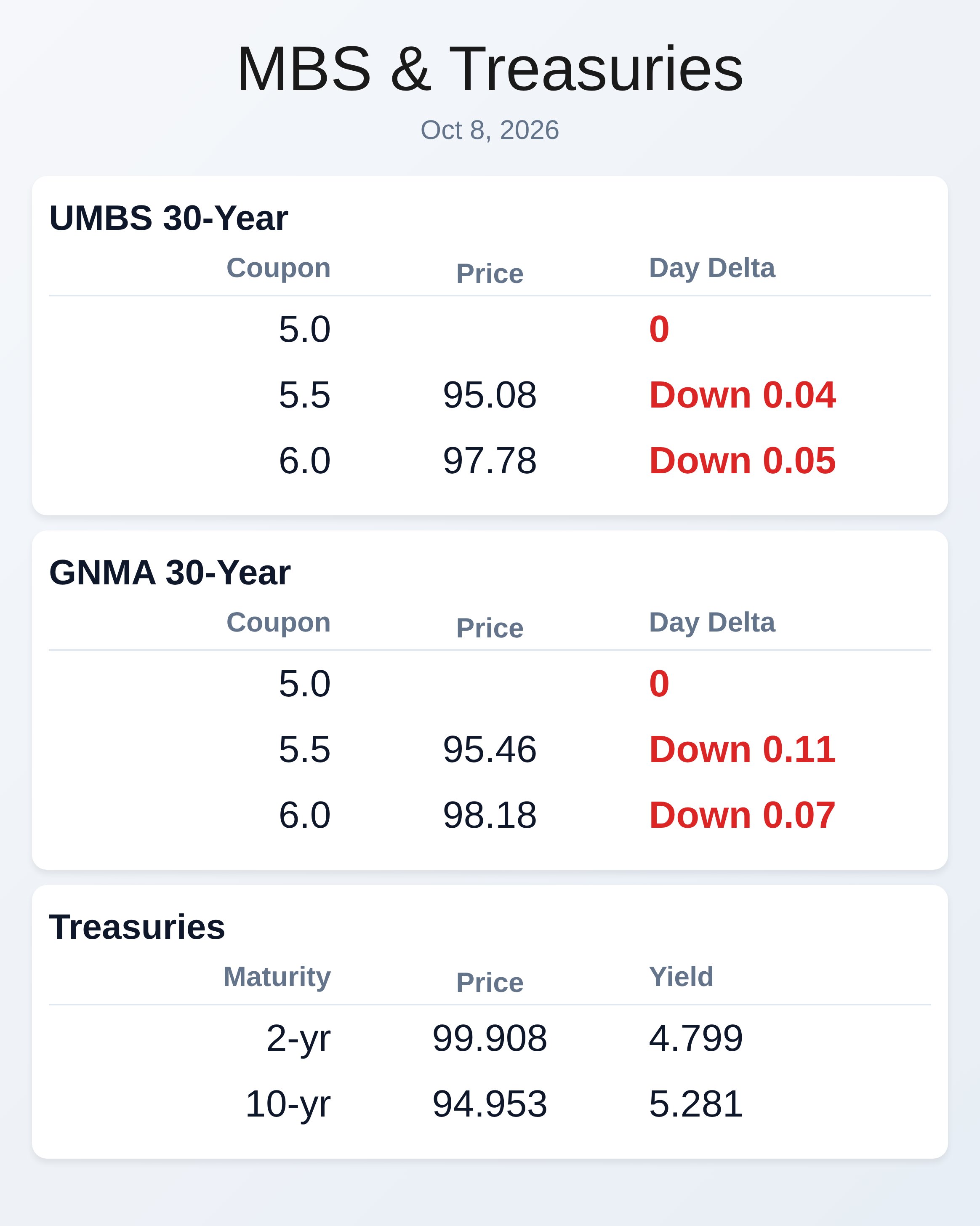
READ MORE **WTMS Blog Today = What's up in Mortgage Today (AM) - 10/08/2026** Bonds surrendered early-morning gains as Federal Reserve Governor Chris Waller signaled that additional rate hikes remain on the table despite September's softer payroll report. The 10-year Treasury yield climbed to 5.343% from the prior close, erasing gains driven by overnight strength in Japanese government bonds and a dip in crude oil below $98 per barrel. UMBS 6.0 coupons fell 25 basis points to 97.58, while GNMA 6.0 declined 9 basis points to 98.16, reflecting persistent downward pressure on mortgage-backed securities. Waller's hawkish comments on persistent inflation and unanchored inflation expectations reignited concerns about the Fed's commitment to tighter policy through at least mid-2027. Oil prices rebounding alongside Treasury weakness suggest energy inflation remains a structural headwind for originators targeting rate-sensitive refinance activity. The U.S. trade deficit widened to $105.6 billion in August, exceeding economist forecasts of $102.1 billion and underscoring the resilience in domestic demand despite elevated interest rates. Imports surged 4.3% while exports rose only 1.4%, highlighting the asymmetry driving global fiscal concerns and weighing on international bond markets. France's 10-year yield spread over Germany narrowed sharply after Marine Le Pen's deficit-reduction proposal, but global sovereign debt anxiety continues to feed spillover pressure into U.S. Treasuries. The broader equity rally powered by artificial intelligence deals and strong corporate earnings has competed aggressively for investor capital, crowding out traditional bond demand. For mortgage sellers, this dynamic means secondary marketing margins remain compressed as investors prioritize higher-yielding equities and corporate debt over agency MBS. Elevated Treasury issuance tied to the U.S. fiscal deficit, combined with war-related inflation pressures and tariff-induced price pass-through, continues to anchor longer-dated yields near multi-year highs. The Federal Reserve's willingness to deploy the Fed Funds Rate as an anti-inflation tool, along with genuine economic resilience in services data and labor markets, has sustained the upward bias in the yield curve. Foreign demand for U.S. debt has weakened gradually due to trade relationship deterioration and tariff concerns, further reducing a traditional source of bond market support. Market participants remain defensive pending tangible evidence of a yield correction, which historically requires sustained daily declines of 6 basis points or more. Originators face headwinds locking borrowers into mid-to-upper-7% mortgage rates, constraining pipeline volume and forcing margin compression strategies on competitive products. Today's economic calendar included the August Trade Balance and weekly jobless claims data, with the latter showing 197,000 initial claims against a forecast of 200,000. Fed remarks from Governor Bowman, Boston President Logan, and New York President Williams preceded a $58 billion auction of 3-year Treasury notes, testing investor appetite amid elevated yields and fiscal uncertainty. Retail sentiment appears resilient according to preliminary CNBC/NRF monitoring, though services-sector price pressures remain a persistent concern for policymakers assessing inflation momentum. The 30-year Treasury auction scheduled for later in the week will provide critical insight into investor demand at current yield levels above 5.6%. Market participants should monitor whether strong economic data continues to argue for additional Fed tightening or whether credit stress signals shift the inflation-versus-growth narrative. Secondary market strategists noted that the intraday bond recovery mid-session failed to establish a convincing floor, as yields hit new long-term highs before rebounding. This pattern reinforces the prevailing trend toward higher rates rather than signaling a durable reversal in the fixed-income outlook. The correlation between oil prices and Treasury yields remains loose but notable, suggesting energy inflation expectations continue to drive term premium compression across the curve. Rate locks remain appropriate only for borrowers with committed closing dates within 30 days, as floating-rate risk continues to outweigh the cost of locking given persistent Fed hawkishness. Loan officers should expect continued pressure on product margins and pipeline velocity until evidence of a meaningful yield correction materializes. Capital markets leaders are recalibrating hedging strategies and secondary marketing operations for an extended higher-rate environment, with some vendors announcing AI-native systems designed to optimize margin capture in compressed-spread scenarios. The mortgage industry's technology vendors gathered at industry conferences this week to demonstrate how intelligent automation could help originators reduce costs and improve execution speed despite lower-volume production. Correspondent partners and wholesale platforms continue to expand down-payment assistance options and deliver non-QM and alternative credit products to maintain borrower access. Servicers report elevated focus on fee prevention and operational efficiency as loan volumes adjust to the new rate regime. For originators, now is the time to stress-test business model assumptions and evaluate whether current staffing and technology investments align with a prolonged period of higher rates and reduced transaction volume. **Locking vs Floating** Remain defensive and avoid aggressive locking until the market demonstrates a successful yield correction, defined as average daily declines of at least 6 basis points sustained over two consecutive trading days. War-related inflation pressures, elevated Treasury issuance driven by fiscal imbalances, strong corporate bond competition, resilient economic data, and the Fed's commitment to fighting inflation all contribute to the ongoing upward bias in rates. Foreign investor demand continues to weaken due to tariff and trade concerns, removing a traditional source of bond market support. The prevailing trend remains firmly toward higher rates, making rate locks appropriate only for borrowers with imminent, committed closing dates. Floating rate risk remains preferable to locking given the Fed's persistent hawkish stance and persistent inflation concerns. **Today's Events** August Trade Balance released at 8:30 AM ET showed a widening deficit to $105.6 billion, exceeding the $102.1 billion forecast. Weekly jobless claims came in at 197,000 versus a forecast of 200,000. Fed remarks from Governor Bowman, Boston President Logan, and New York President Williams were scheduled throughout the day. Treasury auction of $58 billion in 3-year notes was held at 1:00 PM ET. 30-year Treasury bond auction was scheduled for later in the week. **Bond Pricing** **UMBS 30 yr** | Coupon | Price | Intra-Day Change | **GNMA 30 yr** | Coupon | Price | Intra-Day Change | **Treasuries** | Term | Yield | Price | Intra-Day Yield Change | **UMBS 30 Year** | Coupon | Price | Intra-Day Change | |---:|---:|---:| | 5.5 | 95.08 | -0.04 | | 6.0 | 97.78 | -0.05 | | 6.5 | 100.30 | -0.01 | **GNMA 30 Year** | Coupon | Price | Intra-Day Change | |---:|---:|---:| | 5.5 | 95.46 | -0.11 | | 6.0 | 98.18 | -0.07 | | 6.5 | 100.49 | -0.16 | **Treasuries** | Term | Yield | Price | Intra-Day Yield Change | |---:|---:|---:|---:| | 2 yr | 4.799 | 99.908 | 0.040 | | 3 yr | 4.941 | 99.818 | 0.032 | | 5 yr | 5.045 | 99.802 | 0.021 | | 7 yr | 5.166 | 99.038 | 0.008 | | 10 yr | 5.281 | 94.953 | -0.010 | | 30 yr | 5.646 | 92.509 | -0.024 | Stay informed on mortgage markets and secondary strategy. Subscribe free at WellThatMakesSense.com.

Market Data
Mortgage Today (AM) - 10/08/26 {{catlist}}
October 8, 2026
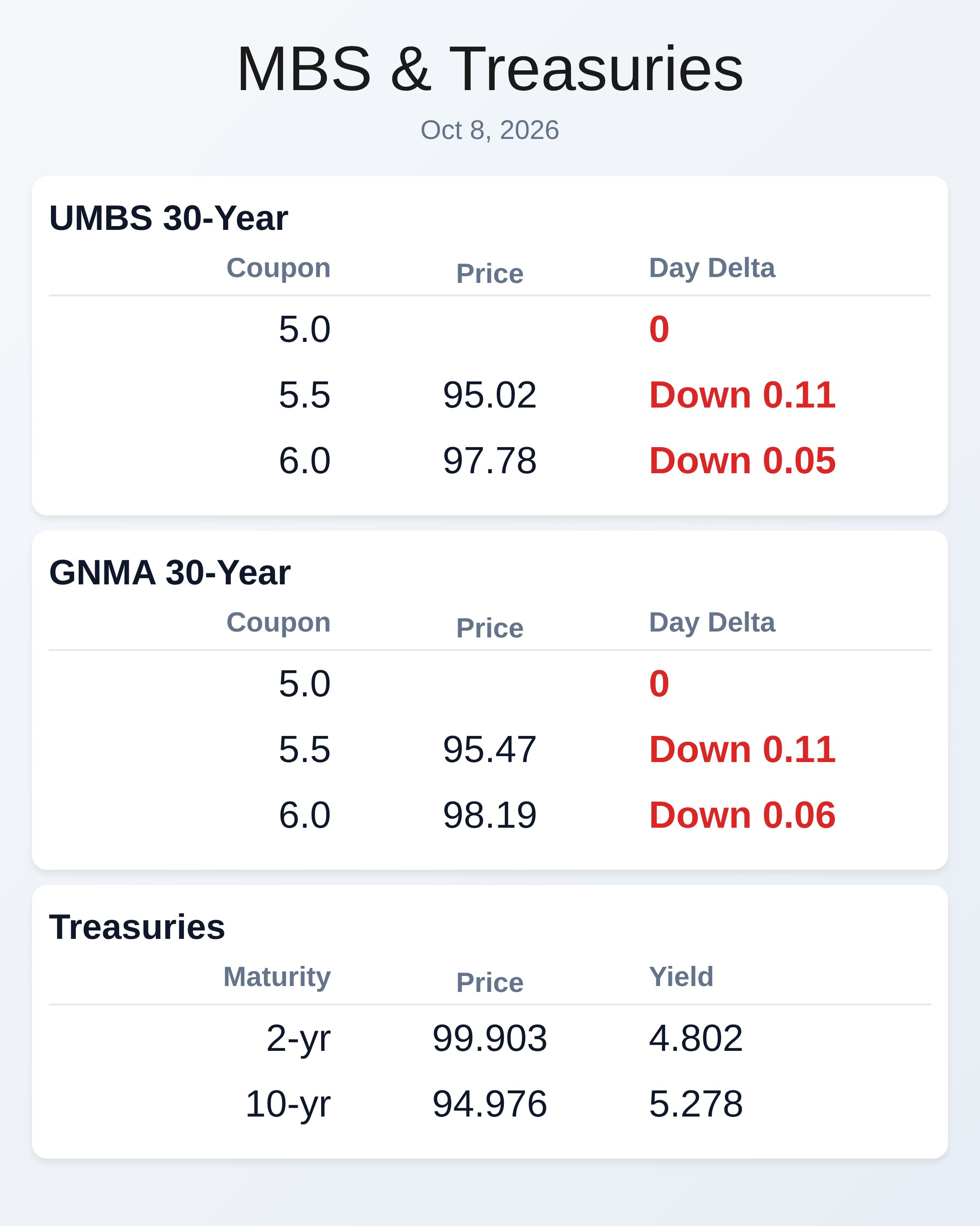
READ MORE **WTMS Blog Today = What's up in Mortgage Today (AM) - 10/08/2026** Treasury yields jumped overnight as Federal Reserve Governor Chris Waller signaled that more rate hikes are needed due to strong economic data and persistent inflation concerns. The 10-year Treasury climbed above 5.34 percent, pushing mortgage rates firmly into mid-7 percent territory as bond markets wrestled with conflicting signals from oil prices and Fed communications. Mortgage-backed securities weakened alongside the broader selloff, with UMBS 6.0 coupons down roughly 22 basis points from recent highs. The persistent upward march in rates shows no signs of reversing without meaningful evidence of economic weakness or inflation decline. For mortgage originators, today's action reinforces the defensive posture that has defined the past six weeks of market trading. Waller's hawkish comments hit the short end of the curve hardest, pulling Fed Funds futures back to levels that signal rising rate expectations well into 2027. The yield curve continued its steepening bias as longer-term bonds absorbed selling pressure from the war-driven inflation narrative, elevated Treasury issuance tied to fiscal imbalances, and ongoing competition for investor demand from equities and corporate debt. Oil prices also rose in sympathy with the broader commodity complex, adding another layer of inflation concern to an already hostile rate backdrop. Foreign demand for U.S. Treasuries continues to weaken amid tariff concerns and deteriorating trade relationships. The fundamental drivers that pushed rates higher since August remain firmly in place with no clear catalysts for meaningful relief. Market observers note that midday recoveries, like the one seen earlier this week, fail to reverse the prevailing uptrend unless yields fall at least 6 basis points daily for multiple consecutive days. The absence of such a correction pattern suggests the current rising-rate environment is structural rather than cyclical. Jobless claims and continued claims data released this morning came in slightly better than expected, adding fuel to the strong-economy narrative that justifies higher rates. Upcoming Treasury auctions of 10-year and 30-year debt this week will test investor appetite at increasingly elevated yield levels. Rate lock activity remains subdued as mortgage professionals await concrete signs of market stabilization before committing to longer-term positions. European bond market volatility, particularly in French sovereign debt, continues to create spillover effects in U.S. Treasury markets despite lower oil prices. The ECB's ongoing inflation concerns and geopolitical uncertainties abroad reinforce the risk-on bias in equities and risk-off bias in fixed income. U.S. mortgage servicers and secondary marketing teams are managing heightened basis risk as mortgage pools reprice daily in reaction to yield volatility. Warehouse lending capacity remains fluid, but pricing has tightened as lenders navigate the uncertain rate path ahead. The broader market consensus suggests that relief, if it comes, will require either a dramatic shift in geopolitical tensions or clear evidence of economic deceleration. Mortgage originators should remain defensive in their pipeline management and client communication strategies. Lock/float decision trees favor locking borrower rates despite pain, as the risk-reward profile continues to favor protection over speculation on further rallies. Correspondent lending networks are experiencing elevated pull-through volatility as borrowers struggle with higher payment obligations in the current rate environment. Staffing decisions at larger production shops are likely being deferred pending clarity on the sustainability of origination volumes at current rate levels. The industry's weekly dashboards now consistently show negative intra-day momentum even when morning recoveries create false hope. **Locking vs Floating** Remain defensive until Treasury yields demonstrate sustainable downward momentum of at least 6 basis points per day for two consecutive days. Rising rate momentum since August has been relentless and driven by multiple structural factors: geopolitical inflation impacts, elevated fiscal issuance, corporate bond competition for investor capital, equity market strength, declining foreign demand tied to tariffs, resilient economic data, and Federal Reserve determination to combat inflation. Mortgage professionals should prioritize locking borrower rates to secure margin and certainty rather than speculating on mean reversion that has not yet materialized. **Today's Events** Thursday, October 8: Jobless Claims (8:30 AM) forecast 200K vs. prior 197K; Continued Claims (8:30 AM) forecast 1,710K vs. prior 1,701K; Fed remarks from Governor Chris Waller; Treasury auctions of 10-year and 30-year securities. **Bond Pricing** **UMBS 30 yr** | Coupon | Price | Intra-Day Change | | 5.5 | 95.02 | -0.11 | | 6.0 | 97.78 | -0.05 | | 5.5 | 95.47 | -0.11 | **GNMA 30 yr** | Coupon | Price | Intra-Day Change | **Treasuries** | Term | Yield | Price | Intra-Day Yield Change | | 10yr | 5.278 | 94.976 | -0.013 | | 30yr | 5.644 | 92.540 | -0.027 |

Market Data
Mortgage Today (PM) - 10/06/26 {{catlist}}
October 6, 2026
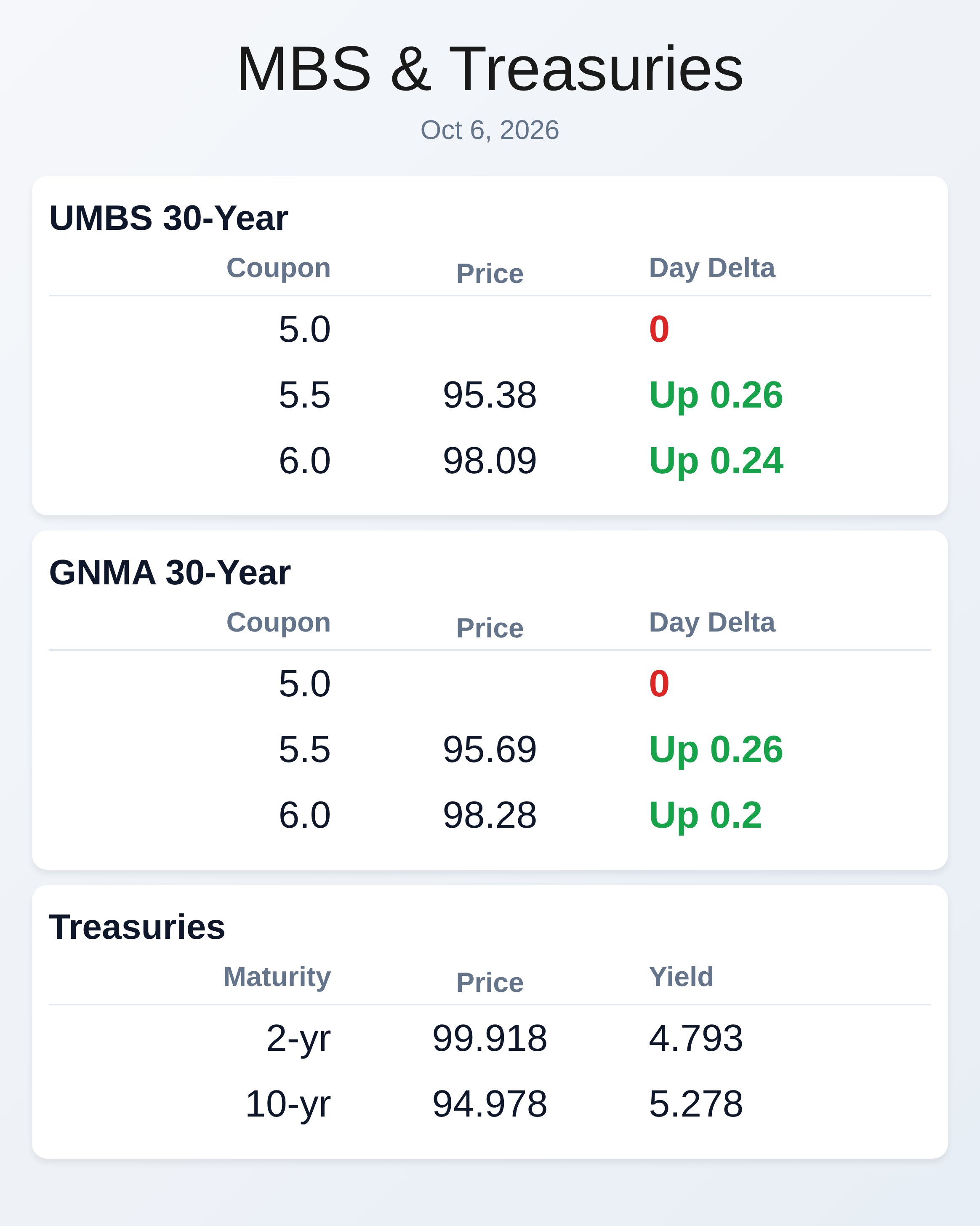
READ MORE I'm ready to help you write the WTMS Blog post, but I need the source emails to analyze. You've indicated "Source emails to study: ~)^�+-zo�" which appears to be corrupted or encoded text. Could you please provide: 1. **The actual source emails** (or paste their content) 2. **Today's date** (so I can format the title correctly in MM/DD/YYYY format) Once I have the source material, I'll: - Fetch all valid article links - Extract relevant mortgage market data - Write the blog post starting immediately with the bold title - Follow all formatting rules precisely Please share the email content and date.

Market Data
LATEST ARTICLES

RECENT ARTICLES

The New “10,000 Hour Rule”

January 5th, 2021|Money|

The 10,000-hour rule is a popular ideology - that when you put 10,000 hours practicing deliberately on an activity you can master it. It is a magical number introduced by K. Anders Ericsson, a [...]

Article Archive

Subscribe

Send me some brain food

Go to Top