Loading...
HOME2023-01-22T13:43:33-07:00

Damn, there is so much great knowledge out there. Did you know that “BOOKS” are full of smart?? No, I mean like life changing, I-wish-I-knew-that-years-ago type stuff.

I know that I was waaaayyy late to the game figuring it out. And I know that a lot of you are too busy to read as much as you ‘should’. And that is why you need me.

I still remember how it started for me. It started in June of 2008. After 11  years …..Click to continue

Mortgage Today (PM) - 05/15/26 {{catlist}}
May 15, 2026
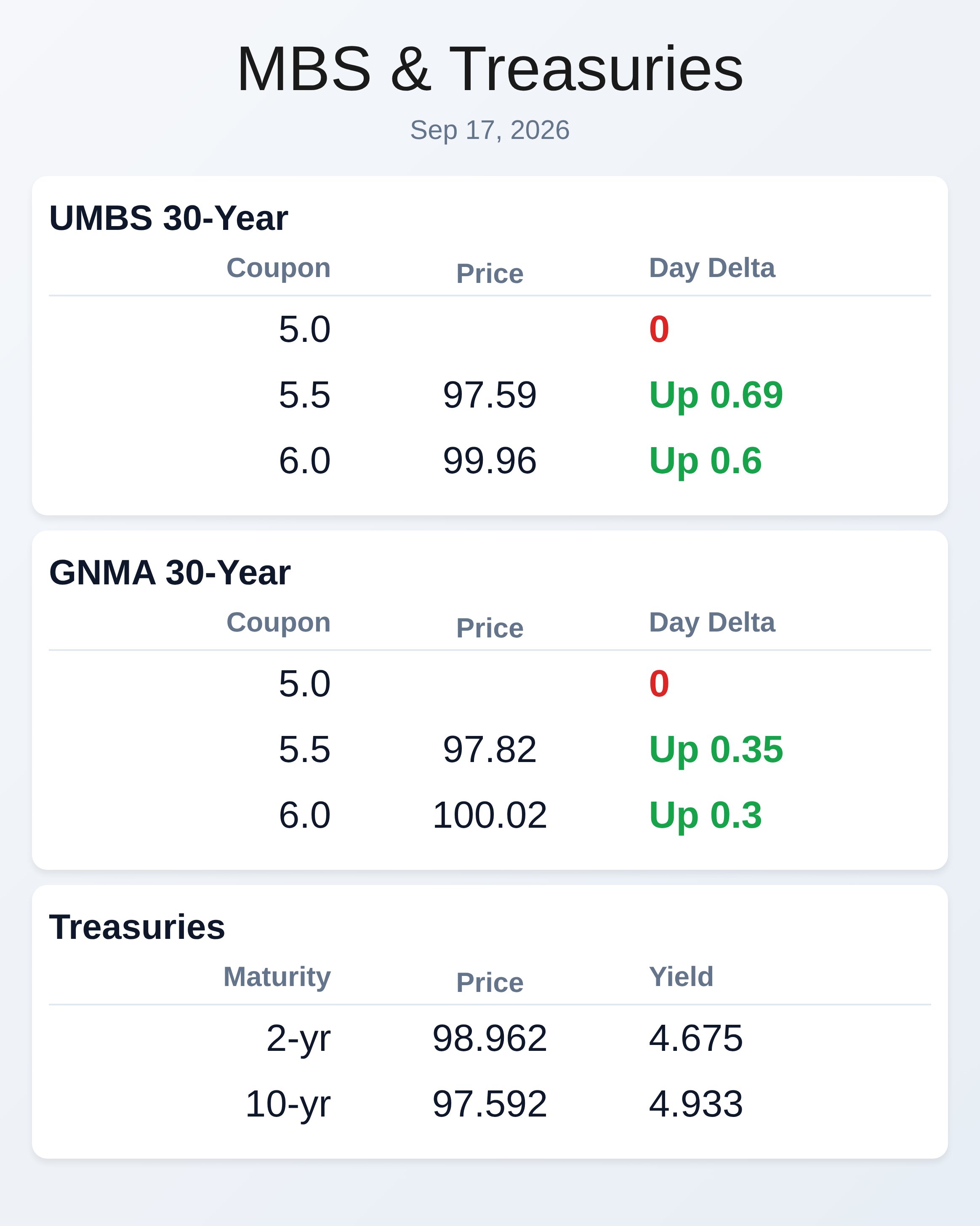
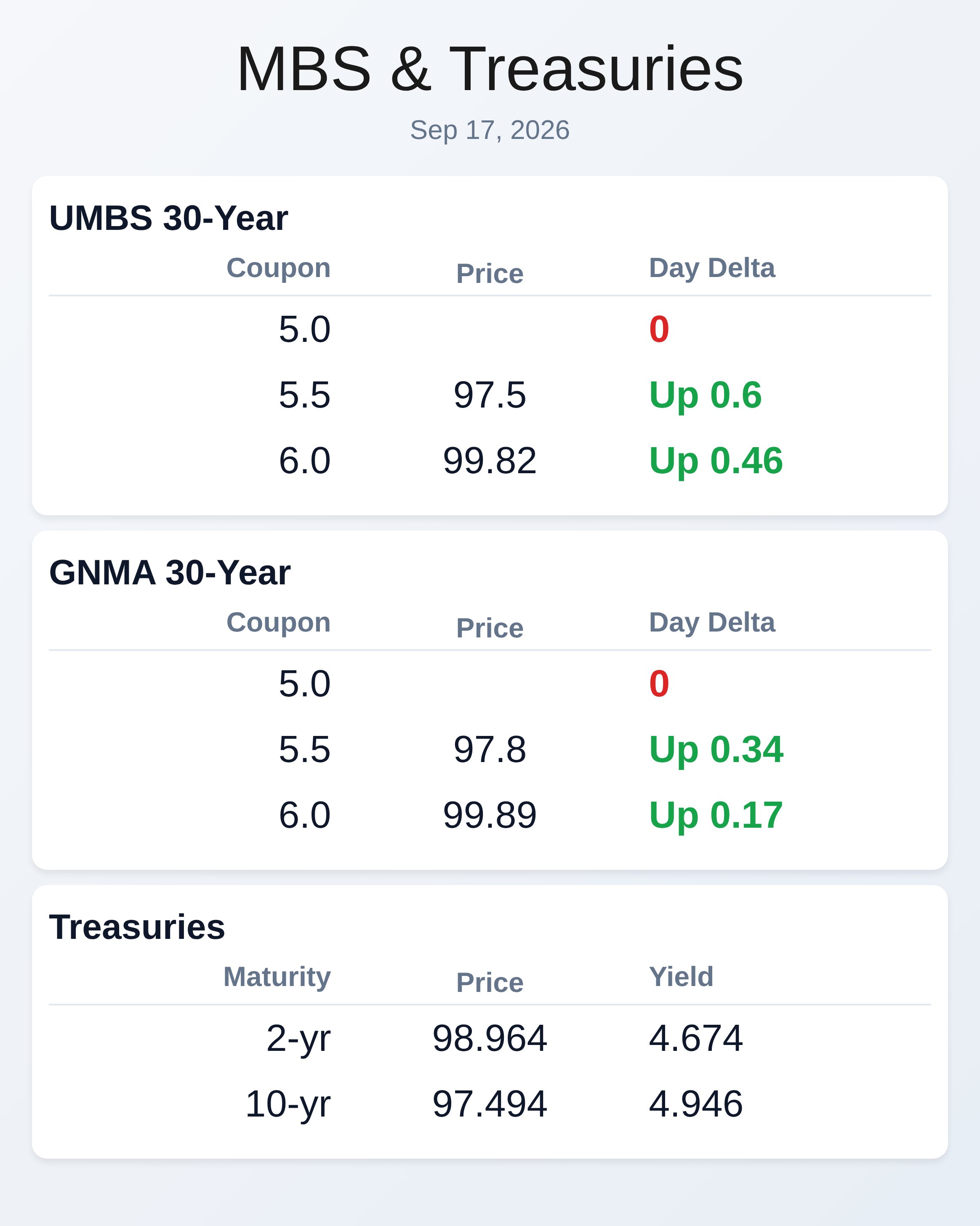
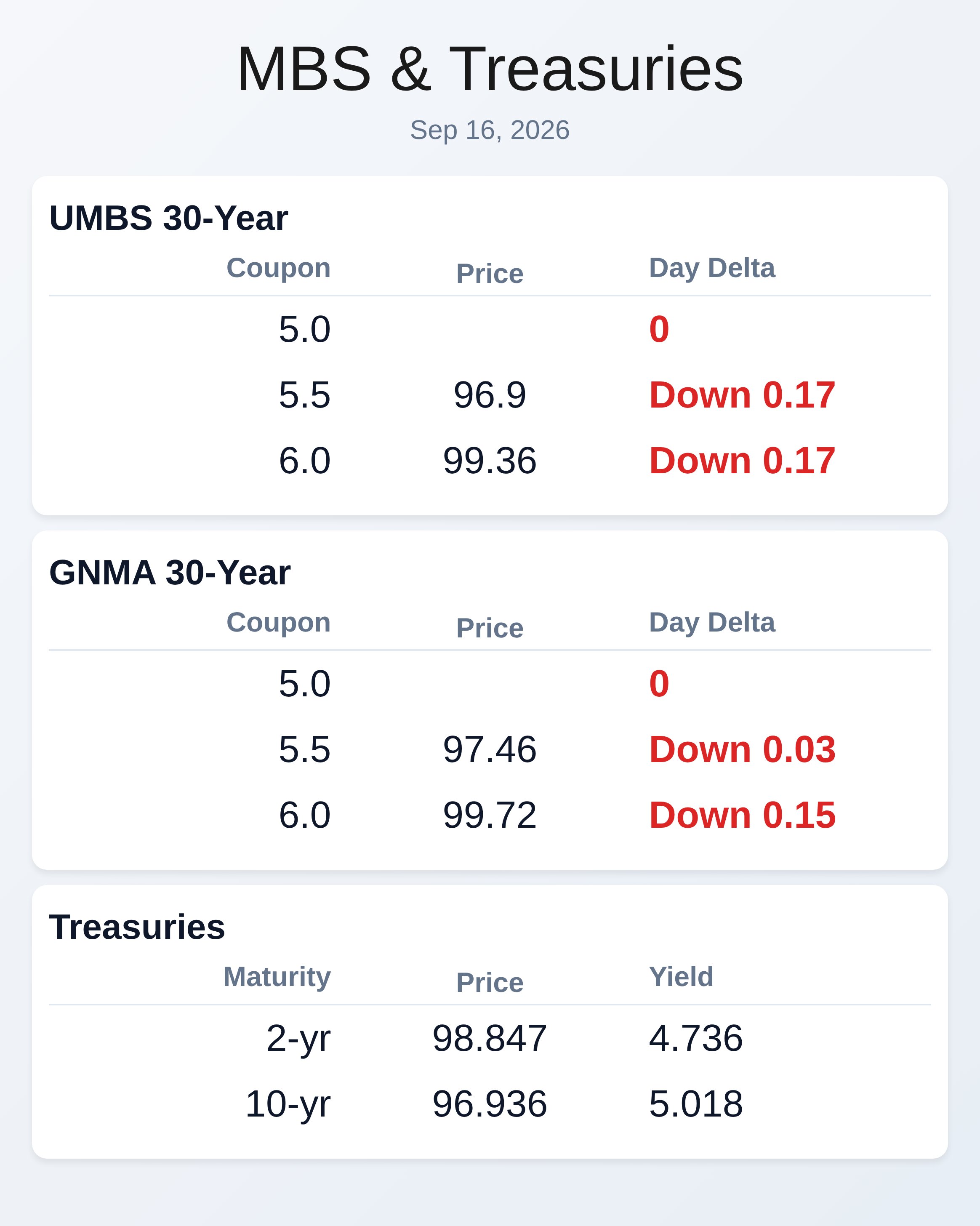
READ MORE **WTMS Blog Today = What's up in Mortgage Today (PM) - 05/15/2026** Mortgage-backed securities plunged 0.75 points Friday as global uncertainty over Iran tensions and persistent inflation fears sent Treasury yields soaring to one-year highs. The 10-year Treasury hit 4.6%, a psychological ceiling that forced bond investors to reassess rate expectations well into 2027, meaning mortgage rates are pricing in extended duration of elevated borrowing costs. NY Fed Manufacturing came in at a scorching 19.60 versus forecast of 7.5, while Industrial Production beat at 0.7% versus 0.3% expected, painting a picture of a surprisingly resilient economy despite recession warnings. These hot economic reads collided head-on with geopolitical anxiety, creating a whipsaw environment where rates moved sharply higher throughout the session with MBS and 10-year yields unable to find any ground. For mortgage originators, Friday's volatility underscores the challenge of rate sheet management when economic strength clashes with inflation persistence and no clear path to Fed rate cuts. Kevin Warsh's Senate confirmation as the next Federal Reserve Chair offered brief market optimism, but the rally quickly faded when reality sank in: sticky inflation dynamics and Iran conflict uncertainty mean rate-cutting expectations are being pushed further into the future. Markets had anticipated Warsh's first FOMC meeting in June might signal dovish policy shifts, yet energy price spikes and broad-based inflation data have complicated that timeline considerably. The 30-year fixed mortgage rate sat at 6.66% on Thursday and appears destined to push higher given Friday's yield trajectory, squeezing both purchase and refinance volume. Treasury auctions this week showed weak demand for long-duration bonds, with pension funds and insurance companies demanding higher yields to absorb new supply. For lenders, this signals that rate stability remains elusive and client conversations must shift from rate relief hopes to longer-term financing strategies. The Rocket/UWM servicing lawsuit escalates an already contentious competitive environment in mortgage origination, with Rocket claiming UWM violated non-solicit agreements by targeting 182,000 Mr. Cooper borrowers through aggressive rate cuts and AI-powered marketing systems. UWM's "Refi Shield 100" program and its KEEP AI system allegedly breached the 2024 MSR sale agreement, costing Rocket nearly $100 million in lost servicing revenue since the Mr. Cooper acquisition. UWM fired back calling the lawsuit "baseless and opportunistic," pointing to the suspicious timing of the filing after Rocket closed the Mr. Cooper deal and after former UWM wholesale executive Mike Fawaz announced a UWM partnership. The legal battle reveals deeper tensions around competitive poaching and the enforceability of non-solicit covenants in an AI-enabled origination landscape. Originators watching this case should understand that aggressive borrower acquisition strategies now carry measurable legal and financial risk, particularly when targeting seasoned loan portfolios. The Two Harbors/CrossCountry/UWM merger battle intensifies as shareholders prepare for the May 19 vote, with UWM accusing Two Harbors of "smoke and mirrors" over dividend announcements and valuation messaging. CrossCountry matched UWM's $12-per-share offer earlier this week, pivoting the contest to governance, servicing economics, and how deal value is being communicated to shareholders rather than pure dollar amounts. The rhetoric has grown sharper as both sides trade pointed statements, suggesting underlying strategic concerns about servicing rights, MSR valuations, and post-merger integration risk. For mortgage servicing professionals, the outcome will reshape competitive positioning in the servicing sector and may signal how much acquirers are willing to pay for mortgage-backed loan portfolio rights going forward. This high-stakes proxy battle is essentially a referendum on servicing viability at current interest rate environments and borrower prepayment assumptions. Ginnie Mae prepayment speeds slowed meaningfully in April as refinancing activity dried up, with VA loans continuing to prepay materially faster than FHA loans thanks to VA streamline efficiency. Servicer dispersion remained wide, with firms like Rocket generating faster prepayments while regional banks and depositories produced stickier collateral reflecting differing customer bases and servicing strategies. This bifurcation means extension risk is real for investors holding slower-paying pools while seasoning and borrower composition become critical valuation drivers. Mortgage-backed security investors are increasingly focused on collateral selection and specified pool characteristics to manage convexity, knowing that broad refinancing waves are off the table for the foreseeable future. For lenders holding long-duration MSR portfolios, these dynamics underscore the importance of strategic servicer partnerships and granular borrower-level analytics. Real wages have turned negative after inflation adjustment, a troubling signal for consumer spending resilience even as retail sales and unemployment figures suggest near-term economic stability. Small business confidence remains subdued while existing home sales continue lagging long-term norms, hinting that housing affordability strain is beginning to filter through buyer behavior despite headline economic strength. The disconnect between positive labor market data and weakening real wage growth suggests consumers are becoming increasingly price-sensitive on groceries, gasoline, and housing costs. Fed policymakers now face a complex scenario: persistent inflation paired with potential growth slowdown leaves little room to cut rates without risking renewed price acceleration. Mortgage originators should prepare messaging that emphasizes long-term commitment to borrowers facing affordability headwinds, positioning purchase and rate-and-term refinance strategies around life planning rather than purely rate-dependent decisions. **Locking vs Floating** Range breakouts at one-year highs change the calculus entirely for lock-versus-float decision-making. While a peaceful Iran resolution would theoretically support lower rates, the timeline is unknowable and yields are now testing resistance at 4.66 with floors at 4.05 and 4.12. When volatility hits this magnitude, traditional float strategies lose credibility because borrowers cannot predict when market normalization occurs. The best guidance is to counsel clients on worst-case scenarios rather than base-case recovery, effectively recommending locks for committed timelines. **Today's Events** NY Fed Manufacturing (May): 19.60 vs. 7.5 forecast, 11.00 previous Industrial Production (April): 0.7% vs. 0.3% forecast, -0.5% previous **Bond Pricing** **UMBS 30 yr** | Coupon | Price | Intra-Day Change | |5.0|97.41|-0.72| |5.5|99.72|-0.49| |6.0|101.56|-0.37| **GNMA 30 yr** | Coupon | Price | Intra-Day Change | |5.0|98.09|-0.74| |5.5|100.27|-0.29| |6.0|101.57|-0.14| **Treasuries** | Term | Yield | Price | Intra-Day Yield Change | Market Data
Mortgage Today (AM) - 05/15/26 {{catlist}}
May 15, 2026
READ MORE **WTMS Blog Today = What's up in Mortgage Today (AM) - 05/15/2026** The afternoon bond rally collapsed on Thursday, leaving mortgage securities and Treasuries sharply weaker heading into Friday. UMBS 30-year prices fell across all coupons, with the 5.0 coupon dropping 44 basis points intraday and the 6.0 coupon falling 20 basis points. GNMA 30-year securities posted similar losses, though slightly smaller in magnitude across the board. The 10-year Treasury yield jumped 65 basis points intraday to 4.55%, signaling a broad selloff in fixed-income markets. Geopolitical tensions and war-related headlines continue to inject volatility into bond pricing with no predictable pattern. The weakness accelerated across the entire yield curve, with even shorter-duration Treasuries posting significant losses. The 2-year yield gained 42 basis points while the 30-year climbed 66 basis points intraday, reflecting broad-based selling pressure. This flattening dynamic puts pressure on mortgage origination margins as the 10-year remains the primary pricing benchmark. Secondary market lenders will need to adjust pricing to lock clients facing uncertainty, likely compressing bid-ask spreads. Current volatility levels suggest clients should avoid making lock-float decisions based on short-term headlines. Short-term rate volatility driven by geopolitical events creates an impossible environment for mechanical lock-float strategies. The unpredictable nature of war-related headlines means traditional support and resistance levels are temporarily unreliable. However, longer-term analysis suggests that a potential peace deal could provide meaningful downward pressure on yields from current levels. Borrowers who can tolerate near-term volatility may benefit from floating locks, but only with clear risk tolerance discussions. The elevated uncertainty argues for locking clients now rather than waiting for a clarity that may not arrive soon. Treasury intraday pricing reflected substantial losses across all maturities, with price declines ranging from 99.641 to 94.709 depending on term. The 10-year Treasury at 4.55% represents a notable move higher, placing it near resistance levels that have capped yields in recent weeks. The steeper 30-year yield at 5.096% continues to reflect inflation expectations and Fed policy uncertainty. Mortgage-backed securities followed Treasury weakness but did not decouple significantly, preserving relative value relationships. The MBS-Treasury spread remains stable despite absolute price weakness, a positive signal for mortgage lender economics. **Locking vs Floating** War headlines continue driving volatile price swings in bonds with no predictable schedule or direction. Building a rational lock-float strategy is nearly impossible when geopolitical catalysts can move yields 50+ basis points in hours. Focus on the bigger picture: a peace agreement would likely bring meaningful rate relief from where yields stand today. In the near term, accept that volatility will persist and position clients accordingly with conservative lock recommendations. The intraday ceiling and floor framework for 10-year yields remains your best tool for tracking bond market momentum beyond daily noise. **Bond Pricing** **UMBS 30 yr** | Coupon | Price | Intra-Day Change | | 5.0 | 97.69 | -0.44 | | 5.5 | 99.92 | -0.29 | | 6.0 | 101.74 | -0.2 | **GNMA 30 yr** | Coupon | Price | Intra-Day Change | | 5.0 | 98.46 | -0.37 | | 5.5 | 100.38 | -0.17 | | 6.0 | 101.54 | -0.17 | **Treasuries** | Term | Yield | Price | Intra-Day Yield Change | | 2 yr | 4.064 | 99.641 | 0.042 | | 3 yr | 4.113 | 98.286 | 0.052 | | 5 yr | 4.213 | 98.489 | 0.062 | | 7 yr | 4.377 | 99.24 | 0.065 | | 10 yr | 4.55 | 96.618 | 0.065 | | 30 yr | 5.096 | 94.709 | 0.066 | Market Data
This $1.3 Billion Mortgage Brawl Just Got Nastier — And It's About to Hit a Breaking Point {{catlist}}
May 15, 2026
READ MORE
 

This $1.3 Billion Mortgage Brawl Just Got Nastier — And It's About to Hit a Breaking Point


If you work in the mortgage industry and you have not been watching the war between UWM and CrossCountry Mortgage over a company called Two Harbors Investment Corp., you have been missing the most dramatic corporate fight the business has seen in years. Open letters. Competing bids. A board calling a rival's offer "predatory." A major shareholder advisory firm flipping the script days before a vote. And a shareholder meeting on Monday that could reshape the industry for a long time.

This is not Wall Street noise. This story touches your pipeline, your pricing, and the economics of the channel you work in every day.

Let's start from the beginning — because this one moves fast.

How It Started

Back in December 2025, United Wholesale Mortgage — the largest wholesale lender in the country — agreed to acquire Two Harbors Investment Corp. in an all-stock deal worth roughly $1.3 billion. Two Harbors is not a household name for most loan officers, but it matters enormously to anyone who cares about mortgage servicing. Two Harbors owns RoundPoint Mortgage Servicing, a platform that sits on top of a $176 billion mortgage servicing rights portfolio. For UWM, which has been aggressively building its in-house servicing capabilities, acquiring RoundPoint would fast-track that strategy in a major way.

The deal looked done. Then March happened.

CrossCountry Mortgage, one of the largest retail lenders in the country and based out of Cleveland, showed up with an unsolicited all-cash offer of $10.80 per share and agreed to cover the $25.4 million termination fee that Two Harbors would owe UWM for walking away. The Two Harbors board looked at cash certainty vs. UWM stock — which had lost 28% of its value in the preceding months — and called CrossCountry's offer superior. They terminated the UWM agreement.

UWM did not go quietly. What followed was one of the most publicly fought corporate battles in recent mortgage industry history.

The Bidding War in Numbers

At one point, a mystery third bidder surfaced with a $10.75 per share offer, only to be quickly passed by CrossCountry raising to $10.80. UWM fired back. CrossCountry raised again to $11.30, which the Two Harbors board accepted. UWM went to $12. CrossCountry matched at $12. UWM raised to $12.50, with shareholders able to choose either $12.50 in cash or 2.3328 shares of UWM stock per Two Harbors share.

The shareholder vote on whether to approve the CrossCountry deal is scheduled for Monday, May 19. That means, as of today, there are four days left on the clock.

The Board's Response Was Not Subtle

When UWM raised to $12.50 this week, the Two Harbors board did not just say no. They dismantled the offer in a sharply worded public statement, calling it "illusory, predatory, and unactionable" — three words you do not typically see in a polished corporate press release. The board's case is this: UWM's $12.50 headline price sounds good, but the default consideration for any shareholder who does not proactively elect cash is UWM stock, currently worth about $7.58 per share as of Monday's close. The board estimates that as many as 30% of Two Harbors shareholders could end up defaulting into stock rather than cash — a scenario the board says UWM has deliberately designed into the offer structure to reduce what it actually pays.

The board also raised pointed financial concerns about UWM's ability to close a deal at all. Fitch has downgraded UWM's credit outlook twice in the past six months. UWM's cash position dropped from $503 million at year-end to $424 million by March 31. The company's leverage is at an all-time high of 3.2 times. And UWM's latest $12.50 bid was not accompanied by an increase in its financing commitment from Mizuho Bank, raising questions about whether the full all-cash option is even funded.

UWM shot back within hours, accusing the board of a "complete and illogical distortion" of its duties to shareholders.

The Proxy Advisor That Changed the Narrative

Here is where it gets interesting for the CrossCountry side of the ledger. Institutional Shareholder Services — known as ISS — is one of the most influential proxy advisory firms in the world. Major institutional investors take their recommendations seriously. And just two days before this writing, ISS issued a recommendation telling Two Harbors shareholders to vote against the CrossCountry deal.

ISS concluded that the board had not run a process designed to maximize shareholder value, and noted that UWM's presence had already been the catalyst that pushed CrossCountry to improve its offer twice. Without UWM staying in the fight, shareholders would have been cashing out at $10.80 per share instead of $12.00. ISS said the board's approach did not appear to be "one that will facilitate full price discovery."

The Two Harbors board called the ISS analysis wrong and doubled down on CrossCountry, but institutional investors do not dismiss ISS recommendations lightly. With the vote five days out, this one genuinely matters.

Why Every Loan Officer Should Be Paying Attention

The surface-level story here is about which company wins a bidding war. The deeper story is about why these two companies are fighting this hard in the first place.

Two Harbors and RoundPoint represent a major chunk of mortgage servicing infrastructure. Whoever ends up owning RoundPoint will control how hundreds of thousands of borrowers' loans get managed after closing — including the borrowers you helped get into their homes. That means retention opportunities, refinance pipelines, and ongoing borrower relationships that flow directly from the servicing platform.

More importantly, mortgage servicing rights have become the strategic resource that major lenders are quietly building empires around. In a market where origination volume is constrained by rates, servicing income is what keeps the lights on. The fight over Two Harbors is a fight over that income — and the pricing strategy that comes with it.

How this ends on Monday will matter for a long time after Monday.

In our next post, we are going to go deeper on what this whole saga is revealing about the financial pressure building underneath the mortgage industry — including some genuinely uncomfortable comparisons that respected analysts are now making in public.

If you want to be the loan officer who actually understands why things work the way they do, subscribe to Well That Makes Sense and we will keep the explanations coming. No jargon. No fluff. Just the stuff that actually matters to your business — delivered to your inbox before your competitors figure out it was important.

 
LATEST ARTICLES

RECENT ARTICLES

What’s up in Mortgage Today (PM) – 09/03/2025

September 3rd, 2025|Money|

WTMS Blog Today = What's up in Mortgage Today (PM) - 09/03/2025 Bond markets showed signs of stabilization this morning as Treasury yields pulled back from recent highs, providing some relief to mortgage-backed securities. The [...]

Article Archive

What’s up in Mortgage Today – 6.15.23

June 15th, 2023|0 Comments

MBS down 17 bps on the open. Stocks gained 19.74 Bonds were already moderately stronger on the day and are extending the gains cautiously so far. Coming in as-expected at the core level [...]

What’s up in Mortgage Today – 6.14.23

June 14th, 2023|0 Comments

Stocks & Bonds winning on the open. MBS up 16. Stocks up 12.5 Bonds were flat to slightly stronger in the overnight session with minimal volatility and average volume. Core Producer Prices, m/m [...]

What’s up in Mortgage Today – 6.13.23

June 13th, 2023|0 Comments

MBS down 17 bps on the open. Stocks gained 19.74 Bonds were already moderately stronger on the day and are extending the gains cautiously so far. Coming in as-expected at the core level [...]

What’s up in Mortgage Today – 6.12.23

June 12th, 2023|0 Comments

MBS down 23 bps and Stocks up 7 Many lenders are not yet out with prices for the day. Those who are could already be considering negative reprices as MBS are currently down [...]

What’s up in Mortgage Today – 6/9/23

June 9th, 2023|0 Comments

MBS down 14 bps on the day. Stocks up 24 points Friday started with a noticeable increase in market activity and interest due to the release of important economic data. The Canadian employment [...]

What’s up in Mortgage Today – 6/8/23

June 8th, 2023|0 Comments

MBS were up 9 bps early. Stocks were flat Bonds were modestly weaker in the overnight session, but have bounced back into positive territory following the much weaker than expected jobless claim numbers. [...]

Subscribe

Send me some brain food

Go to Top